

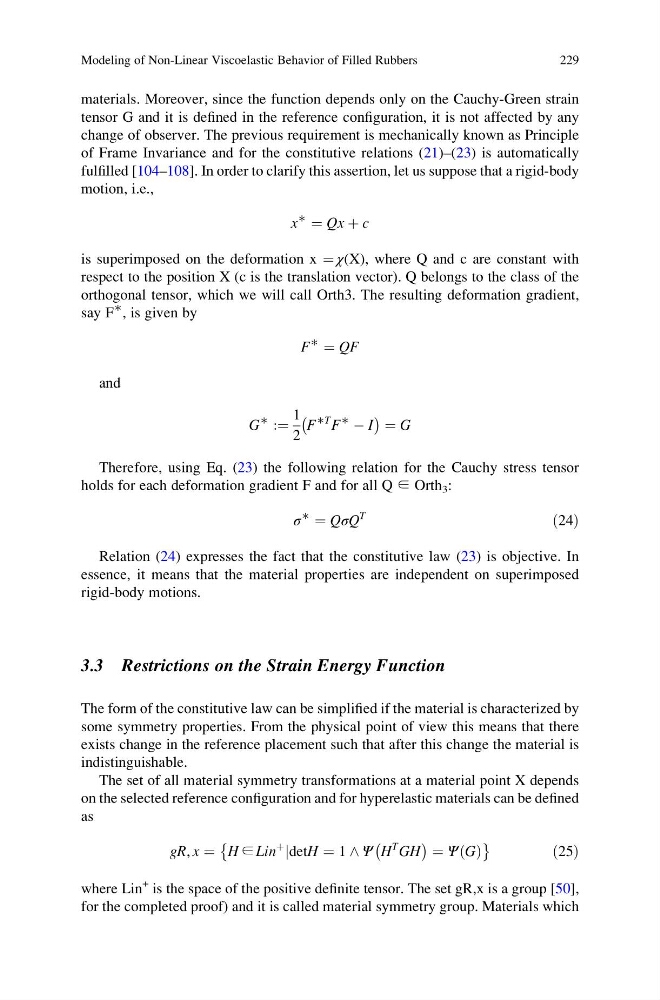
materials. Moreover, since the function depends only on the Cauchy-Green strain
tensor G and it is defined in the reference configuration, it is not affected by any
change of observer. The previous requirement is mechanically known as Principle
of Frame Invariance and for the constitutive relations (21)–(23) is automatically
fulfilled [104–108]. In order to clarify this assertion, let us suppose that a rigid-body
motion, i.e.,
x
∗
¼ Qx þ c
is superimposed on the deformation x ¼ χ(X), where Q and c are constant with
respect to the position X (c is the translation vector). Q belongs to the class of the
orthogonal tensor, which we will call Orth3. The resulting deformation gradient,
say F
∗ , is given by
F
∗
¼ QF
and
G
∗
:¼
1
2
F
∗T F
∗
À I
À
Á ¼ G
Therefore, using Eq. (23) the following relation for the Cauchy stress tensor
holds for each deformation gradient F and for all Q ∈ Orth 3 :
σ
∗
¼ QσQ
T
ð24Þ
Relation (24) expresses the fact that the constitutive law (23) is objective. In
essence, it means that the material properties are independent on superimposed
rigid-body motions.
3.3 Restrictions on the Strain Energy Function
The form of the constitutive law can be simplified if the material is characterized by
some symmetry properties. From the physical point of view this means that there
exists change in the reference placement such that after this change the material is
indistinguishable.
The set of all material symmetry transformations at a material point X depends
on the selected reference configuration and for hyperelastic materials can be defined
as
gR, x ¼ H ∈ Lin
þ
jdetH ¼ 1 ^ Ψ H
T GH
À
Á ¼ Ψ G
ð Þ
È
É
ð25Þ
where Lin
+ is the space of the positive definite tensor. The set gR,x is a group [50],
for the completed proof) and it is called material symmetry group. Materials which
Modeling of Non-Linear Viscoelastic Behavior of Filled Rubbers
229
tensor G and it is defined in the reference configuration, it is not affected by any
change of observer. The previous requirement is mechanically known as Principle
of Frame Invariance and for the constitutive relations (21)–(23) is automatically
fulfilled [104–108]. In order to clarify this assertion, let us suppose that a rigid-body
motion, i.e.,
x
∗
¼ Qx þ c
is superimposed on the deformation x ¼ χ(X), where Q and c are constant with
respect to the position X (c is the translation vector). Q belongs to the class of the
orthogonal tensor, which we will call Orth3. The resulting deformation gradient,
say F
∗ , is given by
F
∗
¼ QF
and
G
∗
:¼
1
2
F
∗T F
∗
À I
À
Á ¼ G
Therefore, using Eq. (23) the following relation for the Cauchy stress tensor
holds for each deformation gradient F and for all Q ∈ Orth 3 :
σ
∗
¼ QσQ
T
ð24Þ
Relation (24) expresses the fact that the constitutive law (23) is objective. In
essence, it means that the material properties are independent on superimposed
rigid-body motions.
3.3 Restrictions on the Strain Energy Function
The form of the constitutive law can be simplified if the material is characterized by
some symmetry properties. From the physical point of view this means that there
exists change in the reference placement such that after this change the material is
indistinguishable.
The set of all material symmetry transformations at a material point X depends
on the selected reference configuration and for hyperelastic materials can be defined
as
gR, x ¼ H ∈ Lin
þ
jdetH ¼ 1 ^ Ψ H
T GH
À
Á ¼ Ψ G
ð Þ
È
É
ð25Þ
where Lin
+ is the space of the positive definite tensor. The set gR,x is a group [50],
for the completed proof) and it is called material symmetry group. Materials which
Modeling of Non-Linear Viscoelastic Behavior of Filled Rubbers
229