

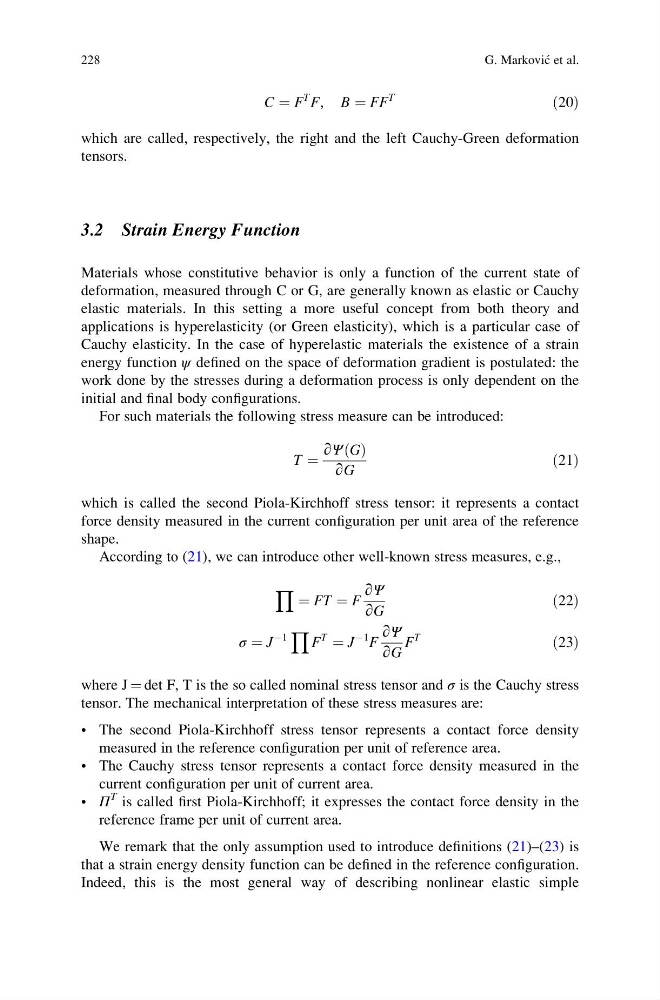
C ¼ F
T F, B ¼ FF
T
ð20Þ
which are called, respectively, the right and the left Cauchy-Green deformation
tensors.
3.2 Strain Energy Function
Materials whose constitutive behavior is only a function of the current state of
deformation, measured through C or G, are generally known as elastic or Cauchy
elastic materials. In this setting a more useful concept from both theory and
applications is hyperelasticity (or Green elasticity), which is a particular case of
Cauchy elasticity. In the case of hyperelastic materials the existence of a strain
energy function ψ defined on the space of deformation gradient is postulated: the
work done by the stresses during a deformation process is only dependent on the
initial and final body configurations.
For such materials the following stress measure can be introduced:
T ¼
∂Ψ G
ð Þ
∂G
ð21Þ
which is called the second Piola-Kirchhoff stress tensor: it represents a contact
force density measured in the current configuration per unit area of the reference
shape.
According to (21), we can introduce other well-known stress measures, e.g.,
Y
¼ FT ¼ F
∂Ψ
∂G
ð22Þ
σ ¼ J
À1
Y
F
T
¼ J
À1 F
∂Ψ
∂G
F
T
ð23Þ
where J ¼ det F, T is the so called nominal stress tensor and σ is the Cauchy stress
tensor. The mechanical interpretation of these stress measures are:
• The second Piola-Kirchhoff stress tensor represents a contact force density
measured in the reference configuration per unit of reference area.
• The Cauchy stress tensor represents a contact force density measured in the
current configuration per unit of current area.
• Π
T is called first Piola-Kirchhoff; it expresses the contact force density in the
reference frame per unit of current area.
We remark that the only assumption used to introduce definitions (21)–(23) is
that a strain energy density function can be defined in the reference configuration.
Indeed, this is the most general way of describing nonlinear elastic simple
228
G. Markovic ´ et al.
T F, B ¼ FF
T
ð20Þ
which are called, respectively, the right and the left Cauchy-Green deformation
tensors.
3.2 Strain Energy Function
Materials whose constitutive behavior is only a function of the current state of
deformation, measured through C or G, are generally known as elastic or Cauchy
elastic materials. In this setting a more useful concept from both theory and
applications is hyperelasticity (or Green elasticity), which is a particular case of
Cauchy elasticity. In the case of hyperelastic materials the existence of a strain
energy function ψ defined on the space of deformation gradient is postulated: the
work done by the stresses during a deformation process is only dependent on the
initial and final body configurations.
For such materials the following stress measure can be introduced:
T ¼
∂Ψ G
ð Þ
∂G
ð21Þ
which is called the second Piola-Kirchhoff stress tensor: it represents a contact
force density measured in the current configuration per unit area of the reference
shape.
According to (21), we can introduce other well-known stress measures, e.g.,
Y
¼ FT ¼ F
∂Ψ
∂G
ð22Þ
σ ¼ J
À1
Y
F
T
¼ J
À1 F
∂Ψ
∂G
F
T
ð23Þ
where J ¼ det F, T is the so called nominal stress tensor and σ is the Cauchy stress
tensor. The mechanical interpretation of these stress measures are:
• The second Piola-Kirchhoff stress tensor represents a contact force density
measured in the reference configuration per unit of reference area.
• The Cauchy stress tensor represents a contact force density measured in the
current configuration per unit of current area.
• Π
T is called first Piola-Kirchhoff; it expresses the contact force density in the
reference frame per unit of current area.
We remark that the only assumption used to introduce definitions (21)–(23) is
that a strain energy density function can be defined in the reference configuration.
Indeed, this is the most general way of describing nonlinear elastic simple
228
G. Markovic ´ et al.