

x ¼ χ X
ð Þ, X ∈ ℜ r
ð13Þ
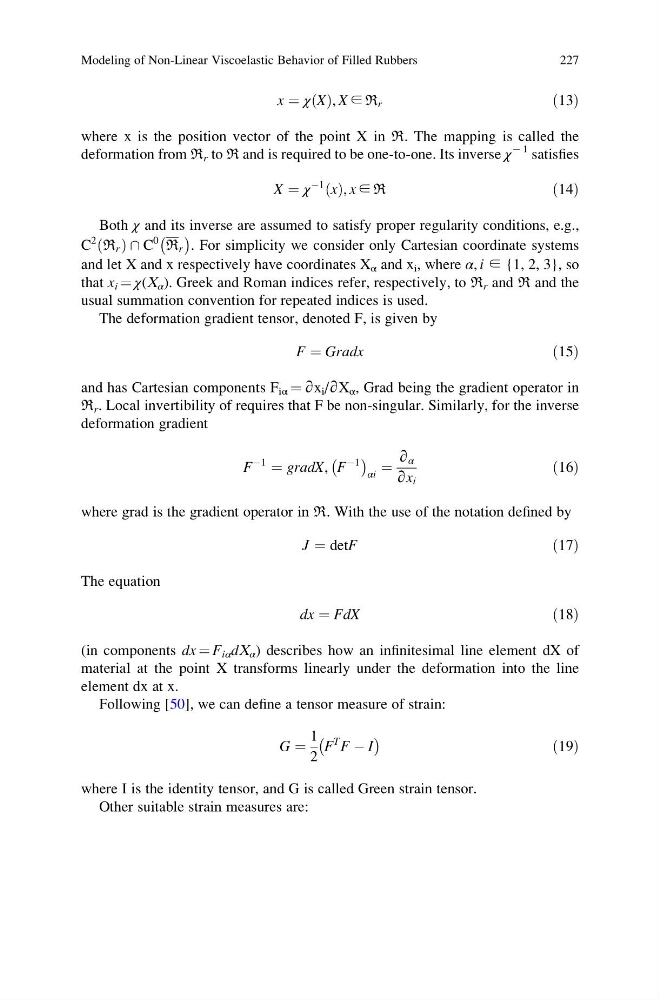
where x is the position vector of the point X in ℜ. The mapping is called the
deformation from ℜ r to ℜ and is required to be one-to-one. Its inverse χ
À 1 satisfies
X ¼ χ
À1 x
ð Þ, x ∈ ℜ
ð14Þ
Both χ and its inverse are assumed to satisfy proper regularity conditions, e.g.,
C
2
ℜ r
ð Þ \C
0
ℜ r
À Á
. For simplicity we consider only Cartesian coordinate systems
and let X and x respectively have coordinates X α and x i , where α, i ∈ {1, 2, 3}, so
that x i ¼ χ(Χ α ). Greek and Roman indices refer, respectively, to ℜ r and ℜ and the
usual summation convention for repeated indices is used.
The deformation gradient tensor, denoted F, is given by
F ¼ Gradx
ð15Þ
and has Cartesian components F iα ¼ ∂x i /∂X α , Grad being the gradient operator in
ℜ r . Local invertibility of requires that F be non-singular. Similarly, for the inverse
deformation gradient
F
À1
¼ gradX, F
À1
À
Á
αi
¼
∂ α
∂x i
ð16Þ
where grad is the gradient operator in ℜ. With the use of the notation defined by
J ¼ detF
ð17Þ
The equation
dx ¼ FdX
ð18Þ
(in components dx ¼ F iα dΧ α ) describes how an infinitesimal line element dX of
material at the point X transforms linearly under the deformation into the line
element dx at x.
Following [50], we can define a tensor measure of strain:
G ¼
1
2
F
T F À I
À
Á
ð19Þ
where I is the identity tensor, and G is called Green strain tensor.
Other suitable strain measures are:
Modeling of Non-Linear Viscoelastic Behavior of Filled Rubbers
227
ð Þ, X ∈ ℜ r
ð13Þ
where x is the position vector of the point X in ℜ. The mapping is called the
deformation from ℜ r to ℜ and is required to be one-to-one. Its inverse χ
À 1 satisfies
X ¼ χ
À1 x
ð Þ, x ∈ ℜ
ð14Þ
Both χ and its inverse are assumed to satisfy proper regularity conditions, e.g.,
C
2
ℜ r
ð Þ \C
0
ℜ r
À Á
. For simplicity we consider only Cartesian coordinate systems
and let X and x respectively have coordinates X α and x i , where α, i ∈ {1, 2, 3}, so
that x i ¼ χ(Χ α ). Greek and Roman indices refer, respectively, to ℜ r and ℜ and the
usual summation convention for repeated indices is used.
The deformation gradient tensor, denoted F, is given by
F ¼ Gradx
ð15Þ
and has Cartesian components F iα ¼ ∂x i /∂X α , Grad being the gradient operator in
ℜ r . Local invertibility of requires that F be non-singular. Similarly, for the inverse
deformation gradient
F
À1
¼ gradX, F
À1
À
Á
αi
¼
∂ α
∂x i
ð16Þ
where grad is the gradient operator in ℜ. With the use of the notation defined by
J ¼ detF
ð17Þ
The equation
dx ¼ FdX
ð18Þ
(in components dx ¼ F iα dΧ α ) describes how an infinitesimal line element dX of
material at the point X transforms linearly under the deformation into the line
element dx at x.
Following [50], we can define a tensor measure of strain:
G ¼
1
2
F
T F À I
À
Á
ð19Þ
where I is the identity tensor, and G is called Green strain tensor.
Other suitable strain measures are:
Modeling of Non-Linear Viscoelastic Behavior of Filled Rubbers
227