

3.4 Compressibility
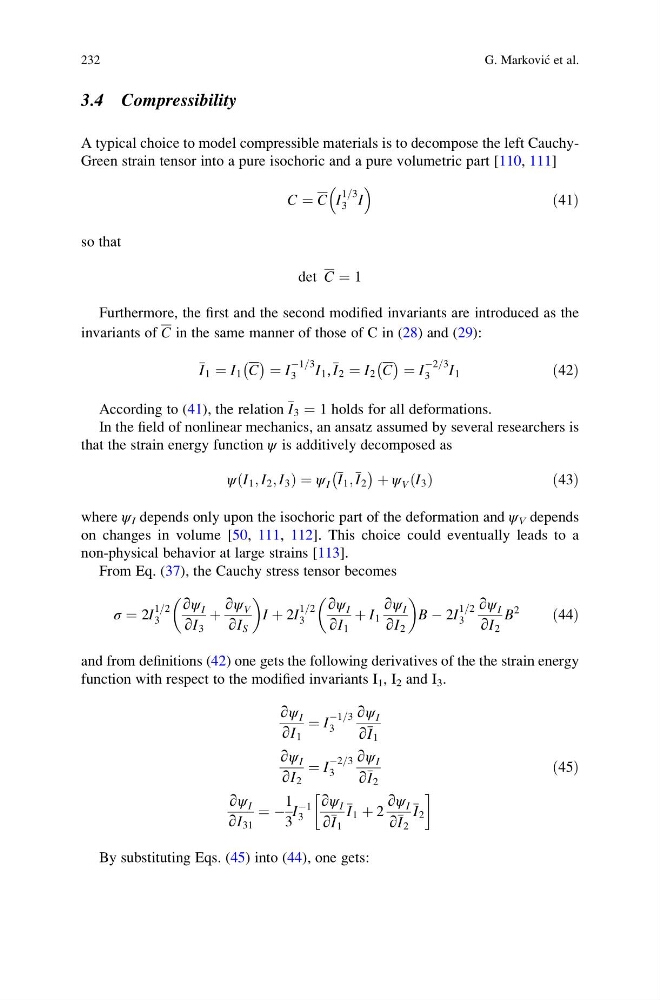
A typical choice to model compressible materials is to decompose the left CauchyGreen strain tensor into a pure isochoric and a pure volumetric part [110, 111]
C ¼ C I
1=3
3 I
ð41Þ
so that
det C ¼ 1
Furthermore, the first and the second modified invariants are introduced as the
invariants of C in the same manner of those of C in (28) and (29):
I 1 ¼ I 1 C
À Á ¼ I
À1=3
3
I 1 , I 2 ¼ I 2 C
À Á ¼ I
À2=3
3
I 1
ð42Þ
According to (41), the relation I 3 ¼ 1 holds for all deformations.
In the field of nonlinear mechanics, an ansatz assumed by several researchers is
that the strain energy function ψ is additively decomposed as
ψ I 1 ; I 2 ; I 3
ð
Þ¼ψ I I 1 ; I 2
À
Á þ ψ V I 3
ð Þ
ð43Þ
where ψ I depends only upon the isochoric part of the deformation and ψ V depends
on changes in volume [50, 111, 112]. This choice could eventually leads to a
non-physical behavior at large strains [113].
From Eq. (37), the Cauchy stress tensor becomes
σ ¼ 2I
1=2
3
∂ψ I
∂I 3
þ
∂ψ V
∂I S
I þ 2I
1=2
3
∂ψ I
∂I 1
þ I 1
∂ψ I
∂I 2
B À 2I
1=2
3
∂ψ I
∂I 2
B
2
ð44Þ
and from definitions (42) one gets the following derivatives of the the strain energy
function with respect to the modified invariants I 1 , I 2 and I 3 .
∂ψ I
∂I 1
¼ I
À1=3
3
∂ψ I
∂I 1
∂ψ I
∂I 2
¼ I
À2=3
3
∂ψ I
∂I 2
ð45Þ
∂ψ I
∂I 31
¼ À
1
3
I
À1
3
∂ψ I
∂I 1
I 1 þ 2
∂ψ I
∂I 2
I 2
!
By substituting Eqs. (45) into (44), one gets:
232
G. Markovic ´ et al.
A typical choice to model compressible materials is to decompose the left CauchyGreen strain tensor into a pure isochoric and a pure volumetric part [110, 111]
C ¼ C I
1=3
3 I
ð41Þ
so that
det C ¼ 1
Furthermore, the first and the second modified invariants are introduced as the
invariants of C in the same manner of those of C in (28) and (29):
I 1 ¼ I 1 C
À Á ¼ I
À1=3
3
I 1 , I 2 ¼ I 2 C
À Á ¼ I
À2=3
3
I 1
ð42Þ
According to (41), the relation I 3 ¼ 1 holds for all deformations.
In the field of nonlinear mechanics, an ansatz assumed by several researchers is
that the strain energy function ψ is additively decomposed as
ψ I 1 ; I 2 ; I 3
ð
Þ¼ψ I I 1 ; I 2
À
Á þ ψ V I 3
ð Þ
ð43Þ
where ψ I depends only upon the isochoric part of the deformation and ψ V depends
on changes in volume [50, 111, 112]. This choice could eventually leads to a
non-physical behavior at large strains [113].
From Eq. (37), the Cauchy stress tensor becomes
σ ¼ 2I
1=2
3
∂ψ I
∂I 3
þ
∂ψ V
∂I S
I þ 2I
1=2
3
∂ψ I
∂I 1
þ I 1
∂ψ I
∂I 2
B À 2I
1=2
3
∂ψ I
∂I 2
B
2
ð44Þ
and from definitions (42) one gets the following derivatives of the the strain energy
function with respect to the modified invariants I 1 , I 2 and I 3 .
∂ψ I
∂I 1
¼ I
À1=3
3
∂ψ I
∂I 1
∂ψ I
∂I 2
¼ I
À2=3
3
∂ψ I
∂I 2
ð45Þ
∂ψ I
∂I 31
¼ À
1
3
I
À1
3
∂ψ I
∂I 1
I 1 þ 2
∂ψ I
∂I 2
I 2
!
By substituting Eqs. (45) into (44), one gets:
232
G. Markovic ´ et al.