

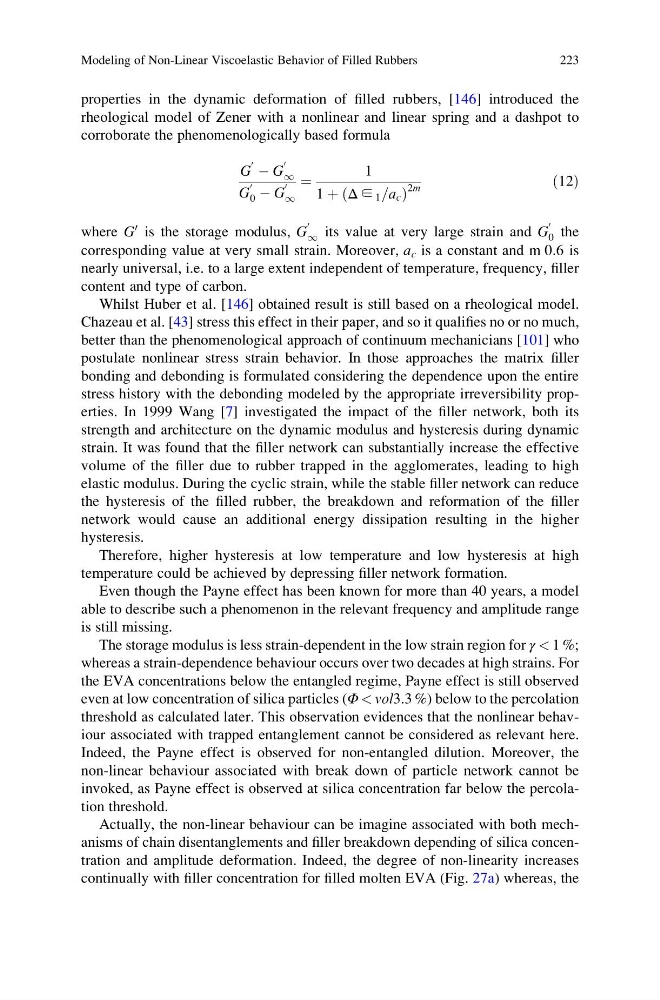
properties in the dynamic deformation of filled rubbers, [146] introduced the
rheological model of Zener with a nonlinear and linear spring and a dashpot to
corroborate the phenomenologically based formula
G
0 À G
0
1
G
0
0 À G
0
1
¼
1
1 þ Δ ∈ 1 =a c
ð
Þ
2m
ð12Þ
where G
0 is the storage modulus, G
0
1 its value at very large strain and G
0
0 the
corresponding value at very small strain. Moreover, a c is a constant and m 0:6 is
nearly universal, i.e. to a large extent independent of temperature, frequency, filler
content and type of carbon.
Whilst Huber et al. [146] obtained result is still based on a rheological model.
Chazeau et al. [43] stress this effect in their paper, and so it qualifies no or no much,
better than the phenomenological approach of continuum mechanicians [101] who
postulate nonlinear stress strain behavior. In those approaches the matrix filler
bonding and debonding is formulated considering the dependence upon the entire
stress history with the debonding modeled by the appropriate irreversibility properties. In 1999 Wang [7] investigated the impact of the filler network, both its
strength and architecture on the dynamic modulus and hysteresis during dynamic
strain. It was found that the filler network can substantially increase the effective
volume of the filler due to rubber trapped in the agglomerates, leading to high
elastic modulus. During the cyclic strain, while the stable filler network can reduce
the hysteresis of the filled rubber, the breakdown and reformation of the filler
network would cause an additional energy dissipation resulting in the higher
hysteresis.
Therefore, higher hysteresis at low temperature and low hysteresis at high
temperature could be achieved by depressing filler network formation.
Even though the Payne effect has been known for more than 40 years, a model
able to describe such a phenomenon in the relevant frequency and amplitude range
is still missing.
The storage modulus is less strain-dependent in the low strain region for γ < 1 %;
whereas a strain-dependence behaviour occurs over two decades at high strains. For
the EVA concentrations below the entangled regime, Payne effect is still observed
even at low concentration of silica particles (Φ < vol3.3 %) below to the percolation
threshold as calculated later. This observation evidences that the nonlinear behaviour associated with trapped entanglement cannot be considered as relevant here.
Indeed, the Payne effect is observed for non-entangled dilution. Moreover, the
non-linear behaviour associated with break down of particle network cannot be
invoked, as Payne effect is observed at silica concentration far below the percolation threshold.
Actually, the non-linear behaviour can be imagine associated with both mechanisms of chain disentanglements and filler breakdown depending of silica concentration and amplitude deformation. Indeed, the degree of non-linearity increases
continually with filler concentration for filled molten EVA (Fig. 27a) whereas, the
Modeling of Non-Linear Viscoelastic Behavior of Filled Rubbers
223
rheological model of Zener with a nonlinear and linear spring and a dashpot to
corroborate the phenomenologically based formula
G
0 À G
0
1
G
0
0 À G
0
1
¼
1
1 þ Δ ∈ 1 =a c
ð
Þ
2m
ð12Þ
where G
0 is the storage modulus, G
0
1 its value at very large strain and G
0
0 the
corresponding value at very small strain. Moreover, a c is a constant and m 0:6 is
nearly universal, i.e. to a large extent independent of temperature, frequency, filler
content and type of carbon.
Whilst Huber et al. [146] obtained result is still based on a rheological model.
Chazeau et al. [43] stress this effect in their paper, and so it qualifies no or no much,
better than the phenomenological approach of continuum mechanicians [101] who
postulate nonlinear stress strain behavior. In those approaches the matrix filler
bonding and debonding is formulated considering the dependence upon the entire
stress history with the debonding modeled by the appropriate irreversibility properties. In 1999 Wang [7] investigated the impact of the filler network, both its
strength and architecture on the dynamic modulus and hysteresis during dynamic
strain. It was found that the filler network can substantially increase the effective
volume of the filler due to rubber trapped in the agglomerates, leading to high
elastic modulus. During the cyclic strain, while the stable filler network can reduce
the hysteresis of the filled rubber, the breakdown and reformation of the filler
network would cause an additional energy dissipation resulting in the higher
hysteresis.
Therefore, higher hysteresis at low temperature and low hysteresis at high
temperature could be achieved by depressing filler network formation.
Even though the Payne effect has been known for more than 40 years, a model
able to describe such a phenomenon in the relevant frequency and amplitude range
is still missing.
The storage modulus is less strain-dependent in the low strain region for γ < 1 %;
whereas a strain-dependence behaviour occurs over two decades at high strains. For
the EVA concentrations below the entangled regime, Payne effect is still observed
even at low concentration of silica particles (Φ < vol3.3 %) below to the percolation
threshold as calculated later. This observation evidences that the nonlinear behaviour associated with trapped entanglement cannot be considered as relevant here.
Indeed, the Payne effect is observed for non-entangled dilution. Moreover, the
non-linear behaviour associated with break down of particle network cannot be
invoked, as Payne effect is observed at silica concentration far below the percolation threshold.
Actually, the non-linear behaviour can be imagine associated with both mechanisms of chain disentanglements and filler breakdown depending of silica concentration and amplitude deformation. Indeed, the degree of non-linearity increases
continually with filler concentration for filled molten EVA (Fig. 27a) whereas, the
Modeling of Non-Linear Viscoelastic Behavior of Filled Rubbers
223