

There have been several attempts to explain the Payne effect by macroscale
mechanism based models. Chazeau et al. [43] classify them as (i) filler-structure
models, (ii) matrix filler bonding and debonding models and (iii) phenomenological
or nonlinear network models. They also state: “Payne himself suggested qualitatively that the amplitude dependence of the torage and loss moduli were due to a
filler network in which the filler contacts depended on the strain amplitude. At
lower amplitudes, he argued that the filler contacts are largely intact and contribute
to the high value of the modulus [moduli, the author]. Conversely, at higher
amplitudes the filler structure has broken down and does not have time to reform”.
Therefore, Payne’s explanation is of class (ii).
Following the work of Payne, [1] proposed an empirical model based on the
agglomeration/deagglomeration kinetics of filler aggregates, assuming a Van der
Waals type interaction between the particles. In a paper addressing universal
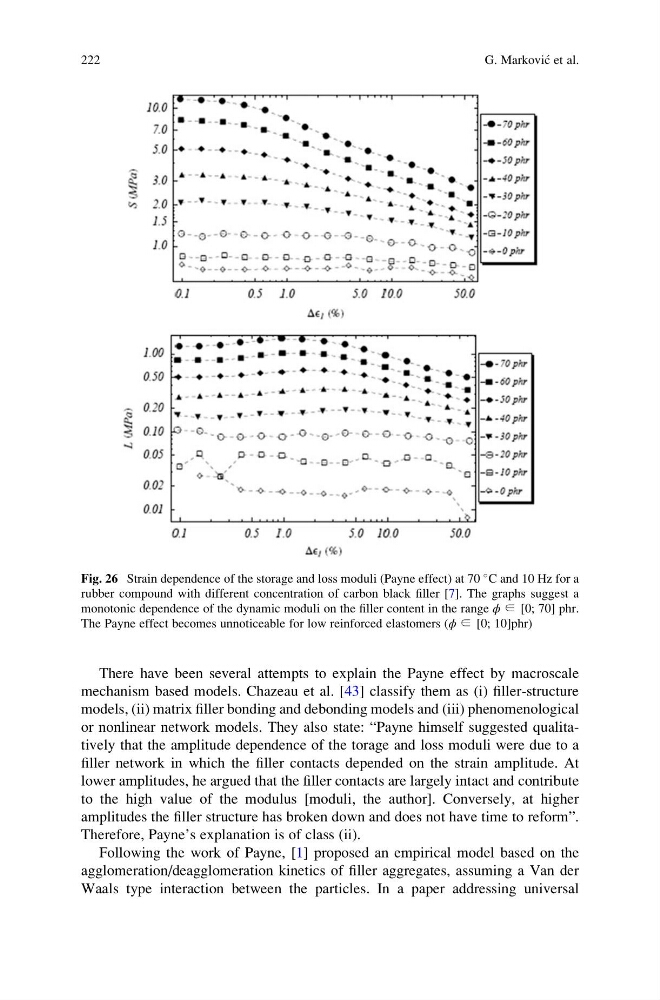
Fig. 26 Strain dependence of the storage and loss moduli (Payne effect) at 70
C and 10 Hz for a
rubber compound with different concentration of carbon black filler [7]. The graphs suggest a
monotonic dependence of the dynamic moduli on the filler content in the range ϕ ∈ [0; 70] phr.
The Payne effect becomes unnoticeable for low reinforced elastomers (ϕ ∈ [0; 10]phr)
222
G. Markovic ´ et al.
mechanism based models. Chazeau et al. [43] classify them as (i) filler-structure
models, (ii) matrix filler bonding and debonding models and (iii) phenomenological
or nonlinear network models. They also state: “Payne himself suggested qualitatively that the amplitude dependence of the torage and loss moduli were due to a
filler network in which the filler contacts depended on the strain amplitude. At
lower amplitudes, he argued that the filler contacts are largely intact and contribute
to the high value of the modulus [moduli, the author]. Conversely, at higher
amplitudes the filler structure has broken down and does not have time to reform”.
Therefore, Payne’s explanation is of class (ii).
Following the work of Payne, [1] proposed an empirical model based on the
agglomeration/deagglomeration kinetics of filler aggregates, assuming a Van der
Waals type interaction between the particles. In a paper addressing universal
Fig. 26 Strain dependence of the storage and loss moduli (Payne effect) at 70
C and 10 Hz for a
rubber compound with different concentration of carbon black filler [7]. The graphs suggest a
monotonic dependence of the dynamic moduli on the filler content in the range ϕ ∈ [0; 70] phr.
The Payne effect becomes unnoticeable for low reinforced elastomers (ϕ ∈ [0; 10]phr)
222
G. Markovic ´ et al.