

fraction of the polymeric chain strongly immobilized onto the filler surface. Therefore less mechanical energy is dissipated during the glass transition process for
systems containing silanized silica.
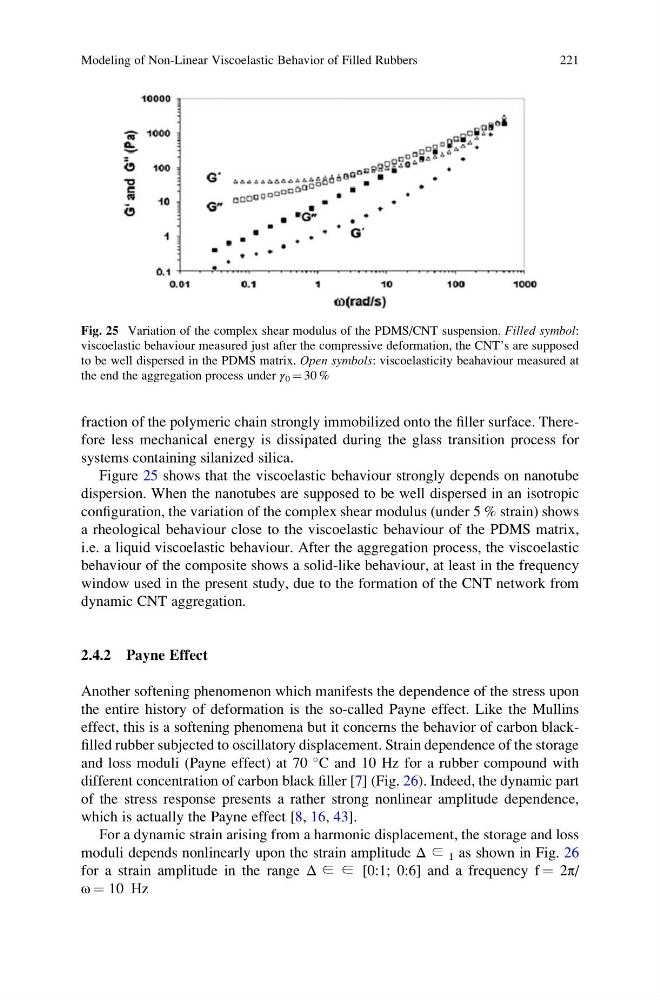
Figure 25 shows that the viscoelastic behaviour strongly depends on nanotube
dispersion. When the nanotubes are supposed to be well dispersed in an isotropic
configuration, the variation of the complex shear modulus (under 5 % strain) shows
a rheological behaviour close to the viscoelastic behaviour of the PDMS matrix,
i.e. a liquid viscoelastic behaviour. After the aggregation process, the viscoelastic
behaviour of the composite shows a solid-like behaviour, at least in the frequency
window used in the present study, due to the formation of the CNT network from
dynamic CNT aggregation.
2.4.2 Payne Effect
Another softening phenomenon which manifests the dependence of the stress upon
the entire history of deformation is the so-called Payne effect. Like the Mullins
effect, this is a softening phenomena but it concerns the behavior of carbon blackfilled rubber subjected to oscillatory displacement. Strain dependence of the storage
and loss moduli (Payne effect) at 70
C and 10 Hz for a rubber compound with
different concentration of carbon black filler [7] (Fig. 26). Indeed, the dynamic part
of the stress response presents a rather strong nonlinear amplitude dependence,
which is actually the Payne effect [8, 16, 43].
For a dynamic strain arising from a harmonic displacement, the storage and loss
moduli depends nonlinearly upon the strain amplitude Δ ∈ 1 as shown in Fig. 26
for a strain amplitude in the range Δ ∈ ∈ [0:1; 0:6] and a frequency f ¼ 2π/
ω ¼ 10 Hz
Fig. 25 Variation of the complex shear modulus of the PDMS/CNT suspension. Filled symbol:
viscoelastic behaviour measured just after the compressive deformation, the CNT’s are supposed
to be well dispersed in the PDMS matrix. Open symbols: viscoelasticity beahaviour measured at
the end the aggregation process under γ 0 ¼ 30 %
Modeling of Non-Linear Viscoelastic Behavior of Filled Rubbers
221
systems containing silanized silica.
Figure 25 shows that the viscoelastic behaviour strongly depends on nanotube
dispersion. When the nanotubes are supposed to be well dispersed in an isotropic
configuration, the variation of the complex shear modulus (under 5 % strain) shows
a rheological behaviour close to the viscoelastic behaviour of the PDMS matrix,
i.e. a liquid viscoelastic behaviour. After the aggregation process, the viscoelastic
behaviour of the composite shows a solid-like behaviour, at least in the frequency
window used in the present study, due to the formation of the CNT network from
dynamic CNT aggregation.
2.4.2 Payne Effect
Another softening phenomenon which manifests the dependence of the stress upon
the entire history of deformation is the so-called Payne effect. Like the Mullins
effect, this is a softening phenomena but it concerns the behavior of carbon blackfilled rubber subjected to oscillatory displacement. Strain dependence of the storage
and loss moduli (Payne effect) at 70
C and 10 Hz for a rubber compound with
different concentration of carbon black filler [7] (Fig. 26). Indeed, the dynamic part
of the stress response presents a rather strong nonlinear amplitude dependence,
which is actually the Payne effect [8, 16, 43].
For a dynamic strain arising from a harmonic displacement, the storage and loss
moduli depends nonlinearly upon the strain amplitude Δ ∈ 1 as shown in Fig. 26
for a strain amplitude in the range Δ ∈ ∈ [0:1; 0:6] and a frequency f ¼ 2π/
ω ¼ 10 Hz
Fig. 25 Variation of the complex shear modulus of the PDMS/CNT suspension. Filled symbol:
viscoelastic behaviour measured just after the compressive deformation, the CNT’s are supposed
to be well dispersed in the PDMS matrix. Open symbols: viscoelasticity beahaviour measured at
the end the aggregation process under γ 0 ¼ 30 %
Modeling of Non-Linear Viscoelastic Behavior of Filled Rubbers
221