

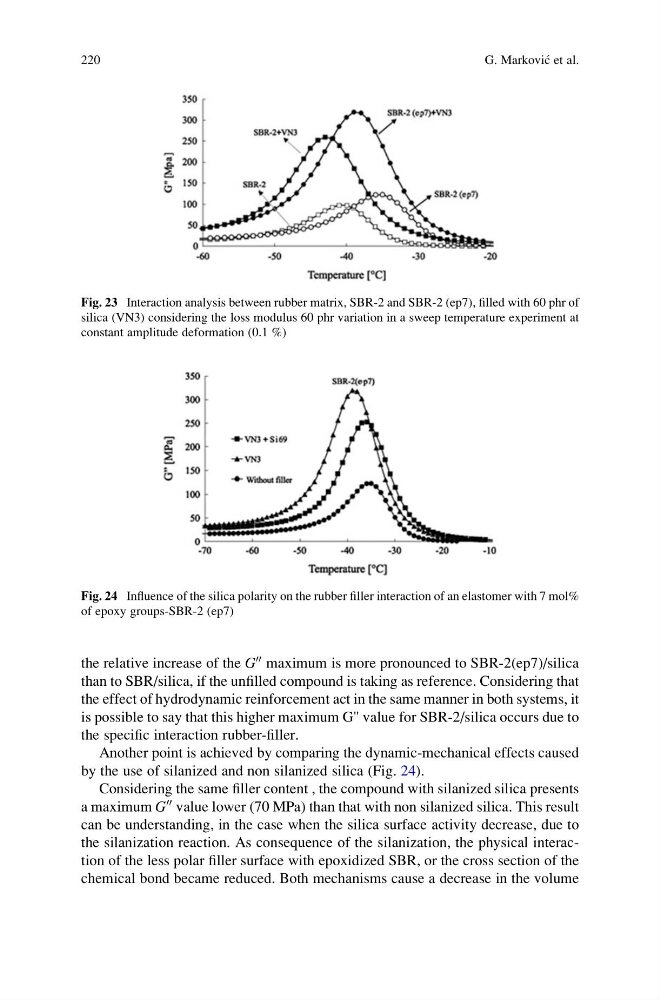
the relative increase of the G
00 maximum is more pronounced to SBR-2(ep7)/silica
than to SBR/silica, if the unfilled compound is taking as reference. Considering that
the effect of hydrodynamic reinforcement act in the same manner in both systems, it
is possible to say that this higher maximum G" value for SBR-2/silica occurs due to
the specific interaction rubber-filler.
Another point is achieved by comparing the dynamic-mechanical effects caused
by the use of silanized and non silanized silica (Fig. 24).
Considering the same filler content , the compound with silanized silica presents
a maximum G
00 value lower (70 MPa) than that with non silanized silica. This result
can be understanding, in the case when the silica surface activity decrease, due to
the silanization reaction. As consequence of the silanization, the physical interaction of the less polar filler surface with epoxidized SBR, or the cross section of the
chemical bond became reduced. Both mechanisms cause a decrease in the volume
Fig. 23 Interaction analysis between rubber matrix, SBR-2 and SBR-2 (ep7), filled with 60 phr of
silica (VN3) considering the loss modulus 60 phr variation in a sweep temperature experiment at
constant amplitude deformation (0.1 %)
Fig. 24 Influence of the silica polarity on the rubber filler interaction of an elastomer with 7 mol%
of epoxy groups-SBR-2 (ep7)
220
G. Markovic ´ et al.
00 maximum is more pronounced to SBR-2(ep7)/silica
than to SBR/silica, if the unfilled compound is taking as reference. Considering that
the effect of hydrodynamic reinforcement act in the same manner in both systems, it
is possible to say that this higher maximum G" value for SBR-2/silica occurs due to
the specific interaction rubber-filler.
Another point is achieved by comparing the dynamic-mechanical effects caused
by the use of silanized and non silanized silica (Fig. 24).
Considering the same filler content , the compound with silanized silica presents
a maximum G
00 value lower (70 MPa) than that with non silanized silica. This result
can be understanding, in the case when the silica surface activity decrease, due to
the silanization reaction. As consequence of the silanization, the physical interaction of the less polar filler surface with epoxidized SBR, or the cross section of the
chemical bond became reduced. Both mechanisms cause a decrease in the volume
Fig. 23 Interaction analysis between rubber matrix, SBR-2 and SBR-2 (ep7), filled with 60 phr of
silica (VN3) considering the loss modulus 60 phr variation in a sweep temperature experiment at
constant amplitude deformation (0.1 %)
Fig. 24 Influence of the silica polarity on the rubber filler interaction of an elastomer with 7 mol%
of epoxy groups-SBR-2 (ep7)
220
G. Markovic ´ et al.