

value, as the epoxidation content increase. Analysing the loss modulus, G
00 , it was
observed a decrease about 35 % of the maximum value of this modulus, as the
content of SBR-2(ep7) increases, confirming the idea of a more efficient rubberfiller interaction.
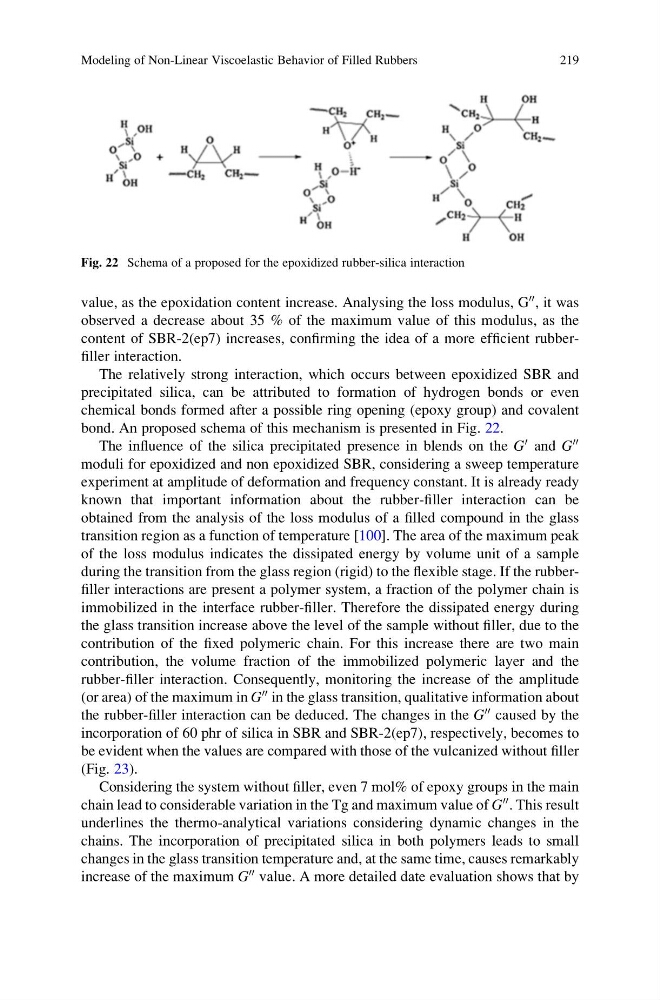
The relatively strong interaction, which occurs between epoxidized SBR and
precipitated silica, can be attributed to formation of hydrogen bonds or even
chemical bonds formed after a possible ring opening (epoxy group) and covalent
bond. An proposed schema of this mechanism is presented in Fig. 22.
The influence of the silica precipitated presence in blends on the G
0 and G
00
moduli for epoxidized and non epoxidized SBR, considering a sweep temperature
experiment at amplitude of deformation and frequency constant. It is already ready
known that important information about the rubber-filler interaction can be
obtained from the analysis of the loss modulus of a filled compound in the glass
transition region as a function of temperature [100]. The area of the maximum peak
of the loss modulus indicates the dissipated energy by volume unit of a sample
during the transition from the glass region (rigid) to the flexible stage. If the rubberfiller interactions are present a polymer system, a fraction of the polymer chain is
immobilized in the interface rubber-filler. Therefore the dissipated energy during
the glass transition increase above the level of the sample without filler, due to the
contribution of the fixed polymeric chain. For this increase there are two main
contribution, the volume fraction of the immobilized polymeric layer and the
rubber-filler interaction. Consequently, monitoring the increase of the amplitude
(or area) of the maximum in G
00 in the glass transition, qualitative information about
the rubber-filler interaction can be deduced. The changes in the G
00 caused by the
incorporation of 60 phr of silica in SBR and SBR-2(ep7), respectively, becomes to
be evident when the values are compared with those of the vulcanized without filler
(Fig. 23).
Considering the system without filler, even 7 mol% of epoxy groups in the main
chain lead to considerable variation in the Tg and maximum value of G
00 . This result
underlines the thermo-analytical variations considering dynamic changes in the
chains. The incorporation of precipitated silica in both polymers leads to small
changes in the glass transition temperature and, at the same time, causes remarkably
increase of the maximum G
00 value. A more detailed date evaluation shows that by
Fig. 22 Schema of a proposed for the epoxidized rubber-silica interaction
Modeling of Non-Linear Viscoelastic Behavior of Filled Rubbers
219
00 , it was
observed a decrease about 35 % of the maximum value of this modulus, as the
content of SBR-2(ep7) increases, confirming the idea of a more efficient rubberfiller interaction.
The relatively strong interaction, which occurs between epoxidized SBR and
precipitated silica, can be attributed to formation of hydrogen bonds or even
chemical bonds formed after a possible ring opening (epoxy group) and covalent
bond. An proposed schema of this mechanism is presented in Fig. 22.
The influence of the silica precipitated presence in blends on the G
0 and G
00
moduli for epoxidized and non epoxidized SBR, considering a sweep temperature
experiment at amplitude of deformation and frequency constant. It is already ready
known that important information about the rubber-filler interaction can be
obtained from the analysis of the loss modulus of a filled compound in the glass
transition region as a function of temperature [100]. The area of the maximum peak
of the loss modulus indicates the dissipated energy by volume unit of a sample
during the transition from the glass region (rigid) to the flexible stage. If the rubberfiller interactions are present a polymer system, a fraction of the polymer chain is
immobilized in the interface rubber-filler. Therefore the dissipated energy during
the glass transition increase above the level of the sample without filler, due to the
contribution of the fixed polymeric chain. For this increase there are two main
contribution, the volume fraction of the immobilized polymeric layer and the
rubber-filler interaction. Consequently, monitoring the increase of the amplitude
(or area) of the maximum in G
00 in the glass transition, qualitative information about
the rubber-filler interaction can be deduced. The changes in the G
00 caused by the
incorporation of 60 phr of silica in SBR and SBR-2(ep7), respectively, becomes to
be evident when the values are compared with those of the vulcanized without filler
(Fig. 23).
Considering the system without filler, even 7 mol% of epoxy groups in the main
chain lead to considerable variation in the Tg and maximum value of G
00 . This result
underlines the thermo-analytical variations considering dynamic changes in the
chains. The incorporation of precipitated silica in both polymers leads to small
changes in the glass transition temperature and, at the same time, causes remarkably
increase of the maximum G
00 value. A more detailed date evaluation shows that by
Fig. 22 Schema of a proposed for the epoxidized rubber-silica interaction
Modeling of Non-Linear Viscoelastic Behavior of Filled Rubbers
219