

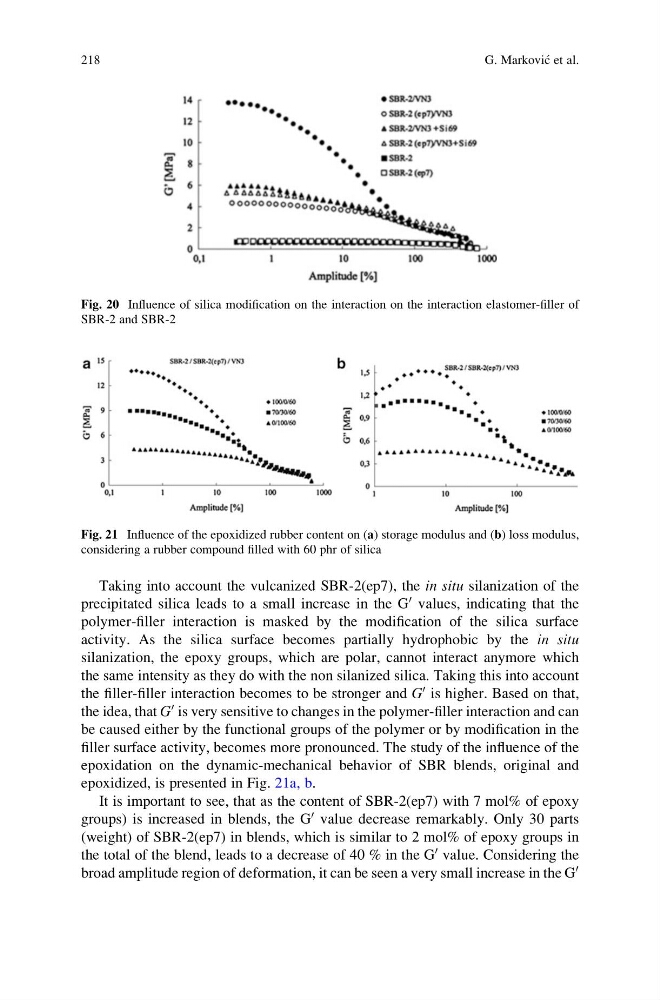
Taking into account the vulcanized SBR-2(ep7), the in situ silanization of the
precipitated silica leads to a small increase in the G
0 values, indicating that the
polymer-filler interaction is masked by the modification of the silica surface
activity. As the silica surface becomes partially hydrophobic by the in situ
silanization, the epoxy groups, which are polar, cannot interact anymore which
the same intensity as they do with the non silanized silica. Taking this into account
the filler-filler interaction becomes to be stronger and G
0 is higher. Based on that,
the idea, that G
0 is very sensitive to changes in the polymer-filler interaction and can
be caused either by the functional groups of the polymer or by modification in the
filler surface activity, becomes more pronounced. The study of the influence of the
epoxidation on the dynamic-mechanical behavior of SBR blends, original and
epoxidized, is presented in Fig. 21a, b.
It is important to see, that as the content of SBR-2(ep7) with 7 mol% of epoxy
groups) is increased in blends, the G
0 value decrease remarkably. Only 30 parts
(weight) of SBR-2(ep7) in blends, which is similar to 2 mol% of epoxy groups in
the total of the blend, leads to a decrease of 40 % in the G
0 value. Considering the
broad amplitude region of deformation, it can be seen a very small increase in the G
0
Fig. 21 Influence of the epoxidized rubber content on (a) storage modulus and (b) loss modulus,
considering a rubber compound filled with 60 phr of silica
Fig. 20 Influence of silica modification on the interaction on the interaction elastomer-filler of
SBR-2 and SBR-2
218
G. Markovic ´ et al.
precipitated silica leads to a small increase in the G
0 values, indicating that the
polymer-filler interaction is masked by the modification of the silica surface
activity. As the silica surface becomes partially hydrophobic by the in situ
silanization, the epoxy groups, which are polar, cannot interact anymore which
the same intensity as they do with the non silanized silica. Taking this into account
the filler-filler interaction becomes to be stronger and G
0 is higher. Based on that,
the idea, that G
0 is very sensitive to changes in the polymer-filler interaction and can
be caused either by the functional groups of the polymer or by modification in the
filler surface activity, becomes more pronounced. The study of the influence of the
epoxidation on the dynamic-mechanical behavior of SBR blends, original and
epoxidized, is presented in Fig. 21a, b.
It is important to see, that as the content of SBR-2(ep7) with 7 mol% of epoxy
groups) is increased in blends, the G
0 value decrease remarkably. Only 30 parts
(weight) of SBR-2(ep7) in blends, which is similar to 2 mol% of epoxy groups in
the total of the blend, leads to a decrease of 40 % in the G
0 value. Considering the
broad amplitude region of deformation, it can be seen a very small increase in the G
0
Fig. 21 Influence of the epoxidized rubber content on (a) storage modulus and (b) loss modulus,
considering a rubber compound filled with 60 phr of silica
Fig. 20 Influence of silica modification on the interaction on the interaction elastomer-filler of
SBR-2 and SBR-2
218
G. Markovic ´ et al.