

also accounted for in the model by the use of a dissipation function, which evolves
with deformation history.
A phenomenological model based on the limiting chain extensibility associated
with the Gent model of rubber elasticity has been proposed by [96]. The Gent strain
energy function [98] was modified to incorporate stress softening characteristics
typical of the Mullins effect. Although the Gent model is phenomenological in
nature, a microscopically based interpretation was given to all of its constitutive
parameters. In this way, it has been possible to develop a model for the Mullins
effect based on the alteration of the polymeric network. Indeed they showed that
their approach is a particular case of the more general framework of pseudoelasticity developed in [97].
Simo [51] proposed to penalize the classic elastic strain energy densities, W 0 (F),
designed to fit the hyperelastic stress-strain responses of rubber-like materials
submitted to the deformation gradient F, by a reducing parameter of the Kachanov
form [99].
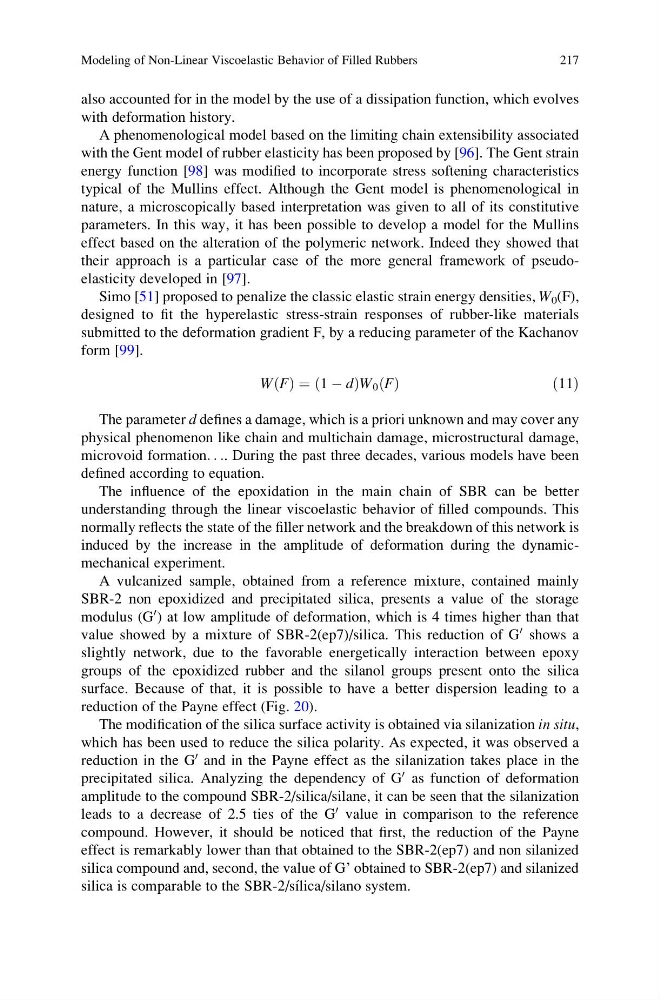
W F
ð Þ ¼ 1 À d
ð
ÞW 0 F
ð Þ
ð11Þ
The parameter d defines a damage, which is a priori unknown and may cover any
physical phenomenon like chain and multichain damage, microstructural damage,
microvoid formation. . .. During the past three decades, various models have been
defined according to equation.
The influence of the epoxidation in the main chain of SBR can be better
understanding through the linear viscoelastic behavior of filled compounds. This
normally reflects the state of the filler network and the breakdown of this network is
induced by the increase in the amplitude of deformation during the dynamicmechanical experiment.
A vulcanized sample, obtained from a reference mixture, contained mainly
SBR-2 non epoxidized and precipitated silica, presents a value of the storage
modulus (G
0 ) at low amplitude of deformation, which is 4 times higher than that
value showed by a mixture of SBR-2(ep7)/silica. This reduction of G
0 shows a
slightly network, due to the favorable energetically interaction between epoxy
groups of the epoxidized rubber and the silanol groups present onto the silica
surface. Because of that, it is possible to have a better dispersion leading to a
reduction of the Payne effect (Fig. 20).
The modification of the silica surface activity is obtained via silanization in situ,
which has been used to reduce the silica polarity. As expected, it was observed a
reduction in the G
0 and in the Payne effect as the silanization takes place in the
precipitated silica. Analyzing the dependency of G
0 as function of deformation
amplitude to the compound SBR-2/silica/silane, it can be seen that the silanization
leads to a decrease of 2.5 ties of the G
0 value in comparison to the reference
compound. However, it should be noticed that first, the reduction of the Payne
effect is remarkably lower than that obtained to the SBR-2(ep7) and non silanized
silica compound and, second, the value of G’ obtained to SBR-2(ep7) and silanized
silica is comparable to the SBR-2/sı ´lica/silano system.
Modeling of Non-Linear Viscoelastic Behavior of Filled Rubbers
217
with deformation history.
A phenomenological model based on the limiting chain extensibility associated
with the Gent model of rubber elasticity has been proposed by [96]. The Gent strain
energy function [98] was modified to incorporate stress softening characteristics
typical of the Mullins effect. Although the Gent model is phenomenological in
nature, a microscopically based interpretation was given to all of its constitutive
parameters. In this way, it has been possible to develop a model for the Mullins
effect based on the alteration of the polymeric network. Indeed they showed that
their approach is a particular case of the more general framework of pseudoelasticity developed in [97].
Simo [51] proposed to penalize the classic elastic strain energy densities, W 0 (F),
designed to fit the hyperelastic stress-strain responses of rubber-like materials
submitted to the deformation gradient F, by a reducing parameter of the Kachanov
form [99].
W F
ð Þ ¼ 1 À d
ð
ÞW 0 F
ð Þ
ð11Þ
The parameter d defines a damage, which is a priori unknown and may cover any
physical phenomenon like chain and multichain damage, microstructural damage,
microvoid formation. . .. During the past three decades, various models have been
defined according to equation.
The influence of the epoxidation in the main chain of SBR can be better
understanding through the linear viscoelastic behavior of filled compounds. This
normally reflects the state of the filler network and the breakdown of this network is
induced by the increase in the amplitude of deformation during the dynamicmechanical experiment.
A vulcanized sample, obtained from a reference mixture, contained mainly
SBR-2 non epoxidized and precipitated silica, presents a value of the storage
modulus (G
0 ) at low amplitude of deformation, which is 4 times higher than that
value showed by a mixture of SBR-2(ep7)/silica. This reduction of G
0 shows a
slightly network, due to the favorable energetically interaction between epoxy
groups of the epoxidized rubber and the silanol groups present onto the silica
surface. Because of that, it is possible to have a better dispersion leading to a
reduction of the Payne effect (Fig. 20).
The modification of the silica surface activity is obtained via silanization in situ,
which has been used to reduce the silica polarity. As expected, it was observed a
reduction in the G
0 and in the Payne effect as the silanization takes place in the
precipitated silica. Analyzing the dependency of G
0 as function of deformation
amplitude to the compound SBR-2/silica/silane, it can be seen that the silanization
leads to a decrease of 2.5 ties of the G
0 value in comparison to the reference
compound. However, it should be noticed that first, the reduction of the Payne
effect is remarkably lower than that obtained to the SBR-2(ep7) and non silanized
silica compound and, second, the value of G’ obtained to SBR-2(ep7) and silanized
silica is comparable to the SBR-2/sı ´lica/silano system.
Modeling of Non-Linear Viscoelastic Behavior of Filled Rubbers
217