

the breakdown of linkages between filler and rubber. Their interpretation has
provided a useful starting point for the work of other researchers.
One of the other early investigations was done by Mullins and Tobin [94] who
considered the filled rubber as a heterogeneous system comprising hard and soft
phases. The hard phase was considered to be inextensible and the soft phase to have
the characteristics of gum rubber. During deformation, hard regions are broken
down and transformed into soft regions. Then the fraction of the soft region
becomes greater with the increasing tension which in turn is responsible for the
reduced material stiffness. However, Mullins and Tobin did not provide a direct
physical interpretation for their model. More recently, new insights into Mullin’s
effect have been obtained and many researchers proposed their own constitutive
model [52, 81, 95–97].
In [52] a micromechanically based continuum damage model for carbon-black
filled elastomers was introduced. The key point of the paper was to incorporate both
a damage induced phenomenon such as Mullin’s effect and the viscous behavior of
a theory of viscoelasticity. Within the framework of damage elasticity, relaxation
processes in the material are described via stress-like convected internal variables,
governed by dissipative evolution equations they are interpreted as the
nonequilibrium interaction stresses between the polymer chains in the network.
Ogden and Roxburgh [97] proposed to account for the Mullins effect with a
phenomenological model based on the theory of incompressible isotropic elasticity
amended by the incorporation of a single continuous damage parameter. The
dissipation is measured by a damage function which depends only on the damage
parameter and on the point of the primary loading path from which unloading
begins. A specific form of this function with two adjustable material constants,
coupled with standard forms of the (incompressible, isotropic) strain-energy function, was used to illustrate the qualitative features of the Mullins effect in both
simple tension and pure shear. However any effects of residual strain were not
incorporated. Dorfmann and Ogden [81] introduced a constitutive model for the
Mullins effect with permanent set in particle-reinforced rubber. The theory of
pseudoelasticity has been used for this model, the basis of which is the inclusion
of two variables in the energy function in order to capture separately the stress
softening and residual strain effects. The dissipation of energy i.e. the difference
between the energy input during loading and the energy returned on unloading is
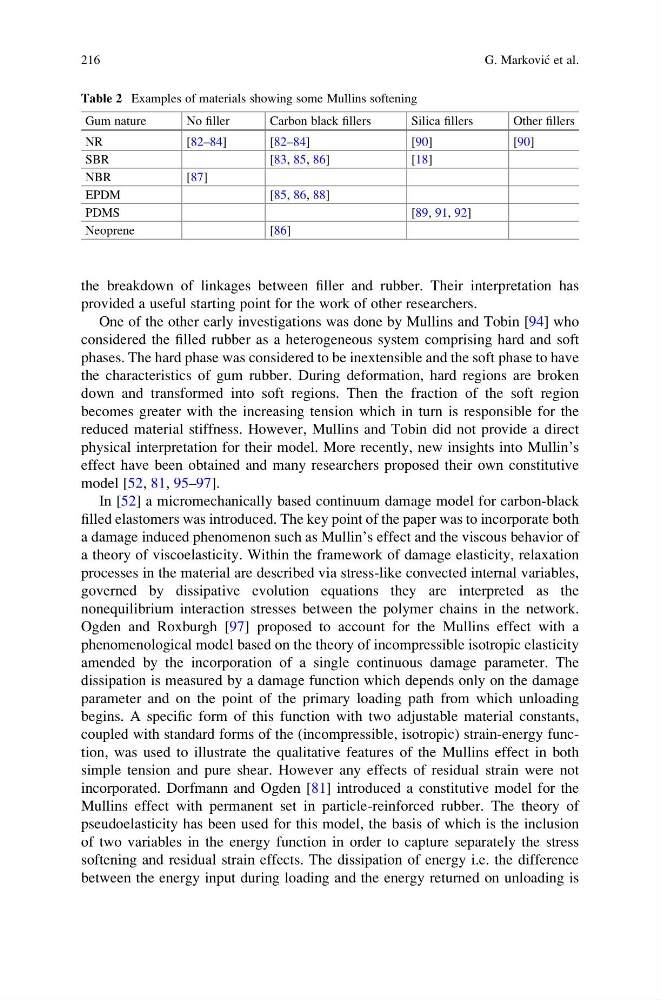
Table 2 Examples of materials showing some Mullins softening
Gum nature
No filler
Carbon black fillers
Silica fillers
Other fillers
NR
[82–84]
[ 82–84]
[ 90]
[ 90]
SBR
[83, 85, 86]
[ 18]
NBR
[87]
EPDM
[85, 86, 88]
PDMS
[89, 91, 92]
Neoprene
[86]
216
G. Markovic ´ et al.
provided a useful starting point for the work of other researchers.
One of the other early investigations was done by Mullins and Tobin [94] who
considered the filled rubber as a heterogeneous system comprising hard and soft
phases. The hard phase was considered to be inextensible and the soft phase to have
the characteristics of gum rubber. During deformation, hard regions are broken
down and transformed into soft regions. Then the fraction of the soft region
becomes greater with the increasing tension which in turn is responsible for the
reduced material stiffness. However, Mullins and Tobin did not provide a direct
physical interpretation for their model. More recently, new insights into Mullin’s
effect have been obtained and many researchers proposed their own constitutive
model [52, 81, 95–97].
In [52] a micromechanically based continuum damage model for carbon-black
filled elastomers was introduced. The key point of the paper was to incorporate both
a damage induced phenomenon such as Mullin’s effect and the viscous behavior of
a theory of viscoelasticity. Within the framework of damage elasticity, relaxation
processes in the material are described via stress-like convected internal variables,
governed by dissipative evolution equations they are interpreted as the
nonequilibrium interaction stresses between the polymer chains in the network.
Ogden and Roxburgh [97] proposed to account for the Mullins effect with a
phenomenological model based on the theory of incompressible isotropic elasticity
amended by the incorporation of a single continuous damage parameter. The
dissipation is measured by a damage function which depends only on the damage
parameter and on the point of the primary loading path from which unloading
begins. A specific form of this function with two adjustable material constants,
coupled with standard forms of the (incompressible, isotropic) strain-energy function, was used to illustrate the qualitative features of the Mullins effect in both
simple tension and pure shear. However any effects of residual strain were not
incorporated. Dorfmann and Ogden [81] introduced a constitutive model for the
Mullins effect with permanent set in particle-reinforced rubber. The theory of
pseudoelasticity has been used for this model, the basis of which is the inclusion
of two variables in the energy function in order to capture separately the stress
softening and residual strain effects. The dissipation of energy i.e. the difference
between the energy input during loading and the energy returned on unloading is
Table 2 Examples of materials showing some Mullins softening
Gum nature
No filler
Carbon black fillers
Silica fillers
Other fillers
NR
[82–84]
[ 82–84]
[ 90]
[ 90]
SBR
[83, 85, 86]
[ 18]
NBR
[87]
EPDM
[85, 86, 88]
PDMS
[89, 91, 92]
Neoprene
[86]
216
G. Markovic ´ et al.