

simple. Even for thermorheological simple materials such a procedure can be
expected to be valid only over a limited time and temperature range, primarily
above the glass transition temperature [78].
The influence of the carbon black loading on the dynamic modulus of the green
compound as well as of the vulcanizate can be seen in Fig. 14. The carbon black N
115 was chosen as example, but in principle the behavior is similar for all grades of
carbon black. The unfilled rubber shows no indication of non-linearity in the green
compound as well as in the vulcanizate. After adding the filler, the low strain
modulus G 0 rises more that the high strain modulus G, resulting in a non-linear
viscoelastic behavior, known as Payne-effect G 0 –G 1
The viscoelastic behavior vs. strain is investigated for silica filled natural rubber
and the results show the qualitative features generally observed for the Payne effect.
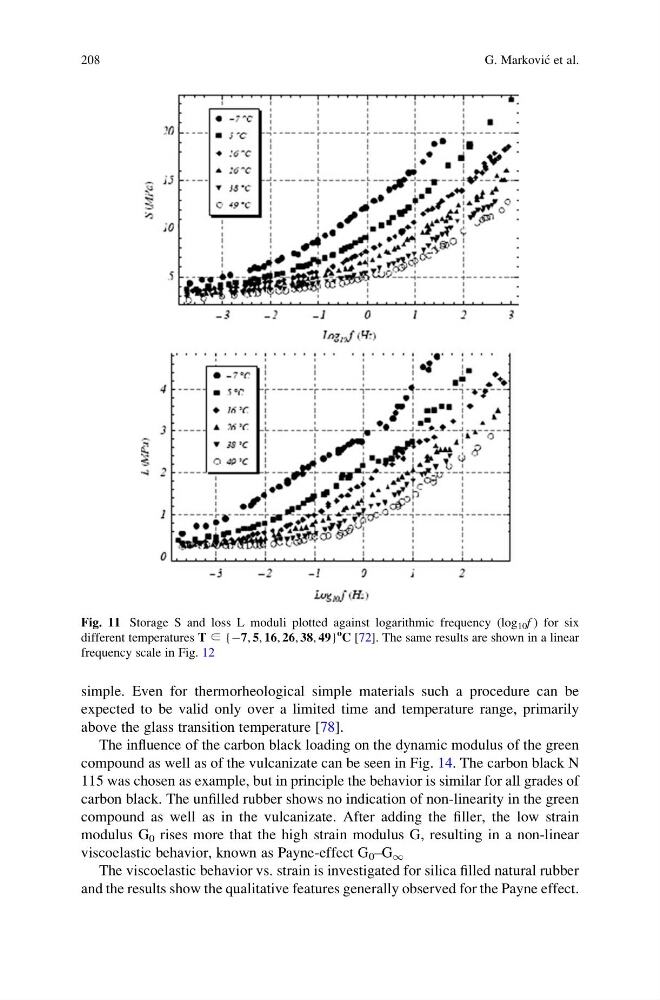
Fig. 11 Storage S and loss L moduli plotted against logarithmic frequency (log 10 f ) for six
different temperatures T ∈ {À7, 5, 16, 26, 38, 49}
o
C [72]. The same results are shown in a linear
frequency scale in Fig. 12
208
G. Markovic ´ et al.
expected to be valid only over a limited time and temperature range, primarily
above the glass transition temperature [78].
The influence of the carbon black loading on the dynamic modulus of the green
compound as well as of the vulcanizate can be seen in Fig. 14. The carbon black N
115 was chosen as example, but in principle the behavior is similar for all grades of
carbon black. The unfilled rubber shows no indication of non-linearity in the green
compound as well as in the vulcanizate. After adding the filler, the low strain
modulus G 0 rises more that the high strain modulus G, resulting in a non-linear
viscoelastic behavior, known as Payne-effect G 0 –G 1
The viscoelastic behavior vs. strain is investigated for silica filled natural rubber
and the results show the qualitative features generally observed for the Payne effect.
Fig. 11 Storage S and loss L moduli plotted against logarithmic frequency (log 10 f ) for six
different temperatures T ∈ {À7, 5, 16, 26, 38, 49}
o
C [72]. The same results are shown in a linear
frequency scale in Fig. 12
208
G. Markovic ´ et al.