

could reasonably be taken as temperature independent within the common working
range.
A standard assumption made in the modeling of filled elastomers, which can be
corroborated by experimental data, is the so-called thermorehologically simple
behavior. Within this context, the basic postulate is that a viscoelastic mechanical
property—relaxation function, creep function or complex moduli—at a series of
different temperatures, when plotted against the logarithm of time or frequency can
be superimposed to form a single curve [75, 76], shifting the various curves at
different temperatures along the time or frequency axis. Such as temperature
dependence is schematically shown in Fig. 11 for the storage S and loss L moduli.
Similar temperature dependence is shown for the relaxation function in Figs. 12
and 13 [77]. Materials obeying this empirical principle are called thermorheological
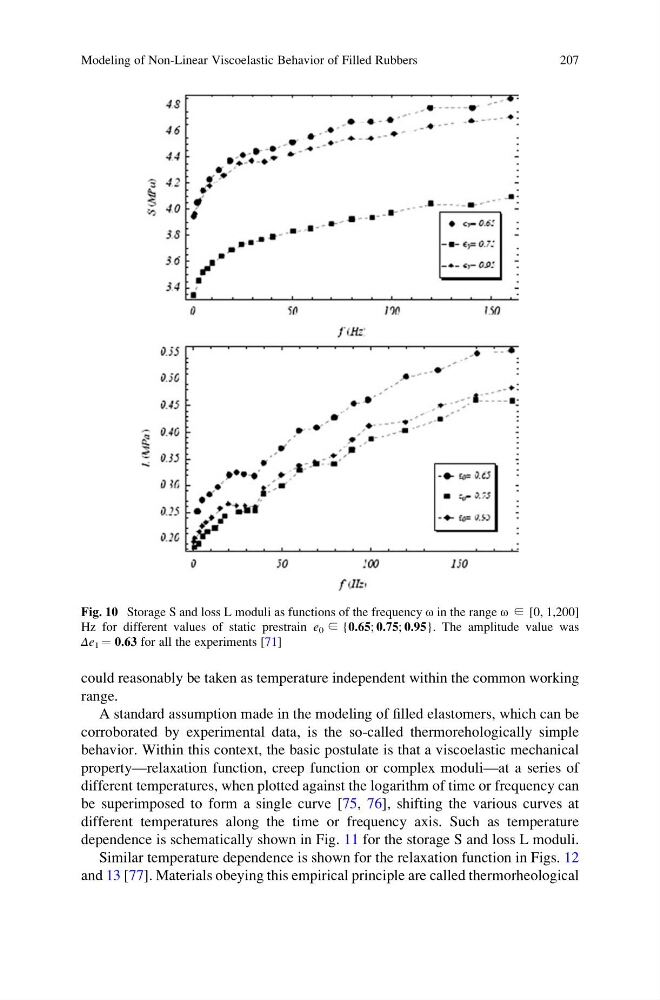
Fig. 10 Storage S and loss L moduli as functions of the frequency ω in the range ω ∈ [0, 1,200]
Hz for different values of static prestrain e 0 ∈ {0.65; 0.75; 0.95}. The amplitude value was
Δe 1 ¼ 0.63 for all the experiments [71]
Modeling of Non-Linear Viscoelastic Behavior of Filled Rubbers
207
range.
A standard assumption made in the modeling of filled elastomers, which can be
corroborated by experimental data, is the so-called thermorehologically simple
behavior. Within this context, the basic postulate is that a viscoelastic mechanical
property—relaxation function, creep function or complex moduli—at a series of
different temperatures, when plotted against the logarithm of time or frequency can
be superimposed to form a single curve [75, 76], shifting the various curves at
different temperatures along the time or frequency axis. Such as temperature
dependence is schematically shown in Fig. 11 for the storage S and loss L moduli.
Similar temperature dependence is shown for the relaxation function in Figs. 12
and 13 [77]. Materials obeying this empirical principle are called thermorheological
Fig. 10 Storage S and loss L moduli as functions of the frequency ω in the range ω ∈ [0, 1,200]
Hz for different values of static prestrain e 0 ∈ {0.65; 0.75; 0.95}. The amplitude value was
Δe 1 ¼ 0.63 for all the experiments [71]
Modeling of Non-Linear Viscoelastic Behavior of Filled Rubbers
207