

The effect of the strain amplitude on the storage modulus at various silica concentrations for the composites is shown in Fig. 15.
The storage modulus is the highest at small amplitude (referred to as E
0
0 ) and
gradually decreases to a low value (referred to as E
0
1 ). The magnitude of the Payne
effect (E 0
0 –E
0 1 ) increases with the silica content. At low silica loading, the
observed variation in the amplitude of the Payne effect is weak. But as the silica
concentration increases, significant and pronounced variation is observed. This is
principally due to the breakdown of the filler networks at high strains. At low filler
loading, the chances of forming agglomerates are practically nil. But at higher
loading, because of the small particle size (12–13 nm) and high specific surface area
[160 (25 m
2 /g)], silica particles tend to agglomerate to higher extent. The structure
of filler particles within the rubber matrix, i.e., the state of dispersion and aggregation has a strong influence on the Payne effect. In the rubber matrix, the state of
0
1
2
3
4
4
6
8
10
12
14
16
L (MPa)
S (MPa)
4
2
6
8
1 0
49 °C
38 °C
26 °C
16 °C
5 °C
–7°C
49 °C
38 °C
26 °C
16 °C
5 °C
–7°C
f (Hz)
0
4
2
6
8
1 0
f (Hz)
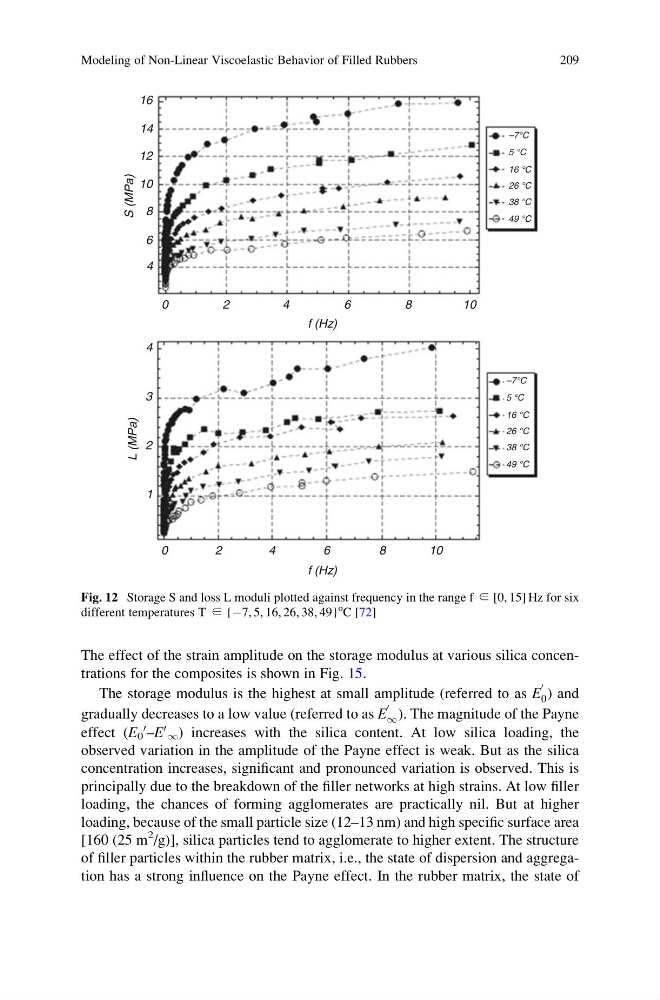
Fig. 12 Storage S and loss L moduli plotted against frequency in the range f ∈ [0, 15] Hz for six
different temperatures T ∈ {À7, 5, 16, 26, 38, 49}
o
C [72]
Modeling of Non-Linear Viscoelastic Behavior of Filled Rubbers
209
The storage modulus is the highest at small amplitude (referred to as E
0
0 ) and
gradually decreases to a low value (referred to as E
0
1 ). The magnitude of the Payne
effect (E 0
0 –E
0 1 ) increases with the silica content. At low silica loading, the
observed variation in the amplitude of the Payne effect is weak. But as the silica
concentration increases, significant and pronounced variation is observed. This is
principally due to the breakdown of the filler networks at high strains. At low filler
loading, the chances of forming agglomerates are practically nil. But at higher
loading, because of the small particle size (12–13 nm) and high specific surface area
[160 (25 m
2 /g)], silica particles tend to agglomerate to higher extent. The structure
of filler particles within the rubber matrix, i.e., the state of dispersion and aggregation has a strong influence on the Payne effect. In the rubber matrix, the state of
0
1
2
3
4
4
6
8
10
12
14
16
L (MPa)
S (MPa)
4
2
6
8
1 0
49 °C
38 °C
26 °C
16 °C
5 °C
–7°C
49 °C
38 °C
26 °C
16 °C
5 °C
–7°C
f (Hz)
0
4
2
6
8
1 0
f (Hz)
Fig. 12 Storage S and loss L moduli plotted against frequency in the range f ∈ [0, 15] Hz for six
different temperatures T ∈ {À7, 5, 16, 26, 38, 49}
o
C [72]
Modeling of Non-Linear Viscoelastic Behavior of Filled Rubbers
209