

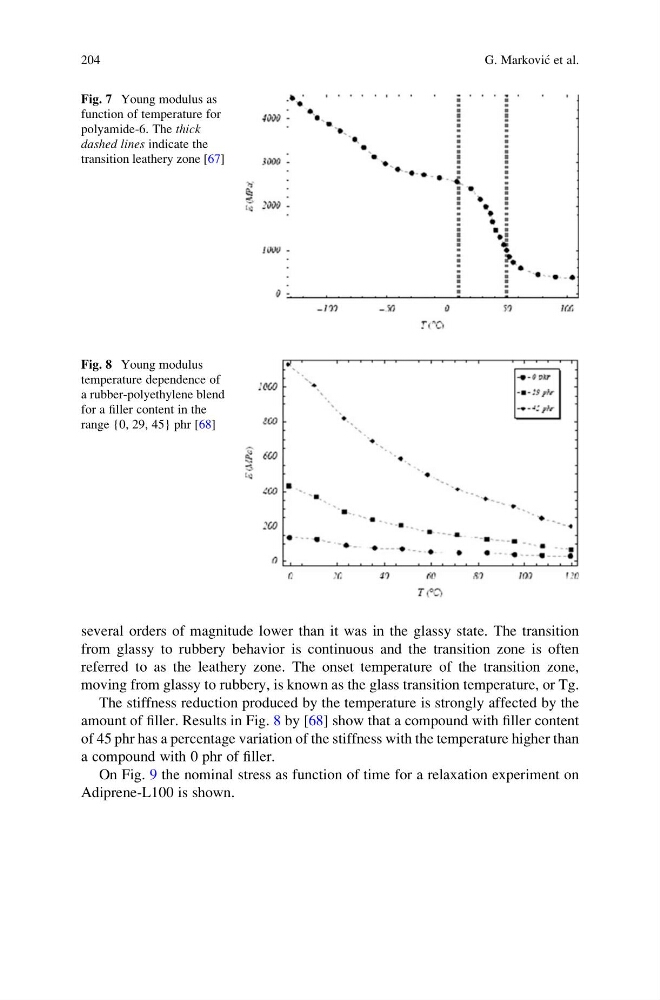
several orders of magnitude lower than it was in the glassy state. The transition
from glassy to rubbery behavior is continuous and the transition zone is often
referred to as the leathery zone. The onset temperature of the transition zone,
moving from glassy to rubbery, is known as the glass transition temperature, or Tg.
The stiffness reduction produced by the temperature is strongly affected by the
amount of filler. Results in Fig. 8 by [68] show that a compound with filler content
of 45 phr has a percentage variation of the stiffness with the temperature higher than
a compound with 0 phr of filler.
On Fig. 9 the nominal stress as function of time for a relaxation experiment on
Adiprene-L100 is shown.
Fig. 7 Young modulus as
function of temperature for
polyamide-6. The thick
dashed lines indicate the
transition leathery zone [67]
Fig. 8 Young modulus
temperature dependence of
a rubber-polyethylene blend
for a filler content in the
range {0, 29, 45} phr [68]
204
G. Markovic ´ et al.
from glassy to rubbery behavior is continuous and the transition zone is often
referred to as the leathery zone. The onset temperature of the transition zone,
moving from glassy to rubbery, is known as the glass transition temperature, or Tg.
The stiffness reduction produced by the temperature is strongly affected by the
amount of filler. Results in Fig. 8 by [68] show that a compound with filler content
of 45 phr has a percentage variation of the stiffness with the temperature higher than
a compound with 0 phr of filler.
On Fig. 9 the nominal stress as function of time for a relaxation experiment on
Adiprene-L100 is shown.
Fig. 7 Young modulus as
function of temperature for
polyamide-6. The thick
dashed lines indicate the
transition leathery zone [67]
Fig. 8 Young modulus
temperature dependence of
a rubber-polyethylene blend
for a filler content in the
range {0, 29, 45} phr [68]
204
G. Markovic ´ et al.