

2.3 Dynamic
The material behavior above-described refers to the quasi-static response. However, elastomers subjected to real world loading conditions possess fluid-like
characteristics typical of a viscoelastic material. When loaded by means of a
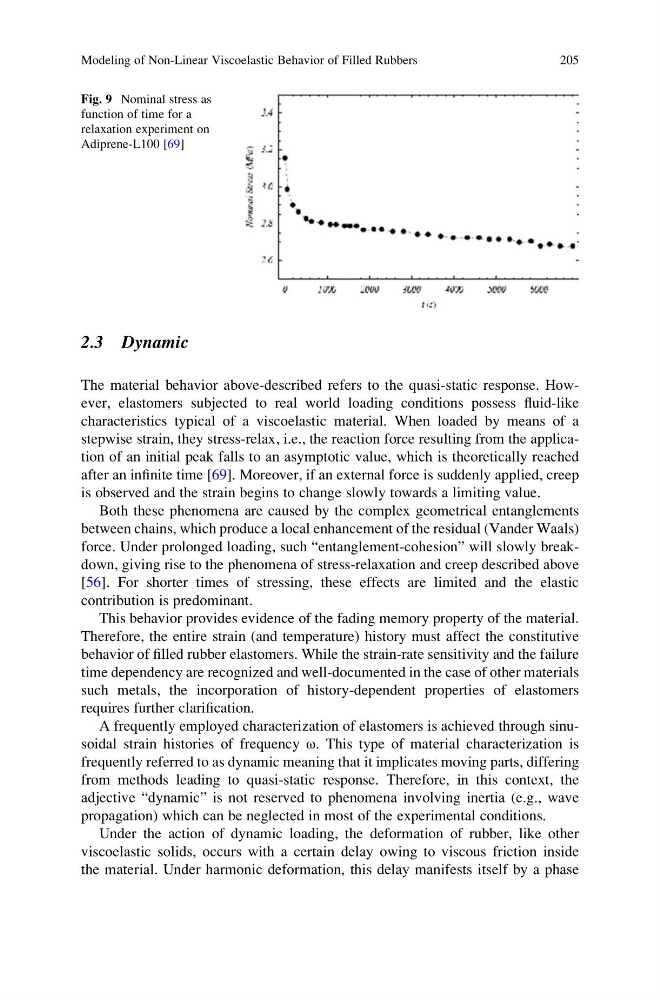
stepwise strain, they stress-relax, i.e., the reaction force resulting from the application of an initial peak falls to an asymptotic value, which is theoretically reached
after an infinite time [69]. Moreover, if an external force is suddenly applied, creep
is observed and the strain begins to change slowly towards a limiting value.
Both these phenomena are caused by the complex geometrical entanglements
between chains, which produce a local enhancement of the residual (Vander Waals)
force. Under prolonged loading, such “entanglement-cohesion” will slowly breakdown, giving rise to the phenomena of stress-relaxation and creep described above
[56]. For shorter times of stressing, these effects are limited and the elastic
contribution is predominant.
This behavior provides evidence of the fading memory property of the material.
Therefore, the entire strain (and temperature) history must affect the constitutive
behavior of filled rubber elastomers. While the strain-rate sensitivity and the failure
time dependency are recognized and well-documented in the case of other materials
such metals, the incorporation of history-dependent properties of elastomers
requires further clarification.
A frequently employed characterization of elastomers is achieved through sinusoidal strain histories of frequency ω. This type of material characterization is
frequently referred to as dynamic meaning that it implicates moving parts, differing
from methods leading to quasi-static response. Therefore, in this context, the
adjective “dynamic” is not reserved to phenomena involving inertia (e.g., wave
propagation) which can be neglected in most of the experimental conditions.
Under the action of dynamic loading, the deformation of rubber, like other
viscoelastic solids, occurs with a certain delay owing to viscous friction inside
the material. Under harmonic deformation, this delay manifests itself by a phase
Fig. 9 Nominal stress as
function of time for a
relaxation experiment on
Adiprene-L100 [69]
Modeling of Non-Linear Viscoelastic Behavior of Filled Rubbers
205
The material behavior above-described refers to the quasi-static response. However, elastomers subjected to real world loading conditions possess fluid-like
characteristics typical of a viscoelastic material. When loaded by means of a
stepwise strain, they stress-relax, i.e., the reaction force resulting from the application of an initial peak falls to an asymptotic value, which is theoretically reached
after an infinite time [69]. Moreover, if an external force is suddenly applied, creep
is observed and the strain begins to change slowly towards a limiting value.
Both these phenomena are caused by the complex geometrical entanglements
between chains, which produce a local enhancement of the residual (Vander Waals)
force. Under prolonged loading, such “entanglement-cohesion” will slowly breakdown, giving rise to the phenomena of stress-relaxation and creep described above
[56]. For shorter times of stressing, these effects are limited and the elastic
contribution is predominant.
This behavior provides evidence of the fading memory property of the material.
Therefore, the entire strain (and temperature) history must affect the constitutive
behavior of filled rubber elastomers. While the strain-rate sensitivity and the failure
time dependency are recognized and well-documented in the case of other materials
such metals, the incorporation of history-dependent properties of elastomers
requires further clarification.
A frequently employed characterization of elastomers is achieved through sinusoidal strain histories of frequency ω. This type of material characterization is
frequently referred to as dynamic meaning that it implicates moving parts, differing
from methods leading to quasi-static response. Therefore, in this context, the
adjective “dynamic” is not reserved to phenomena involving inertia (e.g., wave
propagation) which can be neglected in most of the experimental conditions.
Under the action of dynamic loading, the deformation of rubber, like other
viscoelastic solids, occurs with a certain delay owing to viscous friction inside
the material. Under harmonic deformation, this delay manifests itself by a phase
Fig. 9 Nominal stress as
function of time for a
relaxation experiment on
Adiprene-L100 [69]
Modeling of Non-Linear Viscoelastic Behavior of Filled Rubbers
205