

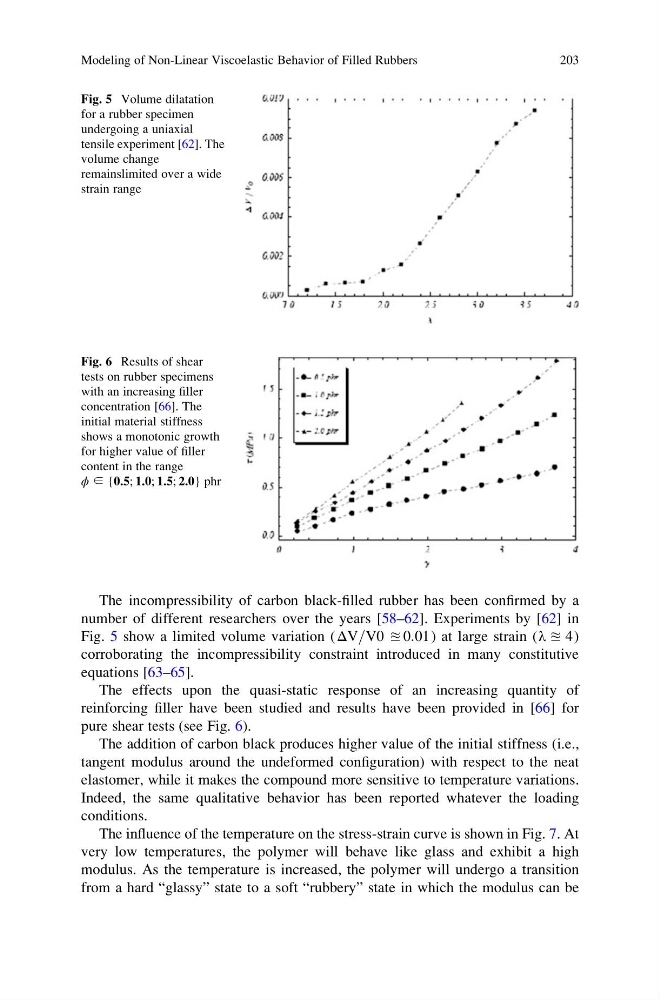
The incompressibility of carbon black-filled rubber has been confirmed by a
number of different researchers over the years [58–62]. Experiments by [62] in
Fig. 5 show a limited volume variation (ΔV=V0 ≊ 0:01) at large strain (λ ≊ 4)
corroborating the incompressibility constraint introduced in many constitutive
equations [63–65].
The effects upon the quasi-static response of an increasing quantity of
reinforcing filler have been studied and results have been provided in [66] for
pure shear tests (see Fig. 6).
The addition of carbon black produces higher value of the initial stiffness (i.e.,
tangent modulus around the undeformed configuration) with respect to the neat
elastomer, while it makes the compound more sensitive to temperature variations.
Indeed, the same qualitative behavior has been reported whatever the loading
conditions.
The influence of the temperature on the stress-strain curve is shown in Fig. 7. At
very low temperatures, the polymer will behave like glass and exhibit a high
modulus. As the temperature is increased, the polymer will undergo a transition
from a hard “glassy” state to a soft “rubbery” state in which the modulus can be
Fig. 5 Volume dilatation
for a rubber specimen
undergoing a uniaxial
tensile experiment [62]. The
volume change
remainslimited over a wide
strain range
Fig. 6 Results of shear
tests on rubber specimens
with an increasing filler
concentration [66]. The
initial material stiffness
shows a monotonic growth
for higher value of filler
content in the range
ϕ ∈ {0.5; 1.0; 1.5; 2.0} phr
Modeling of Non-Linear Viscoelastic Behavior of Filled Rubbers
203
number of different researchers over the years [58–62]. Experiments by [62] in
Fig. 5 show a limited volume variation (ΔV=V0 ≊ 0:01) at large strain (λ ≊ 4)
corroborating the incompressibility constraint introduced in many constitutive
equations [63–65].
The effects upon the quasi-static response of an increasing quantity of
reinforcing filler have been studied and results have been provided in [66] for
pure shear tests (see Fig. 6).
The addition of carbon black produces higher value of the initial stiffness (i.e.,
tangent modulus around the undeformed configuration) with respect to the neat
elastomer, while it makes the compound more sensitive to temperature variations.
Indeed, the same qualitative behavior has been reported whatever the loading
conditions.
The influence of the temperature on the stress-strain curve is shown in Fig. 7. At
very low temperatures, the polymer will behave like glass and exhibit a high
modulus. As the temperature is increased, the polymer will undergo a transition
from a hard “glassy” state to a soft “rubbery” state in which the modulus can be
Fig. 5 Volume dilatation
for a rubber specimen
undergoing a uniaxial
tensile experiment [62]. The
volume change
remainslimited over a wide
strain range
Fig. 6 Results of shear
tests on rubber specimens
with an increasing filler
concentration [66]. The
initial material stiffness
shows a monotonic growth
for higher value of filler
content in the range
ϕ ∈ {0.5; 1.0; 1.5; 2.0} phr
Modeling of Non-Linear Viscoelastic Behavior of Filled Rubbers
203