

2.2 Standard Phenomenology
2.2.1 Quasi-static
The behavior of filled elastomers can be primarily described as hyperelastic: under
static or quasi-static loading dissipative effects are negligible. There have been
numerous experimental studies addressing the response of rubber under quasi-static
loading conditions, including uniaxial tension/compression, shear, equibiaxial tension [53–56].
In all these experimental conditions, the resulting constitutive curves are
strongly nonlinear. However, constitutive nonlinearities coupled with heterogeneous strain field could lead to experimental results which are very difficult to
analyze. Thus, displacement fields leading to homogeneous deformation should be
opted for. A typical example is the equibiaxial (two-dimensional) extension test
which is preferred to the equivalent uniaxial compression, because the difficulties
related to the bulging of the specimen under compressive loading are avoided [56]
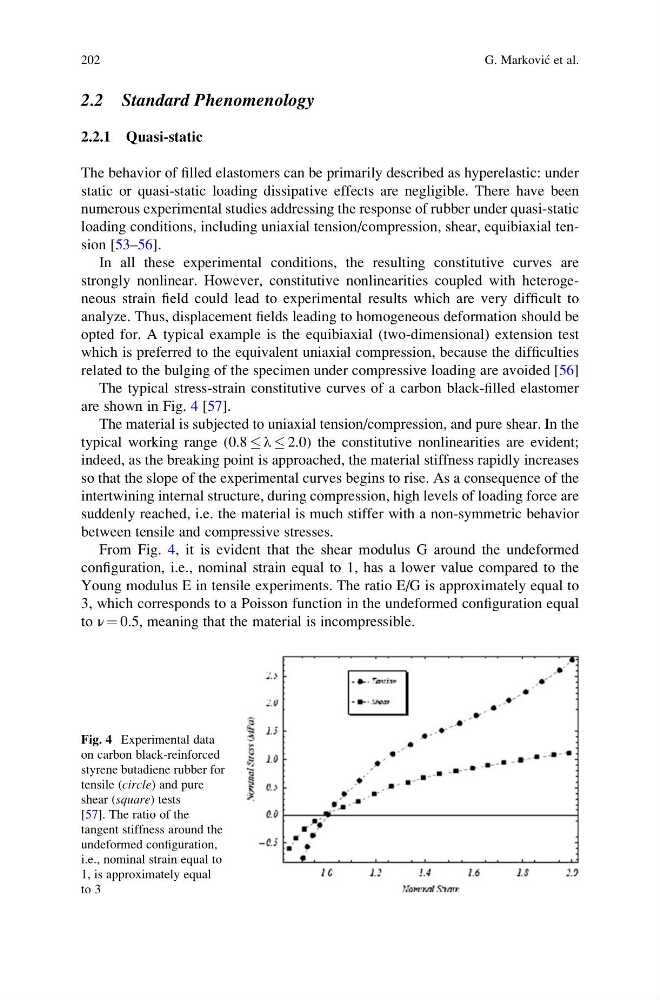
The typical stress-strain constitutive curves of a carbon black-filled elastomer
are shown in Fig. 4 [57].
The material is subjected to uniaxial tension/compression, and pure shear. In the
typical working range (0.8 λ 2.0) the constitutive nonlinearities are evident;
indeed, as the breaking point is approached, the material stiffness rapidly increases
so that the slope of the experimental curves begins to rise. As a consequence of the
intertwining internal structure, during compression, high levels of loading force are
suddenly reached, i.e. the material is much stiffer with a non-symmetric behavior
between tensile and compressive stresses.
From Fig. 4, it is evident that the shear modulus G around the undeformed
configuration, i.e., nominal strain equal to 1, has a lower value compared to the
Young modulus E in tensile experiments. The ratio E/G is approximately equal to
3, which corresponds to a Poisson function in the undeformed configuration equal
to ν ¼ 0.5, meaning that the material is incompressible.
Fig. 4 Experimental data
on carbon black-reinforced
styrene butadiene rubber for
tensile (circle) and pure
shear (square) tests
[57]. The ratio of the
tangent stiffness around the
undeformed configuration,
i.e., nominal strain equal to
1, is approximately equal
to 3
202
G. Markovic ´ et al.
2.2.1 Quasi-static
The behavior of filled elastomers can be primarily described as hyperelastic: under
static or quasi-static loading dissipative effects are negligible. There have been
numerous experimental studies addressing the response of rubber under quasi-static
loading conditions, including uniaxial tension/compression, shear, equibiaxial tension [53–56].
In all these experimental conditions, the resulting constitutive curves are
strongly nonlinear. However, constitutive nonlinearities coupled with heterogeneous strain field could lead to experimental results which are very difficult to
analyze. Thus, displacement fields leading to homogeneous deformation should be
opted for. A typical example is the equibiaxial (two-dimensional) extension test
which is preferred to the equivalent uniaxial compression, because the difficulties
related to the bulging of the specimen under compressive loading are avoided [56]
The typical stress-strain constitutive curves of a carbon black-filled elastomer
are shown in Fig. 4 [57].
The material is subjected to uniaxial tension/compression, and pure shear. In the
typical working range (0.8 λ 2.0) the constitutive nonlinearities are evident;
indeed, as the breaking point is approached, the material stiffness rapidly increases
so that the slope of the experimental curves begins to rise. As a consequence of the
intertwining internal structure, during compression, high levels of loading force are
suddenly reached, i.e. the material is much stiffer with a non-symmetric behavior
between tensile and compressive stresses.
From Fig. 4, it is evident that the shear modulus G around the undeformed
configuration, i.e., nominal strain equal to 1, has a lower value compared to the
Young modulus E in tensile experiments. The ratio E/G is approximately equal to
3, which corresponds to a Poisson function in the undeformed configuration equal
to ν ¼ 0.5, meaning that the material is incompressible.
Fig. 4 Experimental data
on carbon black-reinforced
styrene butadiene rubber for
tensile (circle) and pure
shear (square) tests
[57]. The ratio of the
tangent stiffness around the
undeformed configuration,
i.e., nominal strain equal to
1, is approximately equal
to 3
202
G. Markovic ´ et al.