

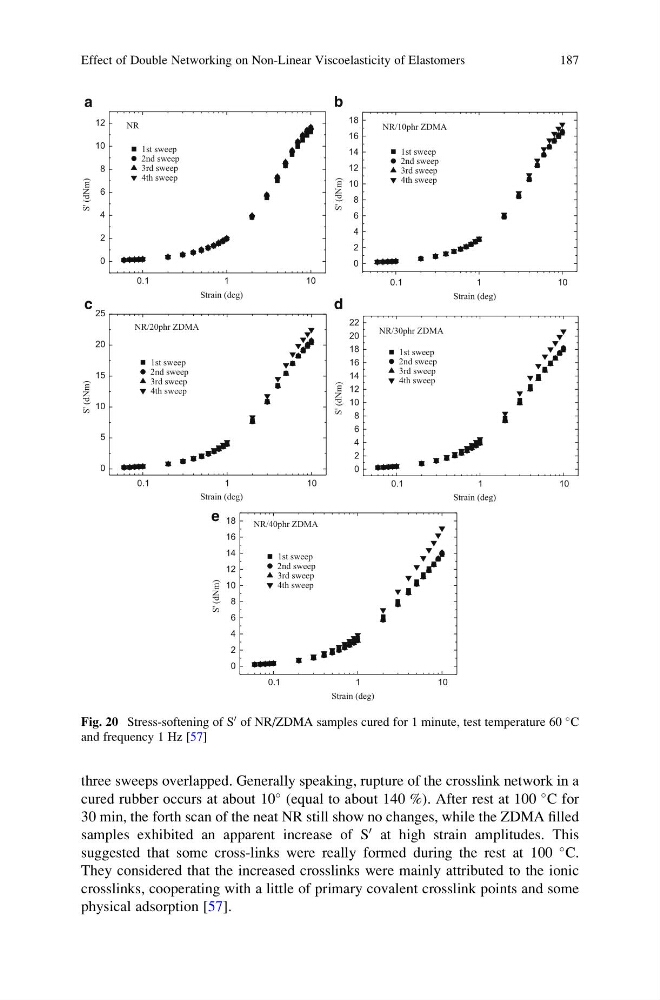
three sweeps overlapped. Generally speaking, rupture of the crosslink network in a
cured rubber occurs at about 10
(equal to about 140 %). After rest at 100
C for
30 min, the forth scan of the neat NR still show no changes, while the ZDMA filled
samples exhibited an apparent increase of S
0 at high strain amplitudes. This
suggested that some cross-links were really formed during the rest at 100
C.
They considered that the increased crosslinks were mainly attributed to the ionic
crosslinks, cooperating with a little of primary covalent crosslink points and some
physical adsorption [57].
0.1
1
10
0
2
4
6
8
10
12
1st sweep
2nd sweep
3rd sweep
4th sweep
NR
S' (dNm)
Strain (deg)
0.1
1
10
0
2
4
6
8
10
12
14
16
18
1st sweep
2nd sweep
3rd sweep
4th sweep
NR/10phr ZDMA
S' (dNm)
Strain (deg)
0.1
1
10
0
5
10
15
20
25
1st sweep
2nd sweep
3rd sweep
4th sweep
NR/20phr ZDMA
S' (dNm)
Strain (deg)
0.1
1
10
0
2
4
6
8
10
12
14
16
18
20
22
1st sweep
2nd sweep
3rd sweep
4th sweep
NR/30phr ZDMA
S' (dNm)
Strain (deg)
0.1
1
10
0
2
4
6
8
10
12
14
16
18
1st sweep
2nd sweep
3rd sweep
4th sweep
NR/40phr ZDMA
S' (dNm)
Strain (deg)
a
b
c
d
e
Fig. 20 Stress-softening of S
0 of NR/ZDMA samples cured for 1 minute, test temperature 60
C
and frequency 1 Hz [57]
Effect of Double Networking on Non-Linear Viscoelasticity of Elastomers
187
cured rubber occurs at about 10
(equal to about 140 %). After rest at 100
C for
30 min, the forth scan of the neat NR still show no changes, while the ZDMA filled
samples exhibited an apparent increase of S
0 at high strain amplitudes. This
suggested that some cross-links were really formed during the rest at 100
C.
They considered that the increased crosslinks were mainly attributed to the ionic
crosslinks, cooperating with a little of primary covalent crosslink points and some
physical adsorption [57].
0.1
1
10
0
2
4
6
8
10
12
1st sweep
2nd sweep
3rd sweep
4th sweep
NR
S' (dNm)
Strain (deg)
0.1
1
10
0
2
4
6
8
10
12
14
16
18
1st sweep
2nd sweep
3rd sweep
4th sweep
NR/10phr ZDMA
S' (dNm)
Strain (deg)
0.1
1
10
0
5
10
15
20
25
1st sweep
2nd sweep
3rd sweep
4th sweep
NR/20phr ZDMA
S' (dNm)
Strain (deg)
0.1
1
10
0
2
4
6
8
10
12
14
16
18
20
22
1st sweep
2nd sweep
3rd sweep
4th sweep
NR/30phr ZDMA
S' (dNm)
Strain (deg)
0.1
1
10
0
2
4
6
8
10
12
14
16
18
1st sweep
2nd sweep
3rd sweep
4th sweep
NR/40phr ZDMA
S' (dNm)
Strain (deg)
a
b
c
d
e
Fig. 20 Stress-softening of S
0 of NR/ZDMA samples cured for 1 minute, test temperature 60
C
and frequency 1 Hz [57]
Effect of Double Networking on Non-Linear Viscoelasticity of Elastomers
187