

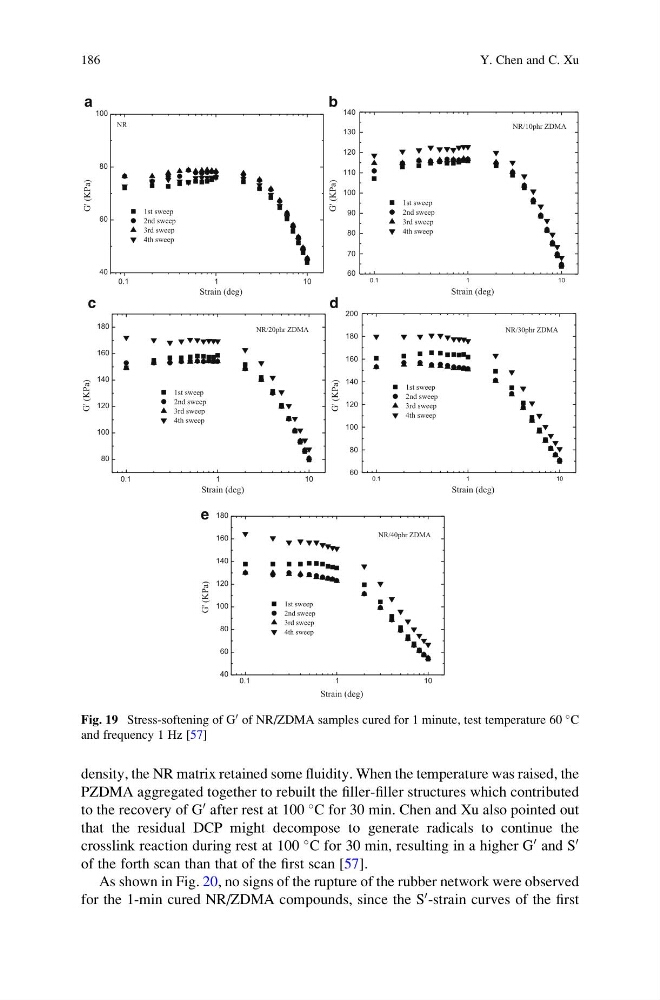
density, the NR matrix retained some fluidity. When the temperature was raised, the
PZDMA aggregated together to rebuilt the filler-filler structures which contributed
to the recovery of G
0 after rest at 100
C for 30 min. Chen and Xu also pointed out
that the residual DCP might decompose to generate radicals to continue the
crosslink reaction during rest at 100
C for 30 min, resulting in a higher G
0 and S
0
of the forth scan than that of the first scan [57].
As shown in Fig. 20, no signs of the rupture of the rubber network were observed
for the 1-min cured NR/ZDMA compounds, since the S
0 -strain curves of the first
0.1
1
10
40
60
80
100
NR
1st sweep
2nd sweep
3rd sweep
4th sweep
G' (KPa)
Strain (deg)
0.1
1
10
60
70
80
90
100
110
120
130
140
1st sweep
2nd sweep
3rd sweep
4th sweep
NR/10phr ZDMA
G' (KPa)
Strain (deg)
0.1
1
10
80
100
120
140
160
180
1st sweep
2nd sweep
3rd sweep
4th sweep
NR/20phr ZDMA
G' (KPa)
Strain (deg)
0.1
1
10
60
80
100
120
140
160
180
200
1st sweep
2nd sweep
3rd sweep
4th sweep
NR/30phr ZDMA
G' (KPa)
Strain (deg)
0.1
1
10
40
60
80
100
120
140
160
180
1st sweep
2nd sweep
3rd sweep
4th sweep
NR/40phr ZDMA
G' (KPa)
Strain (deg)
a
b
c
e
d
Fig. 19 Stress-softening of G
0 of NR/ZDMA samples cured for 1 minute, test temperature 60
C
and frequency 1 Hz [57]
186
Y. Chen and C. Xu
PZDMA aggregated together to rebuilt the filler-filler structures which contributed
to the recovery of G
0 after rest at 100
C for 30 min. Chen and Xu also pointed out
that the residual DCP might decompose to generate radicals to continue the
crosslink reaction during rest at 100
C for 30 min, resulting in a higher G
0 and S
0
of the forth scan than that of the first scan [57].
As shown in Fig. 20, no signs of the rupture of the rubber network were observed
for the 1-min cured NR/ZDMA compounds, since the S
0 -strain curves of the first
0.1
1
10
40
60
80
100
NR
1st sweep
2nd sweep
3rd sweep
4th sweep
G' (KPa)
Strain (deg)
0.1
1
10
60
70
80
90
100
110
120
130
140
1st sweep
2nd sweep
3rd sweep
4th sweep
NR/10phr ZDMA
G' (KPa)
Strain (deg)
0.1
1
10
80
100
120
140
160
180
1st sweep
2nd sweep
3rd sweep
4th sweep
NR/20phr ZDMA
G' (KPa)
Strain (deg)
0.1
1
10
60
80
100
120
140
160
180
200
1st sweep
2nd sweep
3rd sweep
4th sweep
NR/30phr ZDMA
G' (KPa)
Strain (deg)
0.1
1
10
40
60
80
100
120
140
160
180
1st sweep
2nd sweep
3rd sweep
4th sweep
NR/40phr ZDMA
G' (KPa)
Strain (deg)
a
b
c
e
d
Fig. 19 Stress-softening of G
0 of NR/ZDMA samples cured for 1 minute, test temperature 60
C
and frequency 1 Hz [57]
186
Y. Chen and C. Xu