

PZDMA. Because of the large numbers of ion pairs in PZDMA molecules and the
strong electrostatic interaction between ion pairs, aggregates consisting of several
pairs called “multiplets” could be formed, restricting the mobility of adjacent
polymer chains [47]. Moreover, the PZDMA also can form a filler network,
which is similar to a black carbon network. Thus, a considerable PZDMA and
cross-links of NR form a relatively developed “primary network” (containing
covalent crosslink points, ionic cross-links, physical adsorption and filler-filler
joints). As a result, the fact that the 1 min-cured sample with 20 phr ZDMA show
the highest G
0 and S
0 is a result of the developed “primary network”.
Generally speaking, G
0 shows a rapid decrease at a high strain about 100–200 %,
which is mainly contributed by the rubber matrix. In this high strain amplitudes
region, the filler-filler networks have been destroyed completely and rubber is
stretched to deform. In Chen’s study, the G
0 curves of 10 phr and 20 phr are very
close, whereas the 40 phr and pure NR are very close. This reflects that the higher
density of cross-links formed in the samples with 10 phr and 20 phr ZDMA than in
neat NR and sample with 40 phr ZDMA.
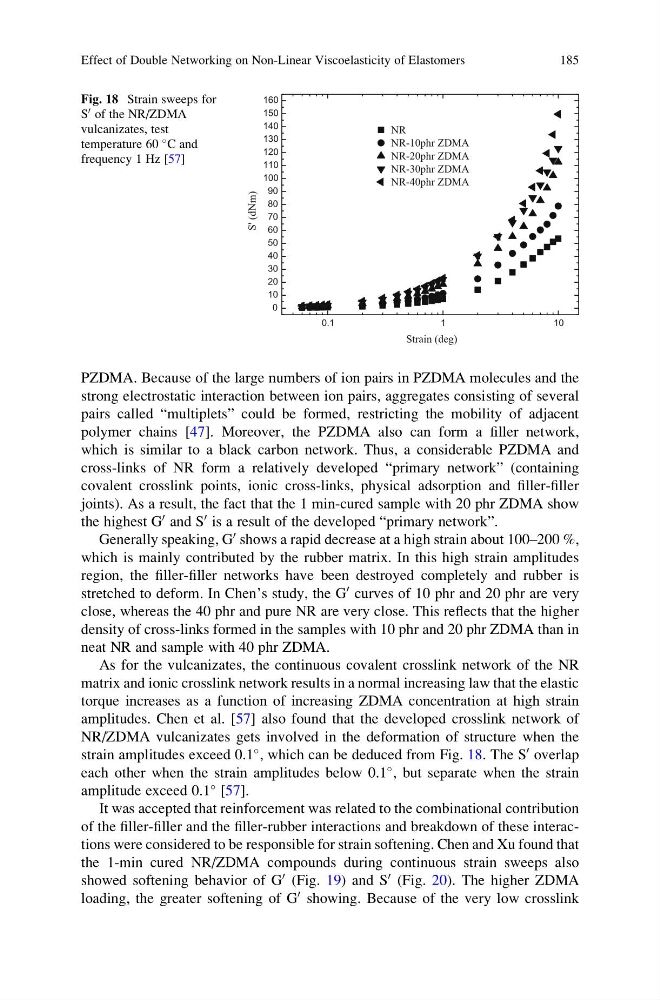
As for the vulcanizates, the continuous covalent crosslink network of the NR
matrix and ionic crosslink network results in a normal increasing law that the elastic
torque increases as a function of increasing ZDMA concentration at high strain
amplitudes. Chen et al. [57] also found that the developed crosslink network of
NR/ZDMA vulcanizates gets involved in the deformation of structure when the
strain amplitudes exceed 0.1
, which can be deduced from Fig. 18. The S
0 overlap
each other when the strain amplitudes below 0.1
, but separate when the strain
amplitude exceed 0.1
[57].
It was accepted that reinforcement was related to the combinational contribution
of the filler-filler and the filler-rubber interactions and breakdown of these interactions were considered to be responsible for strain softening. Chen and Xu found that
the 1-min cured NR/ZDMA compounds during continuous strain sweeps also
showed softening behavior of G
0 (Fig. 19) and S
0 (Fig. 20). The higher ZDMA
loading, the greater softening of G
0 showing. Because of the very low crosslink
0.1
1
10
0
10
20
30
40
50
60
70
80
90
100
110
120
130
140
150
160
NR
NR-10phr ZDMA
NR-20phr ZDMA
NR-30phr ZDMA
NR-40phr ZDMA
S' (dNm)
Strain (deg)
Fig. 18 Strain sweeps for
S
0 of the NR/ZDMA
vulcanizates, test
temperature 60
C and
frequency 1 Hz [57]
Effect of Double Networking on Non-Linear Viscoelasticity of Elastomers
185
strong electrostatic interaction between ion pairs, aggregates consisting of several
pairs called “multiplets” could be formed, restricting the mobility of adjacent
polymer chains [47]. Moreover, the PZDMA also can form a filler network,
which is similar to a black carbon network. Thus, a considerable PZDMA and
cross-links of NR form a relatively developed “primary network” (containing
covalent crosslink points, ionic cross-links, physical adsorption and filler-filler
joints). As a result, the fact that the 1 min-cured sample with 20 phr ZDMA show
the highest G
0 and S
0 is a result of the developed “primary network”.
Generally speaking, G
0 shows a rapid decrease at a high strain about 100–200 %,
which is mainly contributed by the rubber matrix. In this high strain amplitudes
region, the filler-filler networks have been destroyed completely and rubber is
stretched to deform. In Chen’s study, the G
0 curves of 10 phr and 20 phr are very
close, whereas the 40 phr and pure NR are very close. This reflects that the higher
density of cross-links formed in the samples with 10 phr and 20 phr ZDMA than in
neat NR and sample with 40 phr ZDMA.
As for the vulcanizates, the continuous covalent crosslink network of the NR
matrix and ionic crosslink network results in a normal increasing law that the elastic
torque increases as a function of increasing ZDMA concentration at high strain
amplitudes. Chen et al. [57] also found that the developed crosslink network of
NR/ZDMA vulcanizates gets involved in the deformation of structure when the
strain amplitudes exceed 0.1
, which can be deduced from Fig. 18. The S
0 overlap
each other when the strain amplitudes below 0.1
, but separate when the strain
amplitude exceed 0.1
[57].
It was accepted that reinforcement was related to the combinational contribution
of the filler-filler and the filler-rubber interactions and breakdown of these interactions were considered to be responsible for strain softening. Chen and Xu found that
the 1-min cured NR/ZDMA compounds during continuous strain sweeps also
showed softening behavior of G
0 (Fig. 19) and S
0 (Fig. 20). The higher ZDMA
loading, the greater softening of G
0 showing. Because of the very low crosslink
0.1
1
10
0
10
20
30
40
50
60
70
80
90
100
110
120
130
140
150
160
NR
NR-10phr ZDMA
NR-20phr ZDMA
NR-30phr ZDMA
NR-40phr ZDMA
S' (dNm)
Strain (deg)
Fig. 18 Strain sweeps for
S
0 of the NR/ZDMA
vulcanizates, test
temperature 60
C and
frequency 1 Hz [57]
Effect of Double Networking on Non-Linear Viscoelasticity of Elastomers
185