

the G
0 of a black carbon filled rubber vulcanizate [63] generally shows a notable
drop in the region from about 0.1
to 1
which is equal to about 1.4 % to 14 %.
Generally speaking, the rupture of rubber covalent crosslink could not take place
at this strain. Therefore, the “LVE region”, observed in the region from about 0.1
to 1
, is related to the action of the ionic bonds. However, it is difficult to
distinguish the filler network effect and ionic bonds effect, thus they summarized
the two types network deformation together.
2. The rubber network deformed when the strain amplitudes exceeded about 1
. G
0
decreased to a low level which was mainly contributed by rubber matrix at this
time. G
00 and elastic torque (S
0 ) showing an abrupt increase at the high strain
amplitudes was associate with the rubber network deformation. The second loss
peak locating in this region was mainly attributed to the complex results in
combination of ionic crosslinks and rubber covalent network.
5.4 The Non-Linear Viscoelasticity of the NR/ZDMA
Composites at the Initial Stage of Curing
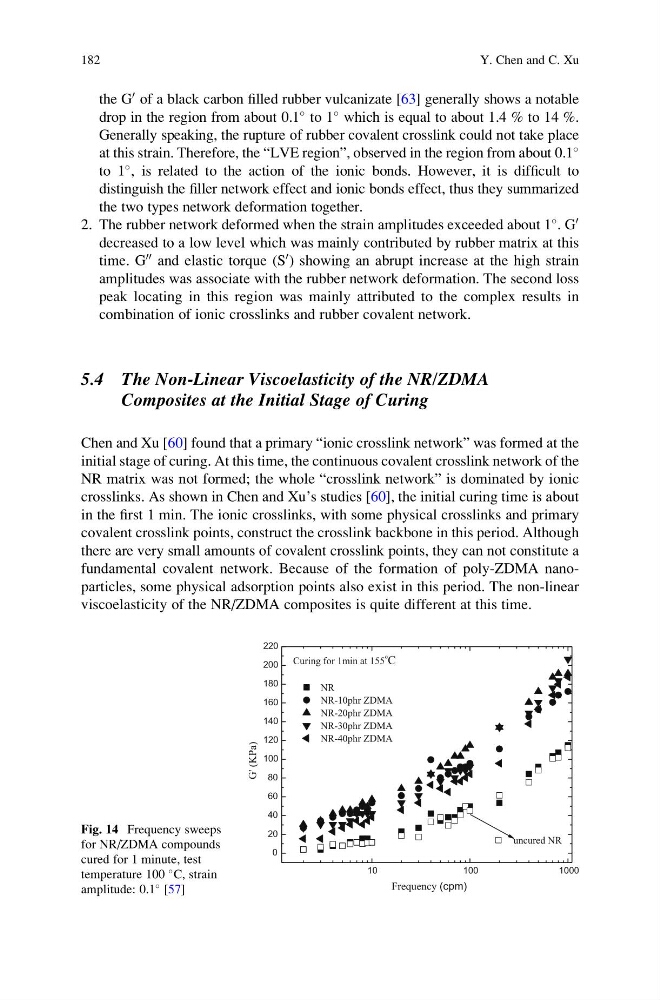
Chen and Xu [60] found that a primary “ionic crosslink network” was formed at the
initial stage of curing. At this time, the continuous covalent crosslink network of the
NR matrix was not formed; the whole “crosslink network” is dominated by ionic
crosslinks. As shown in Chen and Xu’s studies [60], the initial curing time is about
in the first 1 min. The ionic crosslinks, with some physical crosslinks and primary
covalent crosslink points, construct the crosslink backbone in this period. Although
there are very small amounts of covalent crosslink points, they can not constitute a
fundamental covalent network. Because of the formation of poly-ZDMA nanoparticles, some physical adsorption points also exist in this period. The non-linear
viscoelasticity of the NR/ZDMA composites is quite different at this time.
10
100
1000
0
40
20
60
80
100
120
140
160
180
200
220
uncured NR
NR
NR-10phr ZDMA
NR-20phr ZDMA
NR-30phr ZDMA
NR-40phr ZDMA
Curing for 1min at 155
o C
G' (KPa)
Frequency (cpm)
Fig. 14 Frequency sweeps
for NR/ZDMA compounds
cured for 1 minute, test
temperature 100
C, strain
amplitude: 0.1
[57]
182
Y. Chen and C. Xu
0 of a black carbon filled rubber vulcanizate [63] generally shows a notable
drop in the region from about 0.1
to 1
which is equal to about 1.4 % to 14 %.
Generally speaking, the rupture of rubber covalent crosslink could not take place
at this strain. Therefore, the “LVE region”, observed in the region from about 0.1
to 1
, is related to the action of the ionic bonds. However, it is difficult to
distinguish the filler network effect and ionic bonds effect, thus they summarized
the two types network deformation together.
2. The rubber network deformed when the strain amplitudes exceeded about 1
. G
0
decreased to a low level which was mainly contributed by rubber matrix at this
time. G
00 and elastic torque (S
0 ) showing an abrupt increase at the high strain
amplitudes was associate with the rubber network deformation. The second loss
peak locating in this region was mainly attributed to the complex results in
combination of ionic crosslinks and rubber covalent network.
5.4 The Non-Linear Viscoelasticity of the NR/ZDMA
Composites at the Initial Stage of Curing
Chen and Xu [60] found that a primary “ionic crosslink network” was formed at the
initial stage of curing. At this time, the continuous covalent crosslink network of the
NR matrix was not formed; the whole “crosslink network” is dominated by ionic
crosslinks. As shown in Chen and Xu’s studies [60], the initial curing time is about
in the first 1 min. The ionic crosslinks, with some physical crosslinks and primary
covalent crosslink points, construct the crosslink backbone in this period. Although
there are very small amounts of covalent crosslink points, they can not constitute a
fundamental covalent network. Because of the formation of poly-ZDMA nanoparticles, some physical adsorption points also exist in this period. The non-linear
viscoelasticity of the NR/ZDMA composites is quite different at this time.
10
100
1000
0
40
20
60
80
100
120
140
160
180
200
220
uncured NR
NR
NR-10phr ZDMA
NR-20phr ZDMA
NR-30phr ZDMA
NR-40phr ZDMA
Curing for 1min at 155
o C
G' (KPa)
Frequency (cpm)
Fig. 14 Frequency sweeps
for NR/ZDMA compounds
cured for 1 minute, test
temperature 100
C, strain
amplitude: 0.1
[57]
182
Y. Chen and C. Xu