

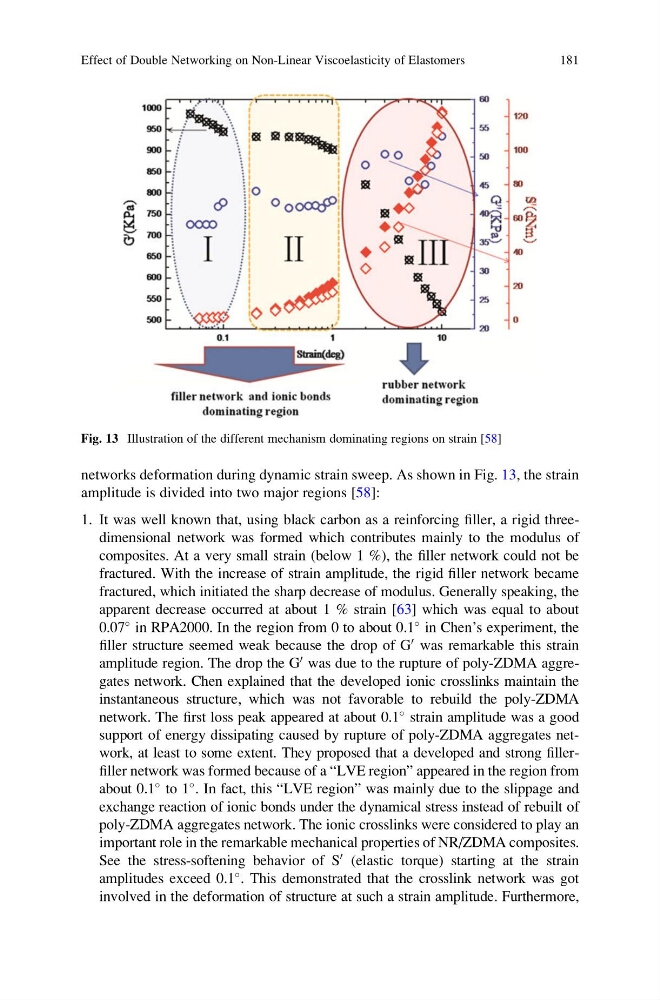
networks deformation during dynamic strain sweep. As shown in Fig. 13, the strain
amplitude is divided into two major regions [58]:
1. It was well known that, using black carbon as a reinforcing filler, a rigid threedimensional network was formed which contributes mainly to the modulus of
composites. At a very small strain (below 1 %), the filler network could not be
fractured. With the increase of strain amplitude, the rigid filler network became
fractured, which initiated the sharp decrease of modulus. Generally speaking, the
apparent decrease occurred at about 1 % strain [63] which was equal to about
0.07
in RPA2000. In the region from 0 to about 0.1
in Chen’s experiment, the
filler structure seemed weak because the drop of G
0 was remarkable this strain
amplitude region. The drop the G
0 was due to the rupture of poly-ZDMA aggregates network. Chen explained that the developed ionic crosslinks maintain the
instantaneous structure, which was not favorable to rebuild the poly-ZDMA
network. The first loss peak appeared at about 0.1
strain amplitude was a good
support of energy dissipating caused by rupture of poly-ZDMA aggregates network, at least to some extent. They proposed that a developed and strong fillerfiller network was formed because of a “LVE region” appeared in the region from
about 0.1
to 1
. In fact, this “LVE region” was mainly due to the slippage and
exchange reaction of ionic bonds under the dynamical stress instead of rebuilt of
poly-ZDMA aggregates network. The ionic crosslinks were considered to play an
important role in the remarkable mechanical properties of NR/ZDMA composites.
See the stress-softening behavior of S
0 (elastic torque) starting at the strain
amplitudes exceed 0.1
. This demonstrated that the crosslink network was got
involved in the deformation of structure at such a strain amplitude. Furthermore,
Fig. 13 Illustration of the different mechanism dominating regions on strain [58]
Effect of Double Networking on Non-Linear Viscoelasticity of Elastomers
181
amplitude is divided into two major regions [58]:
1. It was well known that, using black carbon as a reinforcing filler, a rigid threedimensional network was formed which contributes mainly to the modulus of
composites. At a very small strain (below 1 %), the filler network could not be
fractured. With the increase of strain amplitude, the rigid filler network became
fractured, which initiated the sharp decrease of modulus. Generally speaking, the
apparent decrease occurred at about 1 % strain [63] which was equal to about
0.07
in RPA2000. In the region from 0 to about 0.1
in Chen’s experiment, the
filler structure seemed weak because the drop of G
0 was remarkable this strain
amplitude region. The drop the G
0 was due to the rupture of poly-ZDMA aggregates network. Chen explained that the developed ionic crosslinks maintain the
instantaneous structure, which was not favorable to rebuild the poly-ZDMA
network. The first loss peak appeared at about 0.1
strain amplitude was a good
support of energy dissipating caused by rupture of poly-ZDMA aggregates network, at least to some extent. They proposed that a developed and strong fillerfiller network was formed because of a “LVE region” appeared in the region from
about 0.1
to 1
. In fact, this “LVE region” was mainly due to the slippage and
exchange reaction of ionic bonds under the dynamical stress instead of rebuilt of
poly-ZDMA aggregates network. The ionic crosslinks were considered to play an
important role in the remarkable mechanical properties of NR/ZDMA composites.
See the stress-softening behavior of S
0 (elastic torque) starting at the strain
amplitudes exceed 0.1
. This demonstrated that the crosslink network was got
involved in the deformation of structure at such a strain amplitude. Furthermore,
Fig. 13 Illustration of the different mechanism dominating regions on strain [58]
Effect of Double Networking on Non-Linear Viscoelasticity of Elastomers
181