

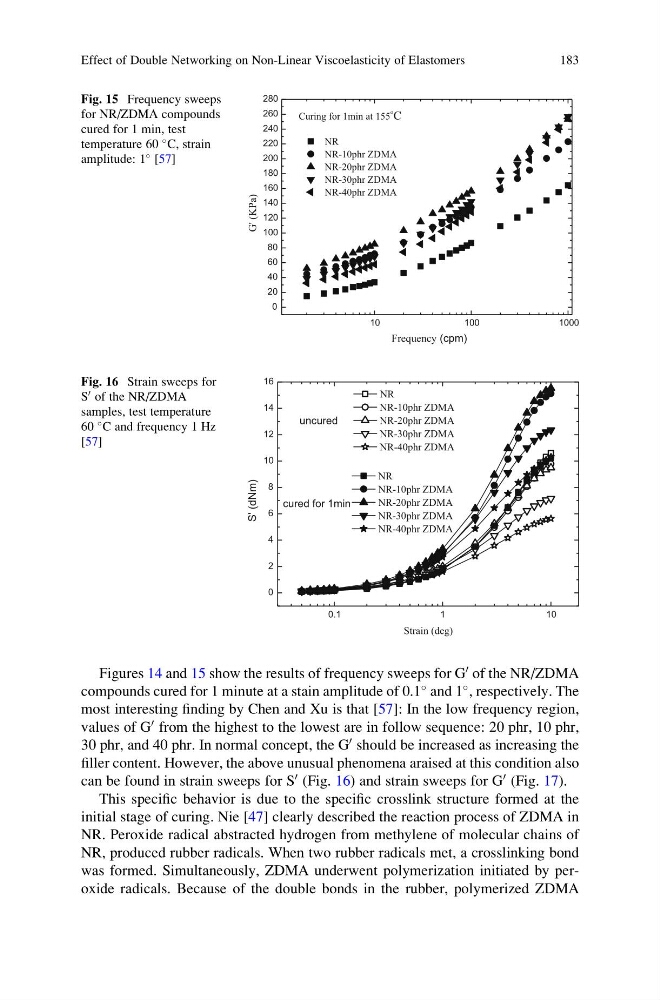
Figures 14 and 15 show the results of frequency sweeps for G
0 of the NR/ZDMA
compounds cured for 1 minute at a stain amplitude of 0.1
and 1
, respectively. The
most interesting finding by Chen and Xu is that [57]: In the low frequency region,
values of G
0 from the highest to the lowest are in follow sequence: 20 phr, 10 phr,
30 phr, and 40 phr. In normal concept, the G
0 should be increased as increasing the
filler content. However, the above unusual phenomena araised at this condition also
can be found in strain sweeps for S
0 (Fig. 16) and strain sweeps for G
0 (Fig. 17).
This specific behavior is due to the specific crosslink structure formed at the
initial stage of curing. Nie [47] clearly described the reaction process of ZDMA in
NR. Peroxide radical abstracted hydrogen from methylene of molecular chains of
NR, produced rubber radicals. When two rubber radicals met, a crosslinking bond
was formed. Simultaneously, ZDMA underwent polymerization initiated by peroxide radicals. Because of the double bonds in the rubber, polymerized ZDMA
10
100
1000
0
20
40
60
80
100
120
140
160
180
200
220
240
260
280
NR
NR-10phr ZDMA
NR-20phr ZDMA
NR-30phr ZDMA
NR-40phr ZDMA
Curing for 1min at 155
o C
G' (KPa)
Frequency (cpm)
Fig. 15 Frequency sweeps
for NR/ZDMA compounds
cured for 1 min, test
temperature 60
C, strain
amplitude: 1
[57]
0.1
1
10
0
2
4
6
8
10
12
14
16
cured for 1min
NR
NR-10phr ZDMA
NR-20phr ZDMA
NR-30phr ZDMA
NR-40phr ZDMA
NR
NR-10phr ZDMA
NR-20phr ZDMA
NR-30phr ZDMA
NR-40phr ZDMA
S' (dNm)
Strain (deg)
uncured
Fig. 16 Strain sweeps for
S
0 of the NR/ZDMA
samples, test temperature
60
C and frequency 1 Hz
[57]
Effect of Double Networking on Non-Linear Viscoelasticity of Elastomers
183
0 of the NR/ZDMA
compounds cured for 1 minute at a stain amplitude of 0.1
and 1
, respectively. The
most interesting finding by Chen and Xu is that [57]: In the low frequency region,
values of G
0 from the highest to the lowest are in follow sequence: 20 phr, 10 phr,
30 phr, and 40 phr. In normal concept, the G
0 should be increased as increasing the
filler content. However, the above unusual phenomena araised at this condition also
can be found in strain sweeps for S
0 (Fig. 16) and strain sweeps for G
0 (Fig. 17).
This specific behavior is due to the specific crosslink structure formed at the
initial stage of curing. Nie [47] clearly described the reaction process of ZDMA in
NR. Peroxide radical abstracted hydrogen from methylene of molecular chains of
NR, produced rubber radicals. When two rubber radicals met, a crosslinking bond
was formed. Simultaneously, ZDMA underwent polymerization initiated by peroxide radicals. Because of the double bonds in the rubber, polymerized ZDMA
10
100
1000
0
20
40
60
80
100
120
140
160
180
200
220
240
260
280
NR
NR-10phr ZDMA
NR-20phr ZDMA
NR-30phr ZDMA
NR-40phr ZDMA
Curing for 1min at 155
o C
G' (KPa)
Frequency (cpm)
Fig. 15 Frequency sweeps
for NR/ZDMA compounds
cured for 1 min, test
temperature 60
C, strain
amplitude: 1
[57]
0.1
1
10
0
2
4
6
8
10
12
14
16
cured for 1min
NR
NR-10phr ZDMA
NR-20phr ZDMA
NR-30phr ZDMA
NR-40phr ZDMA
NR
NR-10phr ZDMA
NR-20phr ZDMA
NR-30phr ZDMA
NR-40phr ZDMA
S' (dNm)
Strain (deg)
uncured
Fig. 16 Strain sweeps for
S
0 of the NR/ZDMA
samples, test temperature
60
C and frequency 1 Hz
[57]
Effect of Double Networking on Non-Linear Viscoelasticity of Elastomers
183