

5.2 Viscoelasticity of NR/ZDMA Vulcanizate
The non-linear viscoelasticity of NR/ZDMA vulcanizate is quite different from that
of uncured compound. During the vulcanization, the polymerization of ZDMA
leads to an increase molecular weight of poly-ZDMA. When the molecular weight
of poly-ZDMA exceeds the critical value, the poly-ZDMA chains separate from the
NR matrix and aggregate to nano-scaled particles, leading to a pronounced Payne
effect. At the same time, the ionic crosslinks introduced by poly-ZDMA function as
“soft interaction” between particles-rubber molecules, resulting a complex
crosslink structure. In the present of ionic crosslinks, the NR/ZDMA vulcanizates
shows a different mechanism of the Payne effect.
The crosslink density of the metal salts of unsaturated carboxylic acids
reinforced rubbers is usually determined by equilibrium swelling experiments. To
distinguish ionic crosslinks from covalent crosslinks, vulcanizate is first swollen in
toluene to determine the total crosslink density V r . Then, the swollen sample is
transferred into a mixture of toluene/chloroacetic acid or acetone/hydrochloric acid
to cut off the ionic crosslinks. Finally, covalent crosslink density V r1 can be
calculated. Thus V r2 , which is calculated by subtracting V r1 from V r , is used to
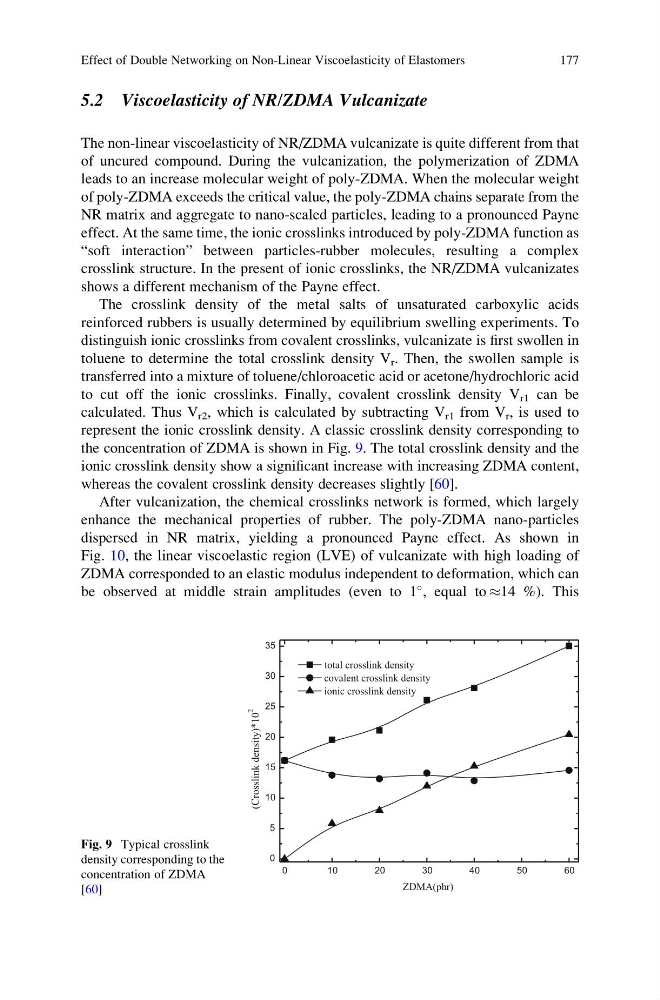
represent the ionic crosslink density. A classic crosslink density corresponding to
the concentration of ZDMA is shown in Fig. 9. The total crosslink density and the
ionic crosslink density show a significant increase with increasing ZDMA content,
whereas the covalent crosslink density decreases slightly [60].
After vulcanization, the chemical crosslinks network is formed, which largely
enhance the mechanical properties of rubber. The poly-ZDMA nano-particles
dispersed in NR matrix, yielding a pronounced Payne effect. As shown in
Fig. 10, the linear viscoelastic region (LVE) of vulcanizate with high loading of
ZDMA corresponded to an elastic modulus independent to deformation, which can
be observed at middle strain amplitudes (even to 1
, equal to %14 %). This
0
1 0
2 0
3 0
4 0
5 0
6 0
0
5
10
15
20
25
30
35
total crosslink density
covalent crosslink density
ionic crosslink density
(Crosslink density)*10
2
ZDMA(phr)
Fig. 9 Typical crosslink
density corresponding to the
concentration of ZDMA
[60]
Effect of Double Networking on Non-Linear Viscoelasticity of Elastomers
177
The non-linear viscoelasticity of NR/ZDMA vulcanizate is quite different from that
of uncured compound. During the vulcanization, the polymerization of ZDMA
leads to an increase molecular weight of poly-ZDMA. When the molecular weight
of poly-ZDMA exceeds the critical value, the poly-ZDMA chains separate from the
NR matrix and aggregate to nano-scaled particles, leading to a pronounced Payne
effect. At the same time, the ionic crosslinks introduced by poly-ZDMA function as
“soft interaction” between particles-rubber molecules, resulting a complex
crosslink structure. In the present of ionic crosslinks, the NR/ZDMA vulcanizates
shows a different mechanism of the Payne effect.
The crosslink density of the metal salts of unsaturated carboxylic acids
reinforced rubbers is usually determined by equilibrium swelling experiments. To
distinguish ionic crosslinks from covalent crosslinks, vulcanizate is first swollen in
toluene to determine the total crosslink density V r . Then, the swollen sample is
transferred into a mixture of toluene/chloroacetic acid or acetone/hydrochloric acid
to cut off the ionic crosslinks. Finally, covalent crosslink density V r1 can be
calculated. Thus V r2 , which is calculated by subtracting V r1 from V r , is used to
represent the ionic crosslink density. A classic crosslink density corresponding to
the concentration of ZDMA is shown in Fig. 9. The total crosslink density and the
ionic crosslink density show a significant increase with increasing ZDMA content,
whereas the covalent crosslink density decreases slightly [60].
After vulcanization, the chemical crosslinks network is formed, which largely
enhance the mechanical properties of rubber. The poly-ZDMA nano-particles
dispersed in NR matrix, yielding a pronounced Payne effect. As shown in
Fig. 10, the linear viscoelastic region (LVE) of vulcanizate with high loading of
ZDMA corresponded to an elastic modulus independent to deformation, which can
be observed at middle strain amplitudes (even to 1
, equal to %14 %). This
0
1 0
2 0
3 0
4 0
5 0
6 0
0
5
10
15
20
25
30
35
total crosslink density
covalent crosslink density
ionic crosslink density
(Crosslink density)*10
2
ZDMA(phr)
Fig. 9 Typical crosslink
density corresponding to the
concentration of ZDMA
[60]
Effect of Double Networking on Non-Linear Viscoelasticity of Elastomers
177