

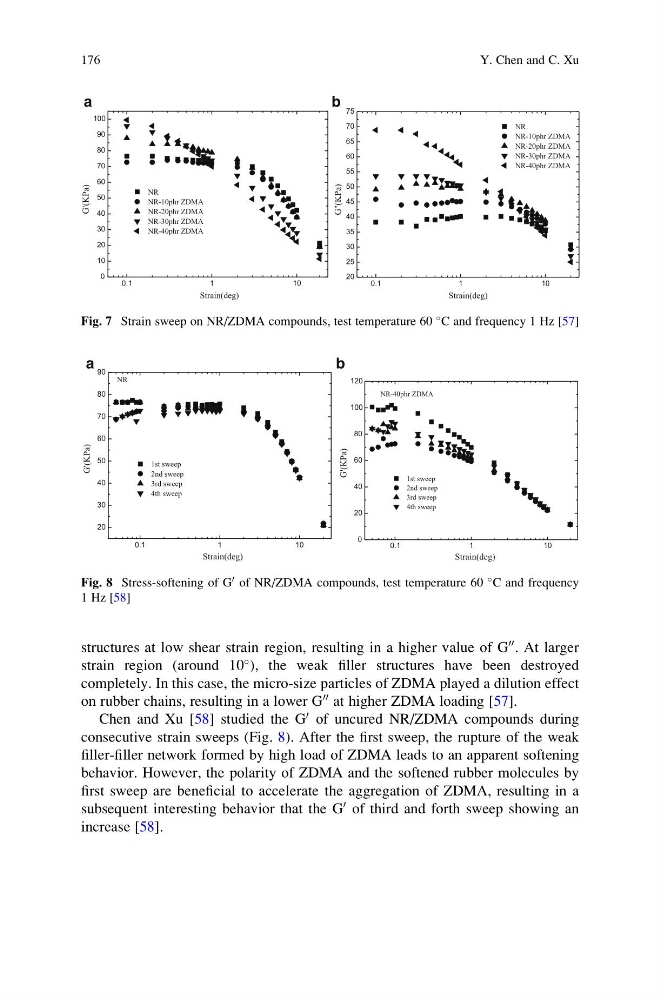
structures at low shear strain region, resulting in a higher value of G
00 . At larger
strain region (around 10
), the weak filler structures have been destroyed
completely. In this case, the micro-size particles of ZDMA played a dilution effect
on rubber chains, resulting in a lower G
00 at higher ZDMA loading [57].
Chen and Xu [58] studied the G
0 of uncured NR/ZDMA compounds during
consecutive strain sweeps (Fig. 8). After the first sweep, the rupture of the weak
filler-filler network formed by high load of ZDMA leads to an apparent softening
behavior. However, the polarity of ZDMA and the softened rubber molecules by
first sweep are beneficial to accelerate the aggregation of ZDMA, resulting in a
subsequent interesting behavior that the G
0 of third and forth sweep showing an
increase [58].
0.1
1
10
0
10
20
30
40
50
60
70
80
90
100
a
NR
NR-10phr ZDMA
NR-20phr ZDMA
NR-30phr ZDMA
NR-40phr ZDMA
G'(KPa)
Strain(deg)
0.1
1
10
20
25
30
35
40
45
50
55
60
65
70
75
b
NR
NR-10phr ZDMA
NR-20phr ZDMA
NR-30phr ZDMA
NR-40phr ZDMA
G''(KPa)
Strain(deg)
Fig. 7 Strain sweep on NR/ZDMA compounds, test temperature 60
C and frequency 1 Hz [57]
0.1
1
10
20
30
40
50
60
70
80
90
1st sweep
2nd sweep
3rd sweep
4th sweep
G'(KPa)
Strain(deg)
NR
0.1
1
10
0
20
40
60
80
100
120
1st sweep
2nd sweep
3rd sweep
4th sweep
NR-40phr ZDMA
G'(KPa)
Strain(deg)
a
b
Fig. 8 Stress-softening of G
0 of NR/ZDMA compounds, test temperature 60
C and frequency
1 Hz [58]
176
Y. Chen and C. Xu
00 . At larger
strain region (around 10
), the weak filler structures have been destroyed
completely. In this case, the micro-size particles of ZDMA played a dilution effect
on rubber chains, resulting in a lower G
00 at higher ZDMA loading [57].
Chen and Xu [58] studied the G
0 of uncured NR/ZDMA compounds during
consecutive strain sweeps (Fig. 8). After the first sweep, the rupture of the weak
filler-filler network formed by high load of ZDMA leads to an apparent softening
behavior. However, the polarity of ZDMA and the softened rubber molecules by
first sweep are beneficial to accelerate the aggregation of ZDMA, resulting in a
subsequent interesting behavior that the G
0 of third and forth sweep showing an
increase [58].
0.1
1
10
0
10
20
30
40
50
60
70
80
90
100
a
NR
NR-10phr ZDMA
NR-20phr ZDMA
NR-30phr ZDMA
NR-40phr ZDMA
G'(KPa)
Strain(deg)
0.1
1
10
20
25
30
35
40
45
50
55
60
65
70
75
b
NR
NR-10phr ZDMA
NR-20phr ZDMA
NR-30phr ZDMA
NR-40phr ZDMA
G''(KPa)
Strain(deg)
Fig. 7 Strain sweep on NR/ZDMA compounds, test temperature 60
C and frequency 1 Hz [57]
0.1
1
10
20
30
40
50
60
70
80
90
1st sweep
2nd sweep
3rd sweep
4th sweep
G'(KPa)
Strain(deg)
NR
0.1
1
10
0
20
40
60
80
100
120
1st sweep
2nd sweep
3rd sweep
4th sweep
NR-40phr ZDMA
G'(KPa)
Strain(deg)
a
b
Fig. 8 Stress-softening of G
0 of NR/ZDMA compounds, test temperature 60
C and frequency
1 Hz [58]
176
Y. Chen and C. Xu