

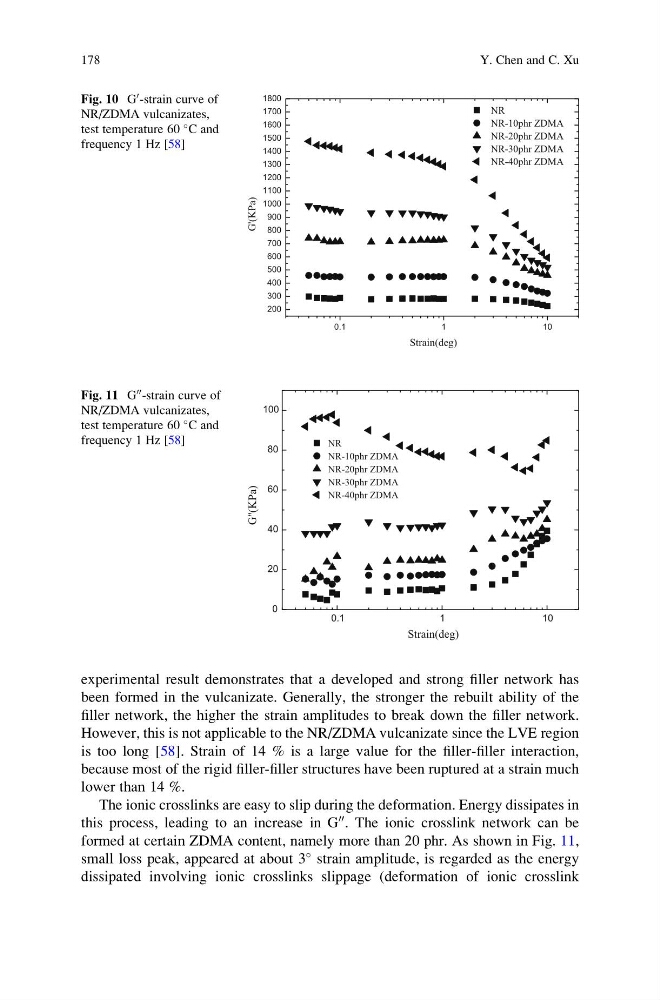
experimental result demonstrates that a developed and strong filler network has
been formed in the vulcanizate. Generally, the stronger the rebuilt ability of the
filler network, the higher the strain amplitudes to break down the filler network.
However, this is not applicable to the NR/ZDMA vulcanizate since the LVE region
is too long [58]. Strain of 14 % is a large value for the filler-filler interaction,
because most of the rigid filler-filler structures have been ruptured at a strain much
lower than 14 %.
The ionic crosslinks are easy to slip during the deformation. Energy dissipates in
this process, leading to an increase in G
00 . The ionic crosslink network can be
formed at certain ZDMA content, namely more than 20 phr. As shown in Fig. 11,
small loss peak, appeared at about 3
strain amplitude, is regarded as the energy
dissipated involving ionic crosslinks slippage (deformation of ionic crosslink
0.1
1
10
200
300
400
500
600
700
800
900
1000
1100
1200
1300
1400
1500
1600
1700
1800
NR
NR-10phr ZDMA
NR-20phr ZDMA
NR-30phr ZDMA
NR-40phr ZDMA
G'(KPa)
Strain(deg)
Fig. 10 G
0 -strain curve of
NR/ZDMA vulcanizates,
test temperature 60
C and
frequency 1 Hz [58]
0.1
1
10
0
20
40
60
80
100
NR
NR-10phr ZDMA
NR-20phr ZDMA
NR-30phr ZDMA
NR-40phr ZDMA
G''(KPa)
Strain(deg)
Fig. 11 G
00 -strain curve of
NR/ZDMA vulcanizates,
test temperature 60
C and
frequency 1 Hz [58]
178
Y. Chen and C. Xu
been formed in the vulcanizate. Generally, the stronger the rebuilt ability of the
filler network, the higher the strain amplitudes to break down the filler network.
However, this is not applicable to the NR/ZDMA vulcanizate since the LVE region
is too long [58]. Strain of 14 % is a large value for the filler-filler interaction,
because most of the rigid filler-filler structures have been ruptured at a strain much
lower than 14 %.
The ionic crosslinks are easy to slip during the deformation. Energy dissipates in
this process, leading to an increase in G
00 . The ionic crosslink network can be
formed at certain ZDMA content, namely more than 20 phr. As shown in Fig. 11,
small loss peak, appeared at about 3
strain amplitude, is regarded as the energy
dissipated involving ionic crosslinks slippage (deformation of ionic crosslink
0.1
1
10
200
300
400
500
600
700
800
900
1000
1100
1200
1300
1400
1500
1600
1700
1800
NR
NR-10phr ZDMA
NR-20phr ZDMA
NR-30phr ZDMA
NR-40phr ZDMA
G'(KPa)
Strain(deg)
Fig. 10 G
0 -strain curve of
NR/ZDMA vulcanizates,
test temperature 60
C and
frequency 1 Hz [58]
0.1
1
10
0
20
40
60
80
100
NR
NR-10phr ZDMA
NR-20phr ZDMA
NR-30phr ZDMA
NR-40phr ZDMA
G''(KPa)
Strain(deg)
Fig. 11 G
00 -strain curve of
NR/ZDMA vulcanizates,
test temperature 60
C and
frequency 1 Hz [58]
178
Y. Chen and C. Xu