

for minimizing the agglomeration and obtaining good mechanical properties.
Crosslinking of a double network after straining may stabilize the
de-agglomerated filler network, which contributes to lower rubber hysteresis.
Wang et al. [34] employed different test mode to investigate the Payne effect of
peroxide cured and sulfur-cured double networks of the carbon black filled rubber.
They found that the Payne effect is reduced after introducing double networks. This
result can be found in different elastomers.
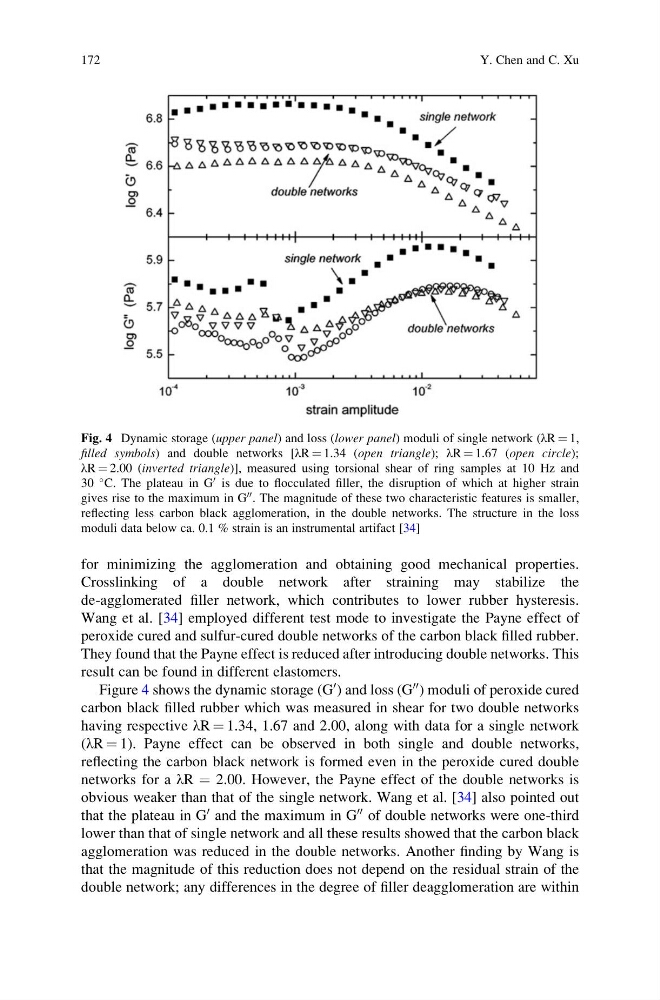
Figure 4 shows the dynamic storage (G
0 ) and loss (G
00 ) moduli of peroxide cured
carbon black filled rubber which was measured in shear for two double networks
having respective λR ¼ 1.34, 1.67 and 2.00, along with data for a single network
(λR ¼ 1). Payne effect can be observed in both single and double networks,
reflecting the carbon black network is formed even in the peroxide cured double
networks for a λR ¼ 2.00. However, the Payne effect of the double networks is
obvious weaker than that of the single network. Wang et al. [34] also pointed out
that the plateau in G
0 and the maximum in G
00 of double networks were one-third
lower than that of single network and all these results showed that the carbon black
agglomeration was reduced in the double networks. Another finding by Wang is
that the magnitude of this reduction does not depend on the residual strain of the
double network; any differences in the degree of filler deagglomeration are within
Fig. 4 Dynamic storage (upper panel) and loss (lower panel) moduli of single network (λR ¼ 1,
filled symbols) and double networks [λR ¼ 1.34 (open triangle); λR ¼ 1.67 (open circle);
λR ¼ 2.00 (inverted triangle)], measured using torsional shear of ring samples at 10 Hz and
30
C. The plateau in G
0 is due to flocculated filler, the disruption of which at higher strain
gives rise to the maximum in G
00 . The magnitude of these two characteristic features is smaller,
reflecting less carbon black agglomeration, in the double networks. The structure in the loss
moduli data below ca. 0.1 % strain is an instrumental artifact [34]
172
Y. Chen and C. Xu
Crosslinking of a double network after straining may stabilize the
de-agglomerated filler network, which contributes to lower rubber hysteresis.
Wang et al. [34] employed different test mode to investigate the Payne effect of
peroxide cured and sulfur-cured double networks of the carbon black filled rubber.
They found that the Payne effect is reduced after introducing double networks. This
result can be found in different elastomers.
Figure 4 shows the dynamic storage (G
0 ) and loss (G
00 ) moduli of peroxide cured
carbon black filled rubber which was measured in shear for two double networks
having respective λR ¼ 1.34, 1.67 and 2.00, along with data for a single network
(λR ¼ 1). Payne effect can be observed in both single and double networks,
reflecting the carbon black network is formed even in the peroxide cured double
networks for a λR ¼ 2.00. However, the Payne effect of the double networks is
obvious weaker than that of the single network. Wang et al. [34] also pointed out
that the plateau in G
0 and the maximum in G
00 of double networks were one-third
lower than that of single network and all these results showed that the carbon black
agglomeration was reduced in the double networks. Another finding by Wang is
that the magnitude of this reduction does not depend on the residual strain of the
double network; any differences in the degree of filler deagglomeration are within
Fig. 4 Dynamic storage (upper panel) and loss (lower panel) moduli of single network (λR ¼ 1,
filled symbols) and double networks [λR ¼ 1.34 (open triangle); λR ¼ 1.67 (open circle);
λR ¼ 2.00 (inverted triangle)], measured using torsional shear of ring samples at 10 Hz and
30
C. The plateau in G
0 is due to flocculated filler, the disruption of which at higher strain
gives rise to the maximum in G
00 . The magnitude of these two characteristic features is smaller,
reflecting less carbon black agglomeration, in the double networks. The structure in the loss
moduli data below ca. 0.1 % strain is an instrumental artifact [34]
172
Y. Chen and C. Xu