

the experimental scatter. The data in Fig. 4 were obtained on ring samples, sheared
in the plane of the double network orientation [34].
Generally, the mechanical properties of double networks exhibit some anisotropy, Roland and Peng [16] investigated the electrical properties of carbon black
filled double networks, finding that the electrical conductivity was lower than for
single networks. After an initial minimum at low strains, however, the conductivity
of the double networks increased more strongly with strain. Hamed and Huang [17]
observed highly anisotropic mechanical properties in natural rubber double networks containing carbon black, the tensile and tear strengths being higher for
deformations parallel to the orientation. Thus Wang [34] also investigated the
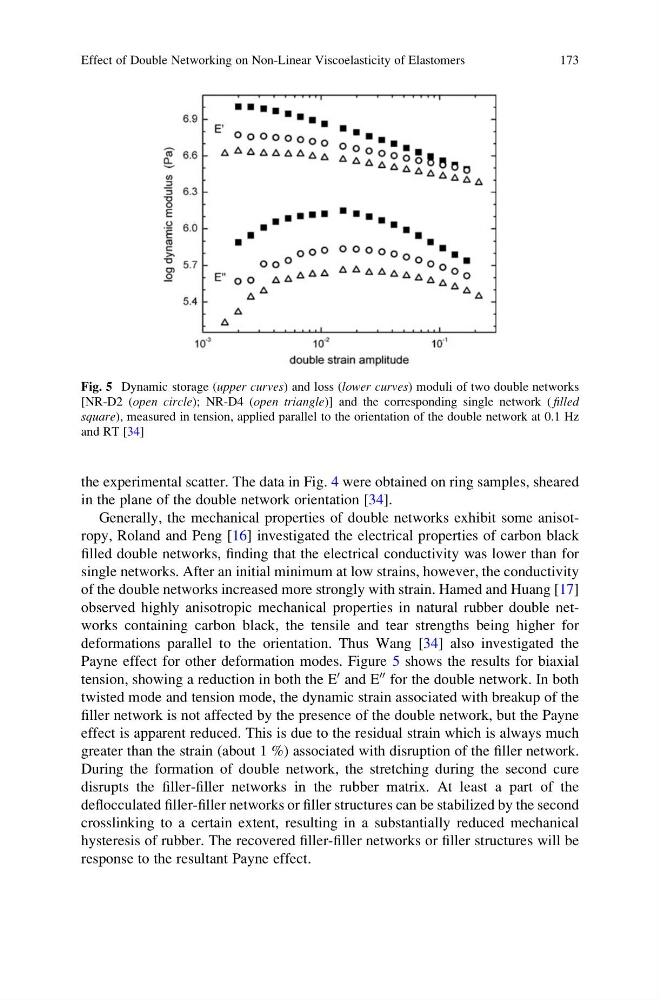
Payne effect for other deformation modes. Figure 5 shows the results for biaxial
tension, showing a reduction in both the E
0 and E
00 for the double network. In both
twisted mode and tension mode, the dynamic strain associated with breakup of the
filler network is not affected by the presence of the double network, but the Payne
effect is apparent reduced. This is due to the residual strain which is always much
greater than the strain (about 1 %) associated with disruption of the filler network.
During the formation of double network, the stretching during the second cure
disrupts the filler-filler networks in the rubber matrix. At least a part of the
deflocculated filler-filler networks or filler structures can be stabilized by the second
crosslinking to a certain extent, resulting in a substantially reduced mechanical
hysteresis of rubber. The recovered filler-filler networks or filler structures will be
response to the resultant Payne effect.
Fig. 5 Dynamic storage (upper curves) and loss (lower curves) moduli of two double networks
[NR-D2 (open circle); NR-D4 (open triangle)] and the corresponding single network ( filled
square), measured in tension, applied parallel to the orientation of the double network at 0.1 Hz
and RT [34]
Effect of Double Networking on Non-Linear Viscoelasticity of Elastomers
173
in the plane of the double network orientation [34].
Generally, the mechanical properties of double networks exhibit some anisotropy, Roland and Peng [16] investigated the electrical properties of carbon black
filled double networks, finding that the electrical conductivity was lower than for
single networks. After an initial minimum at low strains, however, the conductivity
of the double networks increased more strongly with strain. Hamed and Huang [17]
observed highly anisotropic mechanical properties in natural rubber double networks containing carbon black, the tensile and tear strengths being higher for
deformations parallel to the orientation. Thus Wang [34] also investigated the
Payne effect for other deformation modes. Figure 5 shows the results for biaxial
tension, showing a reduction in both the E
0 and E
00 for the double network. In both
twisted mode and tension mode, the dynamic strain associated with breakup of the
filler network is not affected by the presence of the double network, but the Payne
effect is apparent reduced. This is due to the residual strain which is always much
greater than the strain (about 1 %) associated with disruption of the filler network.
During the formation of double network, the stretching during the second cure
disrupts the filler-filler networks in the rubber matrix. At least a part of the
deflocculated filler-filler networks or filler structures can be stabilized by the second
crosslinking to a certain extent, resulting in a substantially reduced mechanical
hysteresis of rubber. The recovered filler-filler networks or filler structures will be
response to the resultant Payne effect.
Fig. 5 Dynamic storage (upper curves) and loss (lower curves) moduli of two double networks
[NR-D2 (open circle); NR-D4 (open triangle)] and the corresponding single network ( filled
square), measured in tension, applied parallel to the orientation of the double network at 0.1 Hz
and RT [34]
Effect of Double Networking on Non-Linear Viscoelasticity of Elastomers
173