

Obviously, this kind of double networks differ to the former introduced transient
double-network. The controlled double networks exhibit anisotropic properties, and
are usually characterized in terms of their residual stretch ratio, λR, equal to the
ratio of their length along the stretch direction of the second cure to the initial length
(prior to the second curing, or equivalently, in the uncured state). However, λR does
not uniquely define a double network, as different cure strains and crosslink
apportionment between the two networks can yield the same residual strain, but
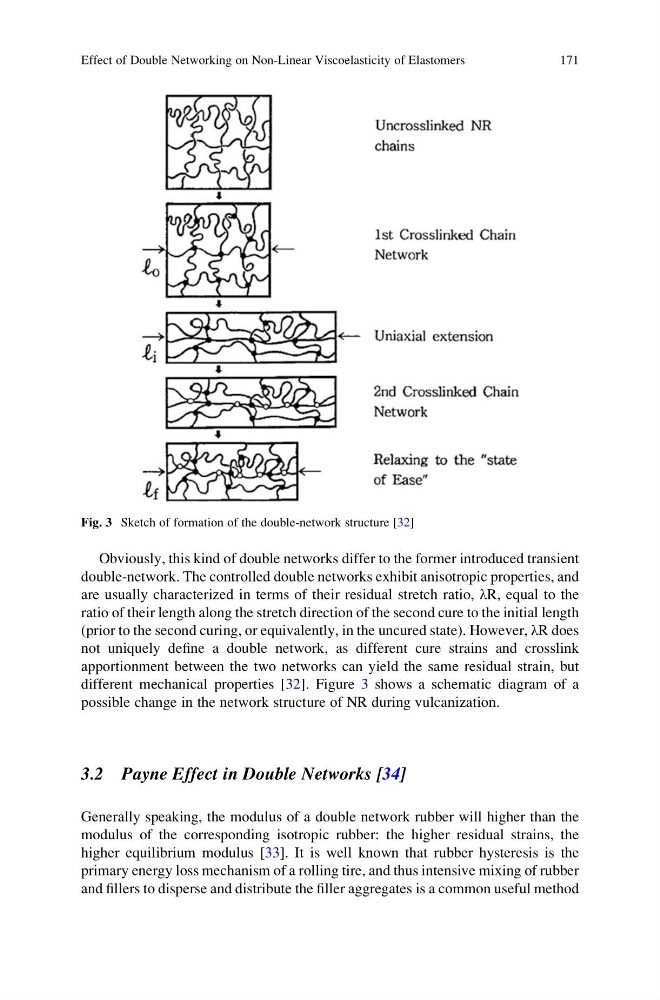
different mechanical properties [32]. Figure 3 shows a schematic diagram of a
possible change in the network structure of NR during vulcanization.
3.2 Payne Effect in Double Networks [34]
Generally speaking, the modulus of a double network rubber will higher than the
modulus of the corresponding isotropic rubber: the higher residual strains, the
higher equilibrium modulus [33]. It is well known that rubber hysteresis is the
primary energy loss mechanism of a rolling tire, and thus intensive mixing of rubber
and fillers to disperse and distribute the filler aggregates is a common useful method
Fig. 3 Sketch of formation of the double-network structure [32]
Effect of Double Networking on Non-Linear Viscoelasticity of Elastomers
171
double-network. The controlled double networks exhibit anisotropic properties, and
are usually characterized in terms of their residual stretch ratio, λR, equal to the
ratio of their length along the stretch direction of the second cure to the initial length
(prior to the second curing, or equivalently, in the uncured state). However, λR does
not uniquely define a double network, as different cure strains and crosslink
apportionment between the two networks can yield the same residual strain, but
different mechanical properties [32]. Figure 3 shows a schematic diagram of a
possible change in the network structure of NR during vulcanization.
3.2 Payne Effect in Double Networks [34]
Generally speaking, the modulus of a double network rubber will higher than the
modulus of the corresponding isotropic rubber: the higher residual strains, the
higher equilibrium modulus [33]. It is well known that rubber hysteresis is the
primary energy loss mechanism of a rolling tire, and thus intensive mixing of rubber
and fillers to disperse and distribute the filler aggregates is a common useful method
Fig. 3 Sketch of formation of the double-network structure [32]
Effect of Double Networking on Non-Linear Viscoelasticity of Elastomers
171