

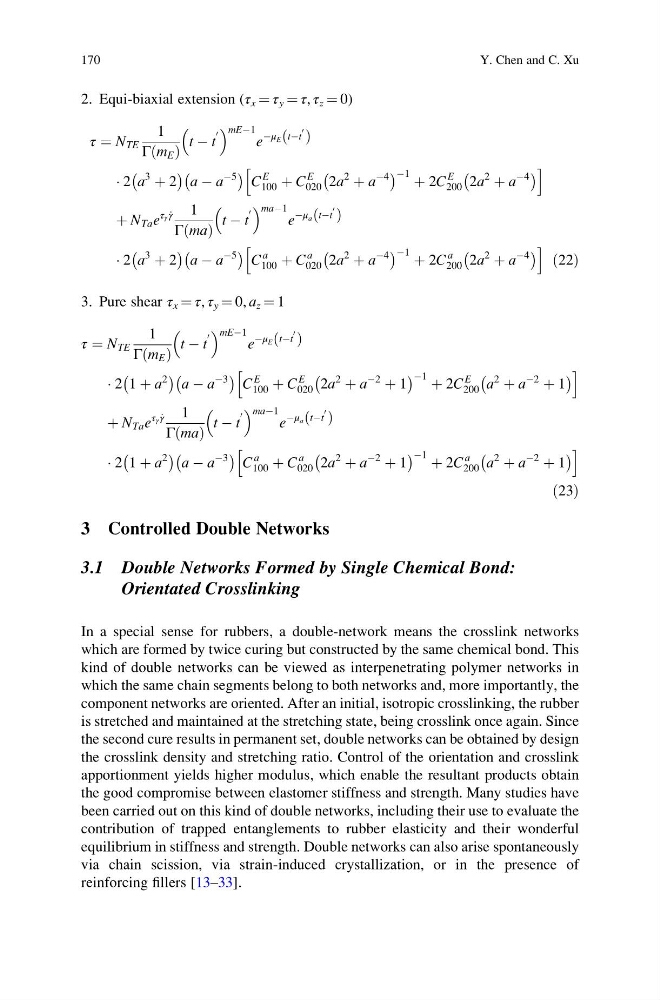
2. Equi-biaxial extension (τ x ¼ τ y ¼ τ, τ z ¼ 0)
τ ¼ N TE
1
Γ m E
ð Þ
t À t
0
mEÀ1
e
Àμ E tÀt
0
ð Þ
Á 2 a
3
þ 2
À
Á
a À a
À5
À
Á
C
E
100 þ C
E
020 2a
2
þ a
À4
À
Á À1 þ 2C
E
200 2a
2
þ a
À4
À
Á
h
i
þ N Ta e
τ γ _
γ
1
Γ ma
ð Þ
t À t
0
maÀ1
e
Àμ a tÀt
0
ð Þ
Á 2 a
3
þ 2
À
Á
a À a
À5
À
Á
C
a
100 þ C
a
020 2a
2
þ a
À4
À
Á À1 þ 2C
a
200 2a
2
þ a
À4
À
Á
h
i
ð22Þ
3. Pure shear τ x ¼ τ, τ y ¼ 0, a z ¼ 1
τ ¼ N TE
1
Γ m E
ð Þ
t À t
0
mEÀ1
e
Àμ E tÀt
0
ð Þ
Á 2 1 þ a
2
À
Á
a À a
À3
À
Á
C
E
100 þ C
E
020 2a
2
þ a
À2
þ 1
À
Á À1 þ 2C
E
200 a
2
þ a
À2
þ 1
À
Á
h
i
þ N Ta e
τ γ _
γ
1
Γ ma
ð Þ
t À t
0
maÀ1
e
Àμ a tÀt
0
ð Þ
Á 2 1 þ a
2
À
Á
a À a
À3
À
Á
C
a
100 þ C
a
020 2a
2
þ a
À2
þ 1
À
Á À1 þ 2C
a
200 a
2
þ a
À2
þ 1
À
Á
h
i
ð23Þ
3 Controlled Double Networks
3.1 Double Networks Formed by Single Chemical Bond:
Orientated Crosslinking
In a special sense for rubbers, a double-network means the crosslink networks
which are formed by twice curing but constructed by the same chemical bond. This
kind of double networks can be viewed as interpenetrating polymer networks in
which the same chain segments belong to both networks and, more importantly, the
component networks are oriented. After an initial, isotropic crosslinking, the rubber
is stretched and maintained at the stretching state, being crosslink once again. Since
the second cure results in permanent set, double networks can be obtained by design
the crosslink density and stretching ratio. Control of the orientation and crosslink
apportionment yields higher modulus, which enable the resultant products obtain
the good compromise between elastomer stiffness and strength. Many studies have
been carried out on this kind of double networks, including their use to evaluate the
contribution of trapped entanglements to rubber elasticity and their wonderful
equilibrium in stiffness and strength. Double networks can also arise spontaneously
via chain scission, via strain-induced crystallization, or in the presence of
reinforcing fillers [13–33].
170
Y. Chen and C. Xu
τ ¼ N TE
1
Γ m E
ð Þ
t À t
0
mEÀ1
e
Àμ E tÀt
0
ð Þ
Á 2 a
3
þ 2
À
Á
a À a
À5
À
Á
C
E
100 þ C
E
020 2a
2
þ a
À4
À
Á À1 þ 2C
E
200 2a
2
þ a
À4
À
Á
h
i
þ N Ta e
τ γ _
γ
1
Γ ma
ð Þ
t À t
0
maÀ1
e
Àμ a tÀt
0
ð Þ
Á 2 a
3
þ 2
À
Á
a À a
À5
À
Á
C
a
100 þ C
a
020 2a
2
þ a
À4
À
Á À1 þ 2C
a
200 2a
2
þ a
À4
À
Á
h
i
ð22Þ
3. Pure shear τ x ¼ τ, τ y ¼ 0, a z ¼ 1
τ ¼ N TE
1
Γ m E
ð Þ
t À t
0
mEÀ1
e
Àμ E tÀt
0
ð Þ
Á 2 1 þ a
2
À
Á
a À a
À3
À
Á
C
E
100 þ C
E
020 2a
2
þ a
À2
þ 1
À
Á À1 þ 2C
E
200 a
2
þ a
À2
þ 1
À
Á
h
i
þ N Ta e
τ γ _
γ
1
Γ ma
ð Þ
t À t
0
maÀ1
e
Àμ a tÀt
0
ð Þ
Á 2 1 þ a
2
À
Á
a À a
À3
À
Á
C
a
100 þ C
a
020 2a
2
þ a
À2
þ 1
À
Á À1 þ 2C
a
200 a
2
þ a
À2
þ 1
À
Á
h
i
ð23Þ
3 Controlled Double Networks
3.1 Double Networks Formed by Single Chemical Bond:
Orientated Crosslinking
In a special sense for rubbers, a double-network means the crosslink networks
which are formed by twice curing but constructed by the same chemical bond. This
kind of double networks can be viewed as interpenetrating polymer networks in
which the same chain segments belong to both networks and, more importantly, the
component networks are oriented. After an initial, isotropic crosslinking, the rubber
is stretched and maintained at the stretching state, being crosslink once again. Since
the second cure results in permanent set, double networks can be obtained by design
the crosslink density and stretching ratio. Control of the orientation and crosslink
apportionment yields higher modulus, which enable the resultant products obtain
the good compromise between elastomer stiffness and strength. Many studies have
been carried out on this kind of double networks, including their use to evaluate the
contribution of trapped entanglements to rubber elasticity and their wonderful
equilibrium in stiffness and strength. Double networks can also arise spontaneously
via chain scission, via strain-induced crystallization, or in the presence of
reinforcing fillers [13–33].
170
Y. Chen and C. Xu