

observed that the modulus (G
0 ) of compounds derived from hybrid CB/OC dual
phase filler is significantly higher than the compounds derived from individual
fillers (CB or OC) indicating the hybrid filler system has a significant synergetic
reinforcement effect on natural rubber [44].
The viscoelastic behavior of rubber composites can also be understood from its
cure characteristics. The influence of organically modified nanoclay-carbon black
(CB) hybrid filler on the curing behavior of natural rubber (NR) have been investigated by J. Sapkota et al. [45]. The effect of clay loading on the Mooney viscosity
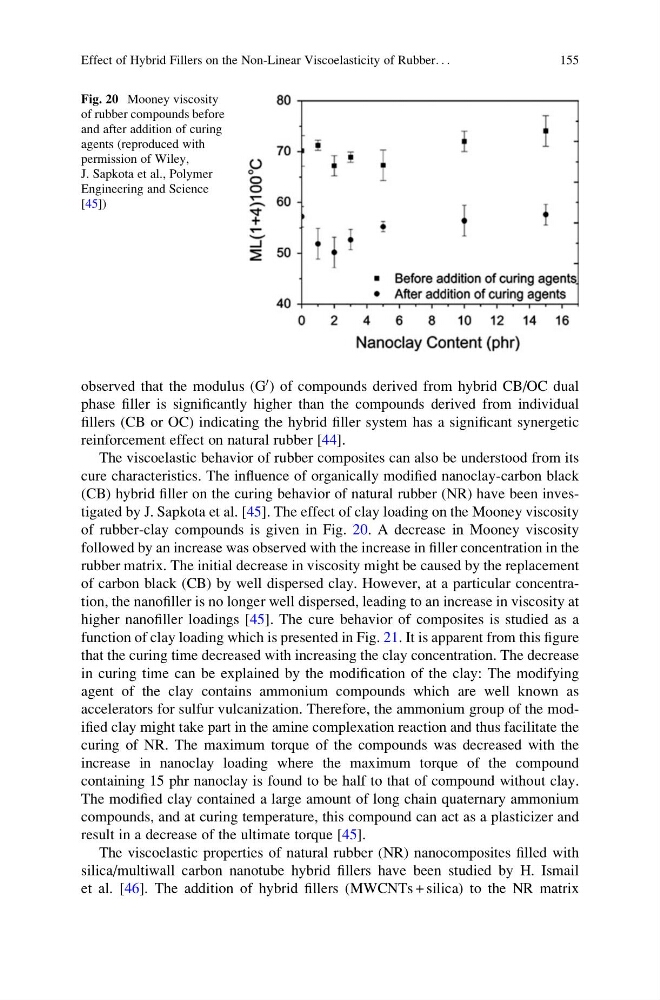
of rubber-clay compounds is given in Fig. 20. A decrease in Mooney viscosity
followed by an increase was observed with the increase in filler concentration in the
rubber matrix. The initial decrease in viscosity might be caused by the replacement
of carbon black (CB) by well dispersed clay. However, at a particular concentration, the nanofiller is no longer well dispersed, leading to an increase in viscosity at
higher nanofiller loadings [45]. The cure behavior of composites is studied as a
function of clay loading which is presented in Fig. 21. It is apparent from this figure
that the curing time decreased with increasing the clay concentration. The decrease
in curing time can be explained by the modification of the clay: The modifying
agent of the clay contains ammonium compounds which are well known as
accelerators for sulfur vulcanization. Therefore, the ammonium group of the modified clay might take part in the amine complexation reaction and thus facilitate the
curing of NR. The maximum torque of the compounds was decreased with the
increase in nanoclay loading where the maximum torque of the compound
containing 15 phr nanoclay is found to be half to that of compound without clay.
The modified clay contained a large amount of long chain quaternary ammonium
compounds, and at curing temperature, this compound can act as a plasticizer and
result in a decrease of the ultimate torque [45].
The viscoelastic properties of natural rubber (NR) nanocomposites filled with
silica/multiwall carbon nanotube hybrid fillers have been studied by H. Ismail
et al. [46]. The addition of hybrid fillers (MWCNTs + silica) to the NR matrix
Fig. 20 Mooney viscosity
of rubber compounds before
and after addition of curing
agents (reproduced with
permission of Wiley,
J. Sapkota et al., Polymer
Engineering and Science
[45])
Effect of Hybrid Fillers on the Non-Linear Viscoelasticity of Rubber. . .
155
0 ) of compounds derived from hybrid CB/OC dual
phase filler is significantly higher than the compounds derived from individual
fillers (CB or OC) indicating the hybrid filler system has a significant synergetic
reinforcement effect on natural rubber [44].
The viscoelastic behavior of rubber composites can also be understood from its
cure characteristics. The influence of organically modified nanoclay-carbon black
(CB) hybrid filler on the curing behavior of natural rubber (NR) have been investigated by J. Sapkota et al. [45]. The effect of clay loading on the Mooney viscosity
of rubber-clay compounds is given in Fig. 20. A decrease in Mooney viscosity
followed by an increase was observed with the increase in filler concentration in the
rubber matrix. The initial decrease in viscosity might be caused by the replacement
of carbon black (CB) by well dispersed clay. However, at a particular concentration, the nanofiller is no longer well dispersed, leading to an increase in viscosity at
higher nanofiller loadings [45]. The cure behavior of composites is studied as a
function of clay loading which is presented in Fig. 21. It is apparent from this figure
that the curing time decreased with increasing the clay concentration. The decrease
in curing time can be explained by the modification of the clay: The modifying
agent of the clay contains ammonium compounds which are well known as
accelerators for sulfur vulcanization. Therefore, the ammonium group of the modified clay might take part in the amine complexation reaction and thus facilitate the
curing of NR. The maximum torque of the compounds was decreased with the
increase in nanoclay loading where the maximum torque of the compound
containing 15 phr nanoclay is found to be half to that of compound without clay.
The modified clay contained a large amount of long chain quaternary ammonium
compounds, and at curing temperature, this compound can act as a plasticizer and
result in a decrease of the ultimate torque [45].
The viscoelastic properties of natural rubber (NR) nanocomposites filled with
silica/multiwall carbon nanotube hybrid fillers have been studied by H. Ismail
et al. [46]. The addition of hybrid fillers (MWCNTs + silica) to the NR matrix
Fig. 20 Mooney viscosity
of rubber compounds before
and after addition of curing
agents (reproduced with
permission of Wiley,
J. Sapkota et al., Polymer
Engineering and Science
[45])
Effect of Hybrid Fillers on the Non-Linear Viscoelasticity of Rubber. . .
155