

the composite and the strong interaction between silica and rubber molecules.
Composites filled with smaller FASi particles possess higher storage modulus
than those with larger particles due to larger surface area, resulting in the formation
of more rubber-filler interactions. The loss modulus peaks of composites filled with
40 phr silica became broader than those with 10 phr because of hindrance of the
molecular motion. The reduction of the loss modulus for composite with smaller
FASi particle sizes is due to the reduction in energy dissipation. From tan δ
vs. temperature curve of FASi/PSi-filled composites, it is observed that the incorporation of larger amount of silica into the NR matrix decreased the damping
characteristics of the composites, resulting in lower and broader damping peak.
This is because the filler acted as a barrier to the mobility of rubber chains,
indicating the reinforcing nature of filler with the rubber matrix. Moreover, a
reduction in damping peak is observed for FASi/PSi-filled composites filled with
small FASi particles [37].
Rheology is the study of flow and deformation of materials under the applied
forces (http://www.malvern.com/en/products/measurement-type/rheology-viscosity/). Rheology exhibits the combination of elastic, viscous, and plastic behavior
by properly combining the elasticity and (Newtonian) fluid mechanics (http://en.
wikipedia.org/wiki/Rheology). Rheological properties of bulk sample deformation
can be measured using a mechanical rheometer or microcapillary viscometer
or Microrheology (http://www.malvern.com/en/products/measurement-type/rheology-viscosity/). The rheological properties of rubber/polymer composites can be
increased by the addition of single/hybrid fillers. The rheological behavior of
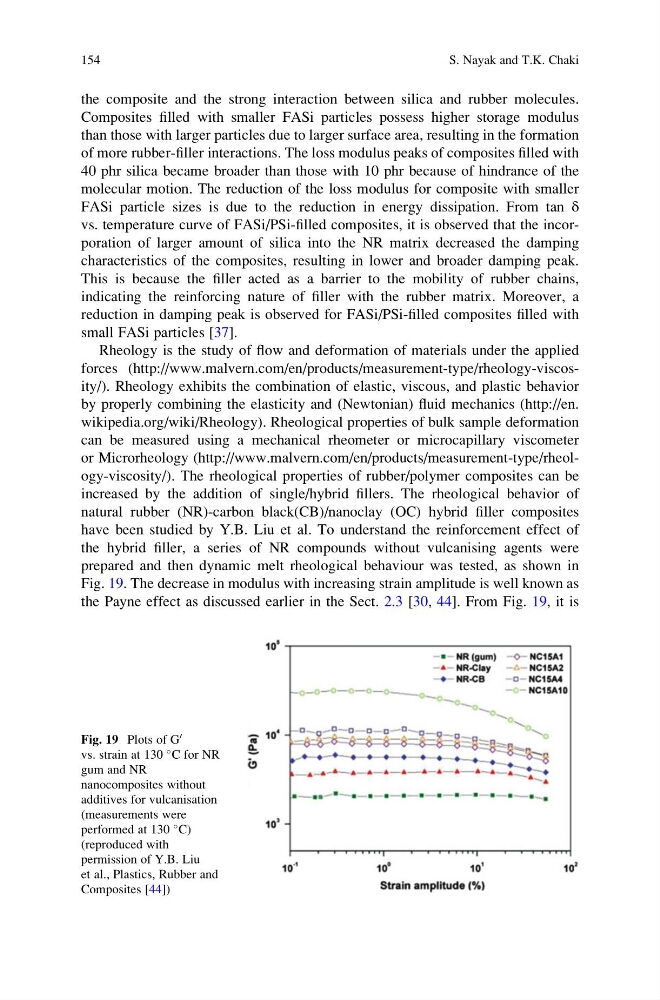
natural rubber (NR)-carbon black(CB)/nanoclay (OC) hybrid filler composites
have been studied by Y.B. Liu et al. To understand the reinforcement effect of
the hybrid filler, a series of NR compounds without vulcanising agents were
prepared and then dynamic melt rheological behaviour was tested, as shown in
Fig. 19. The decrease in modulus with increasing strain amplitude is well known as
the Payne effect as discussed earlier in the Sect. 2.3 [30, 44]. From Fig. 19, it is
Fig. 19 Plots of G
0
vs. strain at 130
C for NR
gum and NR
nanocomposites without
additives for vulcanisation
(measurements were
performed at 130
C)
(reproduced with
permission of Y.B. Liu
et al., Plastics, Rubber and
Composites [44])
154
S. Nayak and T.K. Chaki
Composites filled with smaller FASi particles possess higher storage modulus
than those with larger particles due to larger surface area, resulting in the formation
of more rubber-filler interactions. The loss modulus peaks of composites filled with
40 phr silica became broader than those with 10 phr because of hindrance of the
molecular motion. The reduction of the loss modulus for composite with smaller
FASi particle sizes is due to the reduction in energy dissipation. From tan δ
vs. temperature curve of FASi/PSi-filled composites, it is observed that the incorporation of larger amount of silica into the NR matrix decreased the damping
characteristics of the composites, resulting in lower and broader damping peak.
This is because the filler acted as a barrier to the mobility of rubber chains,
indicating the reinforcing nature of filler with the rubber matrix. Moreover, a
reduction in damping peak is observed for FASi/PSi-filled composites filled with
small FASi particles [37].
Rheology is the study of flow and deformation of materials under the applied
forces (http://www.malvern.com/en/products/measurement-type/rheology-viscosity/). Rheology exhibits the combination of elastic, viscous, and plastic behavior
by properly combining the elasticity and (Newtonian) fluid mechanics (http://en.
wikipedia.org/wiki/Rheology). Rheological properties of bulk sample deformation
can be measured using a mechanical rheometer or microcapillary viscometer
or Microrheology (http://www.malvern.com/en/products/measurement-type/rheology-viscosity/). The rheological properties of rubber/polymer composites can be
increased by the addition of single/hybrid fillers. The rheological behavior of
natural rubber (NR)-carbon black(CB)/nanoclay (OC) hybrid filler composites
have been studied by Y.B. Liu et al. To understand the reinforcement effect of
the hybrid filler, a series of NR compounds without vulcanising agents were
prepared and then dynamic melt rheological behaviour was tested, as shown in
Fig. 19. The decrease in modulus with increasing strain amplitude is well known as
the Payne effect as discussed earlier in the Sect. 2.3 [30, 44]. From Fig. 19, it is
Fig. 19 Plots of G
0
vs. strain at 130
C for NR
gum and NR
nanocomposites without
additives for vulcanisation
(measurements were
performed at 130
C)
(reproduced with
permission of Y.B. Liu
et al., Plastics, Rubber and
Composites [44])
154
S. Nayak and T.K. Chaki