

was varied with the total filler loading fixed at 30 phr. They have achieved the
highest tensile strength for composites at a loading ratio of 29 phr silica/1 phr
MWCNTs. As the MWCNT loading increased in the silica/MWCNT hybrid, the
tensile strength value decreased (Fig. 22) whereas tensile modulus value increased
(Fig. 23). The increase in tensile strength was possibly caused by the higher surface
area, together with the aspect ratio of MWCNTs compared to silica. Further, as the
MWCNT loading ratio increased in the silica/MWCNT hybrid, the MWCNTs
tended to agglomerate which weakened the rubber-filler interaction leading to
decrease in the tensile strength. The continuous increase in tensile modulus
(M 100 ) with the increase in MWCNT is due to the improved stiffness of the
nanocomposites (Fig. 23). The high aspect ratio and large surface area of the
MWCNTs can give better rubber-filler interaction at low MWCNT loading. Moreover, with the increase in the MWCNT loading the agglomeration also increased
which restrict the movement of the NR chain. It caused the composites to become
more rigid [46].
The viscoelastic property (storage modulus) of carbon black and mixture of
carbon black-phenolic resin filled nitrile rubber was investigated by V. Nigam
et al. and also was compared with the storage modulus of pristine elastomer
[47]. The influence of phenolic resin could be obtained from the measurement of
viscoelastic properties of the vulcanizates as measured in dynamic methods e.g.,
storage modulus (E
0 ) (Fig. 24). In Fig. 24, E
0 was found to be maximum when
carbon black and resin used in combination (mix D). Y.B. Liu et al. have reported
the reinforcement of natural rubber with carbonblack/nanoclay hybrid filler. They
had prepared the nanocomposites by the incorporation of a hybrid filler system,
organoclay and carbon black (CB), through melt compounding. It was observed that
the hybrid filler exhibited more significant reinforcing effect over the same loading
of CB on NR matrix [44].
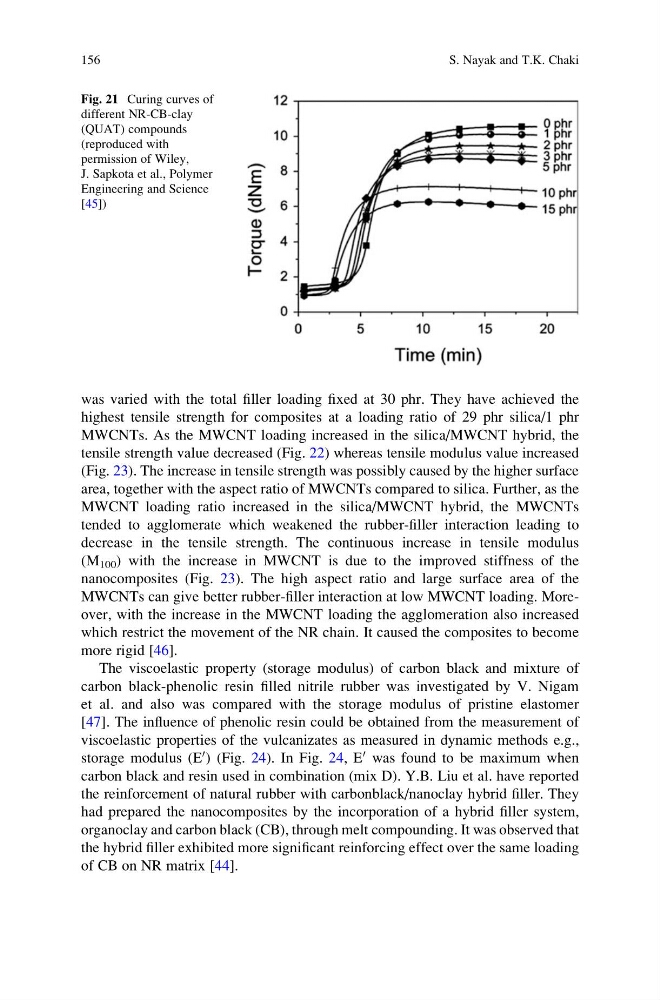
Fig. 21 Curing curves of
different NR-CB-clay
(QUAT) compounds
(reproduced with
permission of Wiley,
J. Sapkota et al., Polymer
Engineering and Science
[45])
156
S. Nayak and T.K. Chaki
highest tensile strength for composites at a loading ratio of 29 phr silica/1 phr
MWCNTs. As the MWCNT loading increased in the silica/MWCNT hybrid, the
tensile strength value decreased (Fig. 22) whereas tensile modulus value increased
(Fig. 23). The increase in tensile strength was possibly caused by the higher surface
area, together with the aspect ratio of MWCNTs compared to silica. Further, as the
MWCNT loading ratio increased in the silica/MWCNT hybrid, the MWCNTs
tended to agglomerate which weakened the rubber-filler interaction leading to
decrease in the tensile strength. The continuous increase in tensile modulus
(M 100 ) with the increase in MWCNT is due to the improved stiffness of the
nanocomposites (Fig. 23). The high aspect ratio and large surface area of the
MWCNTs can give better rubber-filler interaction at low MWCNT loading. Moreover, with the increase in the MWCNT loading the agglomeration also increased
which restrict the movement of the NR chain. It caused the composites to become
more rigid [46].
The viscoelastic property (storage modulus) of carbon black and mixture of
carbon black-phenolic resin filled nitrile rubber was investigated by V. Nigam
et al. and also was compared with the storage modulus of pristine elastomer
[47]. The influence of phenolic resin could be obtained from the measurement of
viscoelastic properties of the vulcanizates as measured in dynamic methods e.g.,
storage modulus (E
0 ) (Fig. 24). In Fig. 24, E
0 was found to be maximum when
carbon black and resin used in combination (mix D). Y.B. Liu et al. have reported
the reinforcement of natural rubber with carbonblack/nanoclay hybrid filler. They
had prepared the nanocomposites by the incorporation of a hybrid filler system,
organoclay and carbon black (CB), through melt compounding. It was observed that
the hybrid filler exhibited more significant reinforcing effect over the same loading
of CB on NR matrix [44].
Fig. 21 Curing curves of
different NR-CB-clay
(QUAT) compounds
(reproduced with
permission of Wiley,
J. Sapkota et al., Polymer
Engineering and Science
[45])
156
S. Nayak and T.K. Chaki