

light emitting devices (http://en.wikipedia.org/wiki/Nanorod). Similar to nanorods,
nanowire is a nanostructure, with the diameter of the order of a nanometer (10
À9 m)
with average aspect ratios than 20. Typical nanowires exhibit aspect ratios of 1,000
or more and they are often referred to as one-dimensional (1-D) materials.
Nanowires have many interesting properties which are not seen in bulk or 3-D
materials. This is because electrons in nanowires are quantum confined laterally and
thus occupy energy levels that are different from the traditional continuum of
energy levels or bands found in bulk materials (http://en.wikipedia.org/wiki/
Nanowire). Nanoflower refers to a compound of certain elements that result in
formations which in microscopic view resemble flowers (http://en.wikipedia.org/
wiki/Nanoflower). Similarly, nanocubes are nanoparticles derived from different
origins having cube shape and size ranges from 1–100 nm.
N. Patra et al. have studied the thermal and mechanical characterization of poly
(methyl methacrylate) nanocomposites filled with TiO 2 nanorods where they have
described the viscoelastic properties PMMA-titania nanorod composites via
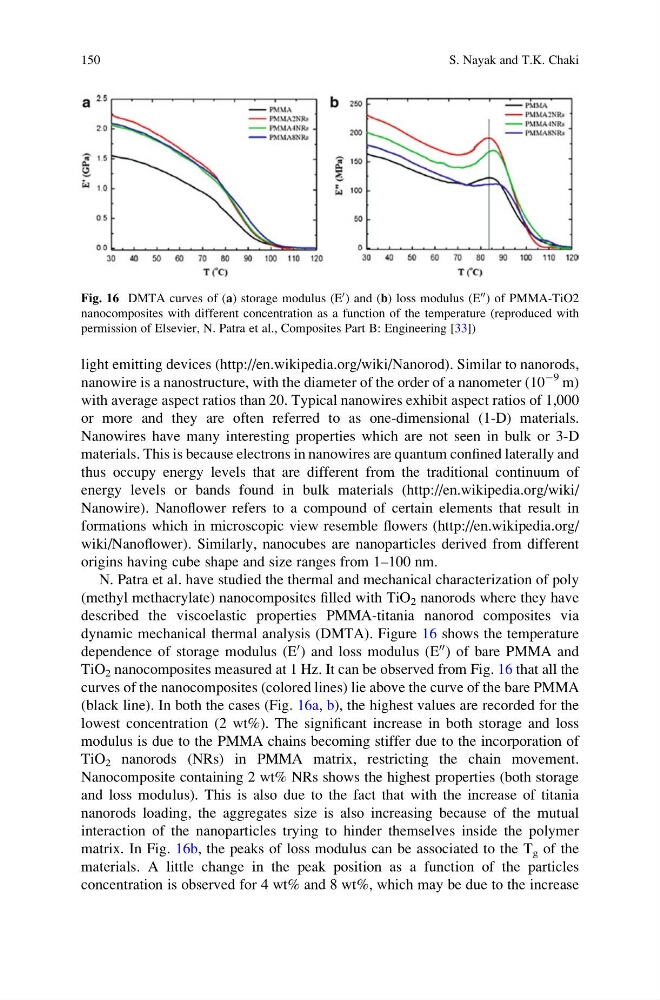
dynamic mechanical thermal analysis (DMTA). Figure 16 shows the temperature
dependence of storage modulus (E
0 ) and loss modulus (E
00 ) of bare PMMA and
TiO 2 nanocomposites measured at 1 Hz. It can be observed from Fig. 16 that all the
curves of the nanocomposites (colored lines) lie above the curve of the bare PMMA
(black line). In both the cases (Fig. 16a, b), the highest values are recorded for the
lowest concentration (2 wt%). The significant increase in both storage and loss
modulus is due to the PMMA chains becoming stiffer due to the incorporation of
TiO 2 nanorods (NRs) in PMMA matrix, restricting the chain movement.
Nanocomposite containing 2 wt% NRs shows the highest properties (both storage
and loss modulus). This is also due to the fact that with the increase of titania
nanorods loading, the aggregates size is also increasing because of the mutual
interaction of the nanoparticles trying to hinder themselves inside the polymer
matrix. In Fig. 16b, the peaks of loss modulus can be associated to the T g of the
materials. A little change in the peak position as a function of the particles
concentration is observed for 4 wt% and 8 wt%, which may be due to the increase
Fig. 16 DMTA curves of (a) storage modulus (E
0 ) and (b) loss modulus (E
00 ) of PMMA-TiO2
nanocomposites with different concentration as a function of the temperature (reproduced with
permission of Elsevier, N. Patra et al., Composites Part B: Engineering [33])
150
S. Nayak and T.K. Chaki
nanowire is a nanostructure, with the diameter of the order of a nanometer (10
À9 m)
with average aspect ratios than 20. Typical nanowires exhibit aspect ratios of 1,000
or more and they are often referred to as one-dimensional (1-D) materials.
Nanowires have many interesting properties which are not seen in bulk or 3-D
materials. This is because electrons in nanowires are quantum confined laterally and
thus occupy energy levels that are different from the traditional continuum of
energy levels or bands found in bulk materials (http://en.wikipedia.org/wiki/
Nanowire). Nanoflower refers to a compound of certain elements that result in
formations which in microscopic view resemble flowers (http://en.wikipedia.org/
wiki/Nanoflower). Similarly, nanocubes are nanoparticles derived from different
origins having cube shape and size ranges from 1–100 nm.
N. Patra et al. have studied the thermal and mechanical characterization of poly
(methyl methacrylate) nanocomposites filled with TiO 2 nanorods where they have
described the viscoelastic properties PMMA-titania nanorod composites via
dynamic mechanical thermal analysis (DMTA). Figure 16 shows the temperature
dependence of storage modulus (E
0 ) and loss modulus (E
00 ) of bare PMMA and
TiO 2 nanocomposites measured at 1 Hz. It can be observed from Fig. 16 that all the
curves of the nanocomposites (colored lines) lie above the curve of the bare PMMA
(black line). In both the cases (Fig. 16a, b), the highest values are recorded for the
lowest concentration (2 wt%). The significant increase in both storage and loss
modulus is due to the PMMA chains becoming stiffer due to the incorporation of
TiO 2 nanorods (NRs) in PMMA matrix, restricting the chain movement.
Nanocomposite containing 2 wt% NRs shows the highest properties (both storage
and loss modulus). This is also due to the fact that with the increase of titania
nanorods loading, the aggregates size is also increasing because of the mutual
interaction of the nanoparticles trying to hinder themselves inside the polymer
matrix. In Fig. 16b, the peaks of loss modulus can be associated to the T g of the
materials. A little change in the peak position as a function of the particles
concentration is observed for 4 wt% and 8 wt%, which may be due to the increase
Fig. 16 DMTA curves of (a) storage modulus (E
0 ) and (b) loss modulus (E
00 ) of PMMA-TiO2
nanocomposites with different concentration as a function of the temperature (reproduced with
permission of Elsevier, N. Patra et al., Composites Part B: Engineering [33])
150
S. Nayak and T.K. Chaki