

content. The major benefit of the polymeric products is that such modified wood
fiber/filler is hydrophobic and cheap, but it also lighter than typical mineral fillers.
Hydrophobic bio-fiber is expected to be very attractive to the auto/transportation
industry, and will certainly be useful in many other thermoplastic and even thermoset polymer applications. Generally, plant based fibers are hydrophilic in nature,
which is a problem that gets more complex in the mixing stage and later in the final
product. If the fiber fillers do not stay dry, the fiber can take up water, swell, take on
fungus, discolor, etc. So for using these types of bio-based fibers one has to treat
them and make them hydrophobic (http://www.polymerohio.org/index.php?
option¼com_content&view¼article&id¼338:bio-friendly-fillers-for-polymers-&catid¼
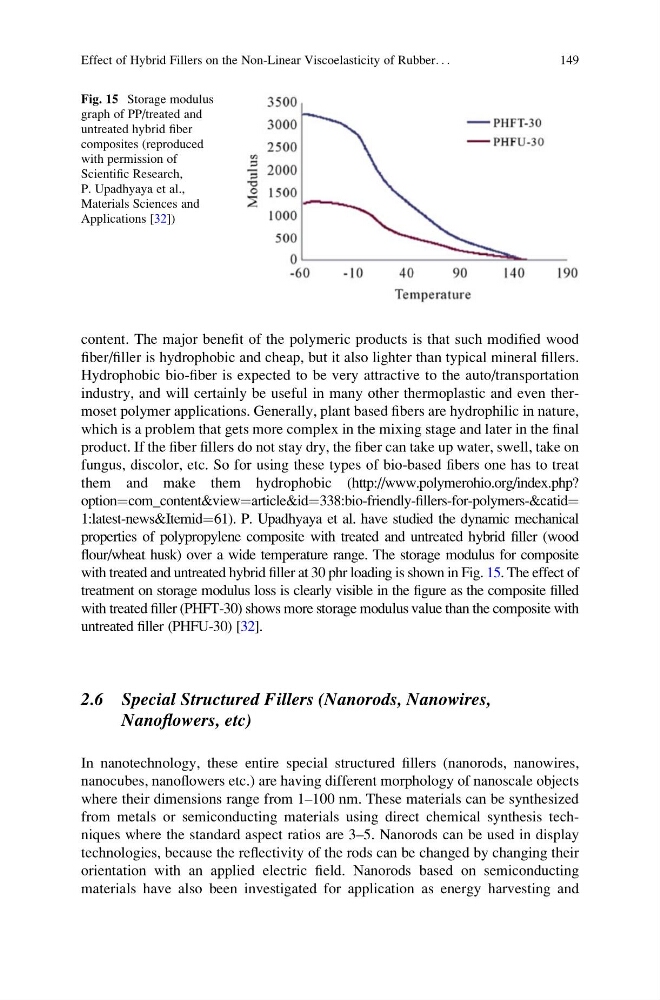
1:latest-news&Itemid¼61). P. Upadhyaya et al. have studied the dynamic mechanical
properties of polypropylene composite with treated and untreated hybrid filler (wood
flour/wheat husk) over a wide temperature range. The storage modulus for composite
with treated and untreated hybrid filler at 30 phr loading is shown in Fig. 15. The effect of
treatment on storage modulus loss is clearly visible in the figure as the composite filled
with treated filler (PHFT-30) shows more storage modulus value than the composite with
untreated filler (PHFU-30) [32].
2.6 Special Structured Fillers (Nanorods, Nanowires,
Nanoflowers, etc)
In nanotechnology, these entire special structured fillers (nanorods, nanowires,
nanocubes, nanoflowers etc.) are having different morphology of nanoscale objects
where their dimensions range from 1–100 nm. These materials can be synthesized
from metals or semiconducting materials using direct chemical synthesis techniques where the standard aspect ratios are 3–5. Nanorods can be used in display
technologies, because the reflectivity of the rods can be changed by changing their
orientation with an applied electric field. Nanorods based on semiconducting
materials have also been investigated for application as energy harvesting and
Fig. 15 Storage modulus
graph of PP/treated and
untreated hybrid fiber
composites (reproduced
with permission of
Scientific Research,
P. Upadhyaya et al.,
Materials Sciences and
Applications [32])
Effect of Hybrid Fillers on the Non-Linear Viscoelasticity of Rubber. . .
149
fiber/filler is hydrophobic and cheap, but it also lighter than typical mineral fillers.
Hydrophobic bio-fiber is expected to be very attractive to the auto/transportation
industry, and will certainly be useful in many other thermoplastic and even thermoset polymer applications. Generally, plant based fibers are hydrophilic in nature,
which is a problem that gets more complex in the mixing stage and later in the final
product. If the fiber fillers do not stay dry, the fiber can take up water, swell, take on
fungus, discolor, etc. So for using these types of bio-based fibers one has to treat
them and make them hydrophobic (http://www.polymerohio.org/index.php?
option¼com_content&view¼article&id¼338:bio-friendly-fillers-for-polymers-&catid¼
1:latest-news&Itemid¼61). P. Upadhyaya et al. have studied the dynamic mechanical
properties of polypropylene composite with treated and untreated hybrid filler (wood
flour/wheat husk) over a wide temperature range. The storage modulus for composite
with treated and untreated hybrid filler at 30 phr loading is shown in Fig. 15. The effect of
treatment on storage modulus loss is clearly visible in the figure as the composite filled
with treated filler (PHFT-30) shows more storage modulus value than the composite with
untreated filler (PHFU-30) [32].
2.6 Special Structured Fillers (Nanorods, Nanowires,
Nanoflowers, etc)
In nanotechnology, these entire special structured fillers (nanorods, nanowires,
nanocubes, nanoflowers etc.) are having different morphology of nanoscale objects
where their dimensions range from 1–100 nm. These materials can be synthesized
from metals or semiconducting materials using direct chemical synthesis techniques where the standard aspect ratios are 3–5. Nanorods can be used in display
technologies, because the reflectivity of the rods can be changed by changing their
orientation with an applied electric field. Nanorods based on semiconducting
materials have also been investigated for application as energy harvesting and
Fig. 15 Storage modulus
graph of PP/treated and
untreated hybrid fiber
composites (reproduced
with permission of
Scientific Research,
P. Upadhyaya et al.,
Materials Sciences and
Applications [32])
Effect of Hybrid Fillers on the Non-Linear Viscoelasticity of Rubber. . .
149