

in crosslinking density. The interactions between the particles and the PMMA
matrix are mainly physical, while the interface does not confer mobility to the
chains in the studied concentrations [33]. A. Lonjon et al. have prepared conducting
nanocomposites
using
poly(vinylidene
difluoride-trifluoroethylene)
[P
(VDF-TrFE)] as the base matrix and nickel nanowires (aspect ratio ~250, up to
30 vol.%) as the filler material. They have prepared metallic nanowires based
nanocomposites through solvent mixing technique which constitute a new class
of multifunctional materials with a high conductivity associated with a ductile
polymer matrix characterized by a high rubbery modulus. The variation of both
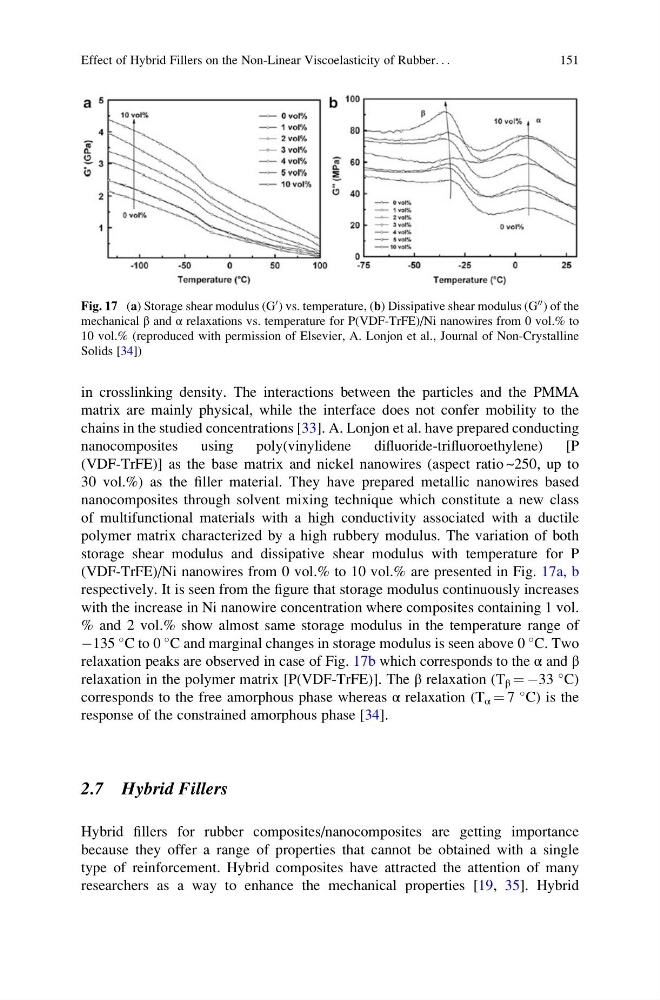
storage shear modulus and dissipative shear modulus with temperature for P
(VDF-TrFE)/Ni nanowires from 0 vol.% to 10 vol.% are presented in Fig. 17a, b
respectively. It is seen from the figure that storage modulus continuously increases
with the increase in Ni nanowire concentration where composites containing 1 vol.
% and 2 vol.% show almost same storage modulus in the temperature range of
À135
C to 0
C and marginal changes in storage modulus is seen above 0
C. Two
relaxation peaks are observed in case of Fig. 17b which corresponds to the α and β
relaxation in the polymer matrix [P(VDF-TrFE)]. The β relaxation (T β ¼ À33
C)
corresponds to the free amorphous phase whereas α relaxation (T α ¼ 7
C) is the
response of the constrained amorphous phase [34].
2.7 Hybrid Fillers
Hybrid fillers for rubber composites/nanocomposites are getting importance
because they offer a range of properties that cannot be obtained with a single
type of reinforcement. Hybrid composites have attracted the attention of many
researchers as a way to enhance the mechanical properties [19, 35]. Hybrid
Fig. 17 (a) Storage shear modulus (G
0 ) vs. temperature, (b) Dissipative shear modulus (G
00 ) of the
mechanical β and α relaxations vs. temperature for P(VDF-TrFE)/Ni nanowires from 0 vol.% to
10 vol.% (reproduced with permission of Elsevier, A. Lonjon et al., Journal of Non-Crystalline
Solids [34])
Effect of Hybrid Fillers on the Non-Linear Viscoelasticity of Rubber. . .
151
matrix are mainly physical, while the interface does not confer mobility to the
chains in the studied concentrations [33]. A. Lonjon et al. have prepared conducting
nanocomposites
using
poly(vinylidene
difluoride-trifluoroethylene)
[P
(VDF-TrFE)] as the base matrix and nickel nanowires (aspect ratio ~250, up to
30 vol.%) as the filler material. They have prepared metallic nanowires based
nanocomposites through solvent mixing technique which constitute a new class
of multifunctional materials with a high conductivity associated with a ductile
polymer matrix characterized by a high rubbery modulus. The variation of both
storage shear modulus and dissipative shear modulus with temperature for P
(VDF-TrFE)/Ni nanowires from 0 vol.% to 10 vol.% are presented in Fig. 17a, b
respectively. It is seen from the figure that storage modulus continuously increases
with the increase in Ni nanowire concentration where composites containing 1 vol.
% and 2 vol.% show almost same storage modulus in the temperature range of
À135
C to 0
C and marginal changes in storage modulus is seen above 0
C. Two
relaxation peaks are observed in case of Fig. 17b which corresponds to the α and β
relaxation in the polymer matrix [P(VDF-TrFE)]. The β relaxation (T β ¼ À33
C)
corresponds to the free amorphous phase whereas α relaxation (T α ¼ 7
C) is the
response of the constrained amorphous phase [34].
2.7 Hybrid Fillers
Hybrid fillers for rubber composites/nanocomposites are getting importance
because they offer a range of properties that cannot be obtained with a single
type of reinforcement. Hybrid composites have attracted the attention of many
researchers as a way to enhance the mechanical properties [19, 35]. Hybrid
Fig. 17 (a) Storage shear modulus (G
0 ) vs. temperature, (b) Dissipative shear modulus (G
00 ) of the
mechanical β and α relaxations vs. temperature for P(VDF-TrFE)/Ni nanowires from 0 vol.% to
10 vol.% (reproduced with permission of Elsevier, A. Lonjon et al., Journal of Non-Crystalline
Solids [34])
Effect of Hybrid Fillers on the Non-Linear Viscoelasticity of Rubber. . .
151