

physical, mechanical and thermo-mechanical properties of BR, SBR and SBR/BR
blends in the presence of carbon black (CB). Graphite sheets were modified to
enhance its dispersion in the rubber matrices, which resulting in an improvement in
the overall physical and mechanical properties of the rubber vulcanizates. Compounds based on 50:50 of BR and SBR with ~3 wt% nanofillers with CB were
fabricated by melt mixing. The intercalated and delaminated structures of the
nanofiller loaded rubber blends were observed. DMTA of the filled rubber compounds shows an increase in the storage modulus compared to the controls. i-MG
containing rubber compounds in the presence of CB showed an increase in the
mechanical, dynamic mechanical, hardness, abrasion resistance and thermal properties compared to the alone CB filled rubber vulcanizates [115].
The effects of EG and i-MG on the dynamic mechanical properties of BR, SBR
and SBR/BR blends were investigated by dynamic mechanical thermal analysis.
The temperature dependent E and tan δ of the rubber composites are represented in
the Fig. 33a–d. Both the elastic and viscous behaviors of the composite materials
affect the resulting strain in the samples due to the application of an oscillating
force. The storage modulus can be regarded as the elastic modulus of the rubber
composites and loss tangent is interconnected to the energy drenched due to energy
dissipation as heat. It can be seen from the Fig. 33a, b that EG and i-MG loaded
SBR/BR composites in the presence of CB showed a drastic increase in the storage
modulus in a wide range of temperature compared to the BR based nanocomposites.
But, in comparison with SBR based nanocomposites, SBR/BR based composites
showed an increase in the storage modulus only at very low temperature region and
then decrease in the storage modulus from low temperature to a high temperature
region, which was due to very low transition temperature of BR. Homogeneous
mixing of SBR with BR and as well as good dispersion of nanofillers in the rubber
blend increases its stiffness, which resulting in an increase in the storage modulus of
the SBR/BR based nanocomposites. Figure 33c, d displayed the temperature
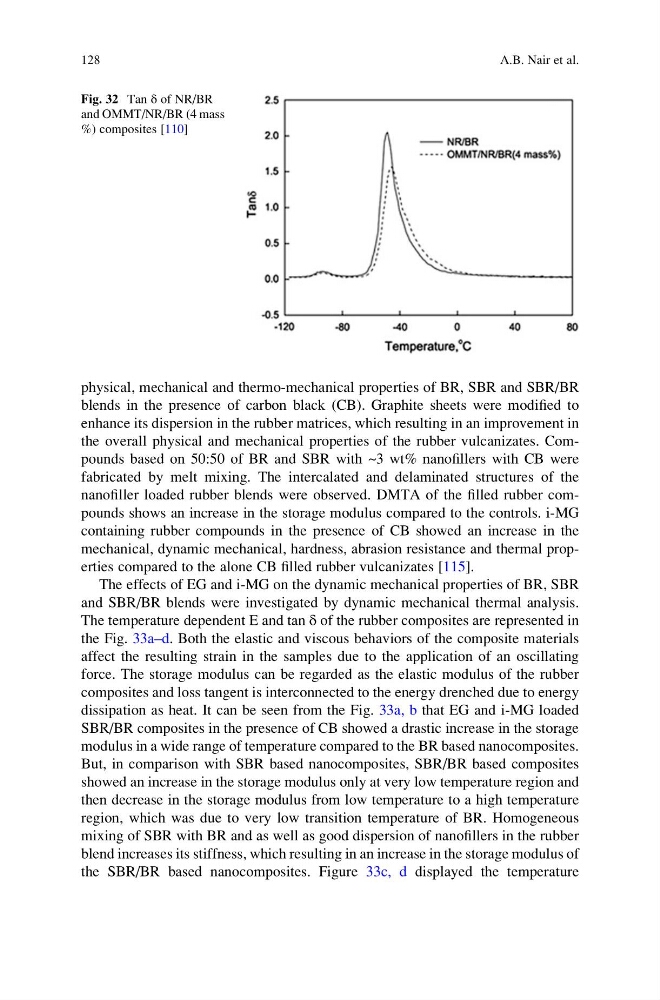
Fig. 32 Tan δ of NR/BR
and OMMT/NR/BR (4 mass
%) composites [110]
128
A.B. Nair et al.
blends in the presence of carbon black (CB). Graphite sheets were modified to
enhance its dispersion in the rubber matrices, which resulting in an improvement in
the overall physical and mechanical properties of the rubber vulcanizates. Compounds based on 50:50 of BR and SBR with ~3 wt% nanofillers with CB were
fabricated by melt mixing. The intercalated and delaminated structures of the
nanofiller loaded rubber blends were observed. DMTA of the filled rubber compounds shows an increase in the storage modulus compared to the controls. i-MG
containing rubber compounds in the presence of CB showed an increase in the
mechanical, dynamic mechanical, hardness, abrasion resistance and thermal properties compared to the alone CB filled rubber vulcanizates [115].
The effects of EG and i-MG on the dynamic mechanical properties of BR, SBR
and SBR/BR blends were investigated by dynamic mechanical thermal analysis.
The temperature dependent E and tan δ of the rubber composites are represented in
the Fig. 33a–d. Both the elastic and viscous behaviors of the composite materials
affect the resulting strain in the samples due to the application of an oscillating
force. The storage modulus can be regarded as the elastic modulus of the rubber
composites and loss tangent is interconnected to the energy drenched due to energy
dissipation as heat. It can be seen from the Fig. 33a, b that EG and i-MG loaded
SBR/BR composites in the presence of CB showed a drastic increase in the storage
modulus in a wide range of temperature compared to the BR based nanocomposites.
But, in comparison with SBR based nanocomposites, SBR/BR based composites
showed an increase in the storage modulus only at very low temperature region and
then decrease in the storage modulus from low temperature to a high temperature
region, which was due to very low transition temperature of BR. Homogeneous
mixing of SBR with BR and as well as good dispersion of nanofillers in the rubber
blend increases its stiffness, which resulting in an increase in the storage modulus of
the SBR/BR based nanocomposites. Figure 33c, d displayed the temperature
Fig. 32 Tan δ of NR/BR
and OMMT/NR/BR (4 mass
%) composites [110]
128
A.B. Nair et al.