

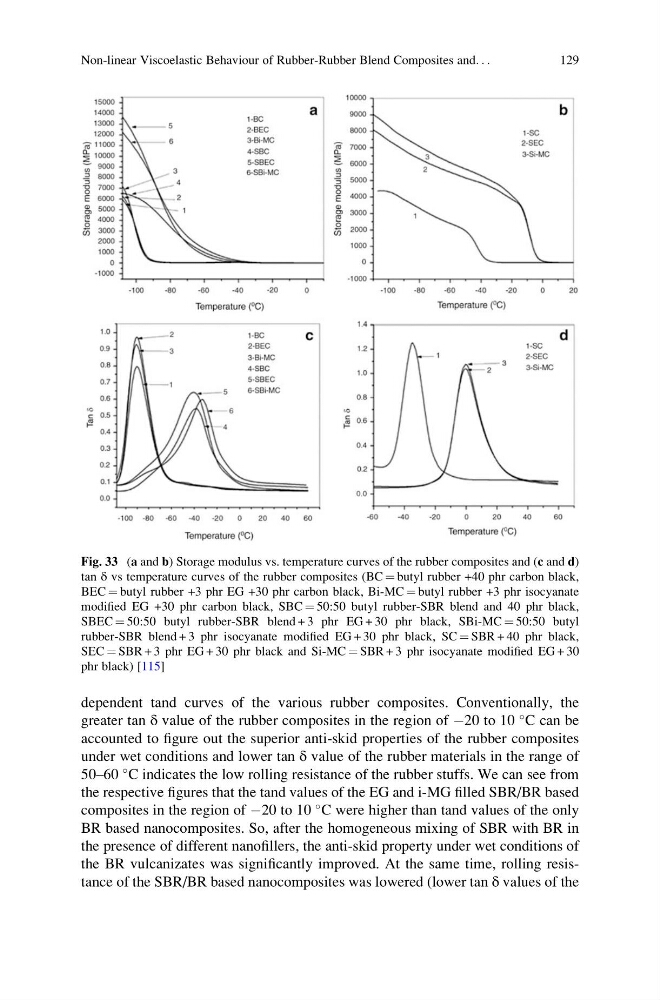
dependent tand curves of the various rubber composites. Conventionally, the
greater tan δ value of the rubber composites in the region of À20 to 10
C can be
accounted to figure out the superior anti-skid properties of the rubber composites
under wet conditions and lower tan δ value of the rubber materials in the range of
50–60
C indicates the low rolling resistance of the rubber stuffs. We can see from
the respective figures that the tand values of the EG and i-MG filled SBR/BR based
composites in the region of À20 to 10
C were higher than tand values of the only
BR based nanocomposites. So, after the homogeneous mixing of SBR with BR in
the presence of different nanofillers, the anti-skid property under wet conditions of
the BR vulcanizates was significantly improved. At the same time, rolling resistance of the SBR/BR based nanocomposites was lowered (lower tan δ values of the
Fig. 33 (a and b) Storage modulus vs. temperature curves of the rubber composites and (c and d)
tan δ vs temperature curves of the rubber composites (BC ¼ butyl rubber +40 phr carbon black,
BEC ¼ butyl rubber +3 phr EG +30 phr carbon black, Bi-MC ¼ butyl rubber +3 phr isocyanate
modified EG +30 phr carbon black, SBC ¼ 50:50 butyl rubber-SBR blend and 40 phr black,
SBEC ¼ 50:50 butyl rubber-SBR blend + 3 phr EG + 30 phr black, SBi-MC ¼ 50:50 butyl
rubber-SBR blend + 3 phr isocyanate modified EG + 30 phr black, SC ¼ SBR + 40 phr black,
SEC ¼ SBR + 3 phr EG + 30 phr black and Si-MC ¼ SBR + 3 phr isocyanate modified EG + 30
phr black) [115]
Non-linear Viscoelastic Behaviour of Rubber-Rubber Blend Composites and. . .
129
greater tan δ value of the rubber composites in the region of À20 to 10
C can be
accounted to figure out the superior anti-skid properties of the rubber composites
under wet conditions and lower tan δ value of the rubber materials in the range of
50–60
C indicates the low rolling resistance of the rubber stuffs. We can see from
the respective figures that the tand values of the EG and i-MG filled SBR/BR based
composites in the region of À20 to 10
C were higher than tand values of the only
BR based nanocomposites. So, after the homogeneous mixing of SBR with BR in
the presence of different nanofillers, the anti-skid property under wet conditions of
the BR vulcanizates was significantly improved. At the same time, rolling resistance of the SBR/BR based nanocomposites was lowered (lower tan δ values of the
Fig. 33 (a and b) Storage modulus vs. temperature curves of the rubber composites and (c and d)
tan δ vs temperature curves of the rubber composites (BC ¼ butyl rubber +40 phr carbon black,
BEC ¼ butyl rubber +3 phr EG +30 phr carbon black, Bi-MC ¼ butyl rubber +3 phr isocyanate
modified EG +30 phr carbon black, SBC ¼ 50:50 butyl rubber-SBR blend and 40 phr black,
SBEC ¼ 50:50 butyl rubber-SBR blend + 3 phr EG + 30 phr black, SBi-MC ¼ 50:50 butyl
rubber-SBR blend + 3 phr isocyanate modified EG + 30 phr black, SC ¼ SBR + 40 phr black,
SEC ¼ SBR + 3 phr EG + 30 phr black and Si-MC ¼ SBR + 3 phr isocyanate modified EG + 30
phr black) [115]
Non-linear Viscoelastic Behaviour of Rubber-Rubber Blend Composites and. . .
129