

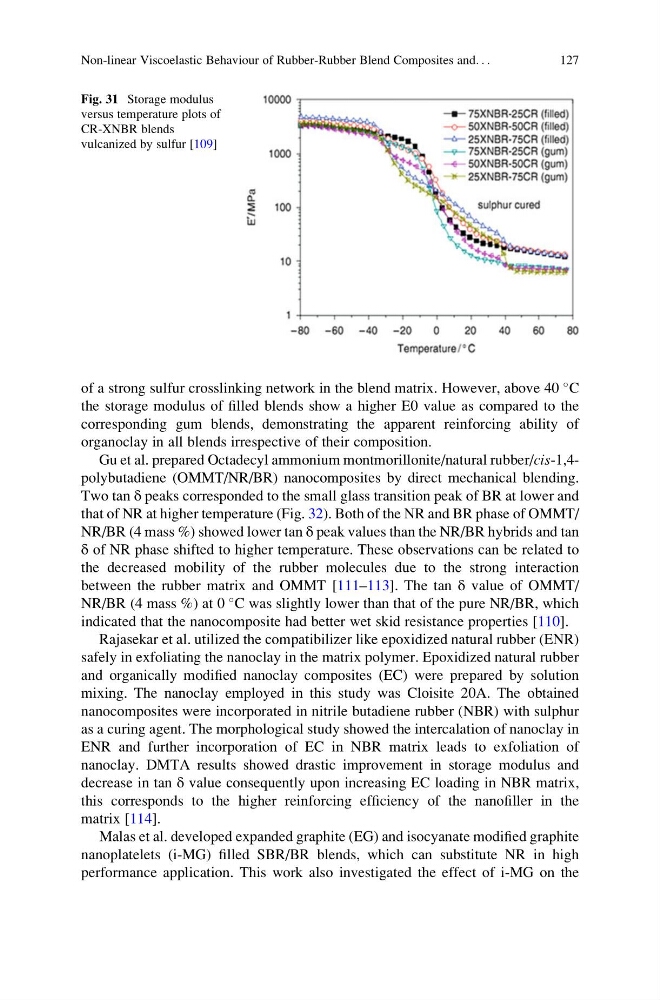
of a strong sulfur crosslinking network in the blend matrix. However, above 40
C
the storage modulus of filled blends show a higher E0 value as compared to the
corresponding gum blends, demonstrating the apparent reinforcing ability of
organoclay in all blends irrespective of their composition.
Gu et al. prepared Octadecyl ammonium montmorillonite/natural rubber/cis-1,4polybutadiene (OMMT/NR/BR) nanocomposites by direct mechanical blending.
Two tan δ peaks corresponded to the small glass transition peak of BR at lower and
that of NR at higher temperature (Fig. 32). Both of the NR and BR phase of OMMT/
NR/BR (4 mass %) showed lower tan δ peak values than the NR/BR hybrids and tan
δ of NR phase shifted to higher temperature. These observations can be related to
the decreased mobility of the rubber molecules due to the strong interaction
between the rubber matrix and OMMT [111–113]. The tan δ value of OMMT/
NR/BR (4 mass %) at 0
C was slightly lower than that of the pure NR/BR, which
indicated that the nanocomposite had better wet skid resistance properties [110].
Rajasekar et al. utilized the compatibilizer like epoxidized natural rubber (ENR)
safely in exfoliating the nanoclay in the matrix polymer. Epoxidized natural rubber
and organically modified nanoclay composites (EC) were prepared by solution
mixing. The nanoclay employed in this study was Cloisite 20A. The obtained
nanocomposites were incorporated in nitrile butadiene rubber (NBR) with sulphur
as a curing agent. The morphological study showed the intercalation of nanoclay in
ENR and further incorporation of EC in NBR matrix leads to exfoliation of
nanoclay. DMTA results showed drastic improvement in storage modulus and
decrease in tan δ value consequently upon increasing EC loading in NBR matrix,
this corresponds to the higher reinforcing efficiency of the nanofiller in the
matrix [114].
Malas et al. developed expanded graphite (EG) and isocyanate modified graphite
nanoplatelets (i-MG) filled SBR/BR blends, which can substitute NR in high
performance application. This work also investigated the effect of i-MG on the
Fig. 31 Storage modulus
versus temperature plots of
CR-XNBR blends
vulcanized by sulfur [109]
Non-linear Viscoelastic Behaviour of Rubber-Rubber Blend Composites and. . .
127
C
the storage modulus of filled blends show a higher E0 value as compared to the
corresponding gum blends, demonstrating the apparent reinforcing ability of
organoclay in all blends irrespective of their composition.
Gu et al. prepared Octadecyl ammonium montmorillonite/natural rubber/cis-1,4polybutadiene (OMMT/NR/BR) nanocomposites by direct mechanical blending.
Two tan δ peaks corresponded to the small glass transition peak of BR at lower and
that of NR at higher temperature (Fig. 32). Both of the NR and BR phase of OMMT/
NR/BR (4 mass %) showed lower tan δ peak values than the NR/BR hybrids and tan
δ of NR phase shifted to higher temperature. These observations can be related to
the decreased mobility of the rubber molecules due to the strong interaction
between the rubber matrix and OMMT [111–113]. The tan δ value of OMMT/
NR/BR (4 mass %) at 0
C was slightly lower than that of the pure NR/BR, which
indicated that the nanocomposite had better wet skid resistance properties [110].
Rajasekar et al. utilized the compatibilizer like epoxidized natural rubber (ENR)
safely in exfoliating the nanoclay in the matrix polymer. Epoxidized natural rubber
and organically modified nanoclay composites (EC) were prepared by solution
mixing. The nanoclay employed in this study was Cloisite 20A. The obtained
nanocomposites were incorporated in nitrile butadiene rubber (NBR) with sulphur
as a curing agent. The morphological study showed the intercalation of nanoclay in
ENR and further incorporation of EC in NBR matrix leads to exfoliation of
nanoclay. DMTA results showed drastic improvement in storage modulus and
decrease in tan δ value consequently upon increasing EC loading in NBR matrix,
this corresponds to the higher reinforcing efficiency of the nanofiller in the
matrix [114].
Malas et al. developed expanded graphite (EG) and isocyanate modified graphite
nanoplatelets (i-MG) filled SBR/BR blends, which can substitute NR in high
performance application. This work also investigated the effect of i-MG on the
Fig. 31 Storage modulus
versus temperature plots of
CR-XNBR blends
vulcanized by sulfur [109]
Non-linear Viscoelastic Behaviour of Rubber-Rubber Blend Composites and. . .
127