

increases to a considerable extent. Any significant change in the damping behavior
is not noticed after incorporation of the organoclay in the rubber blends. It is also
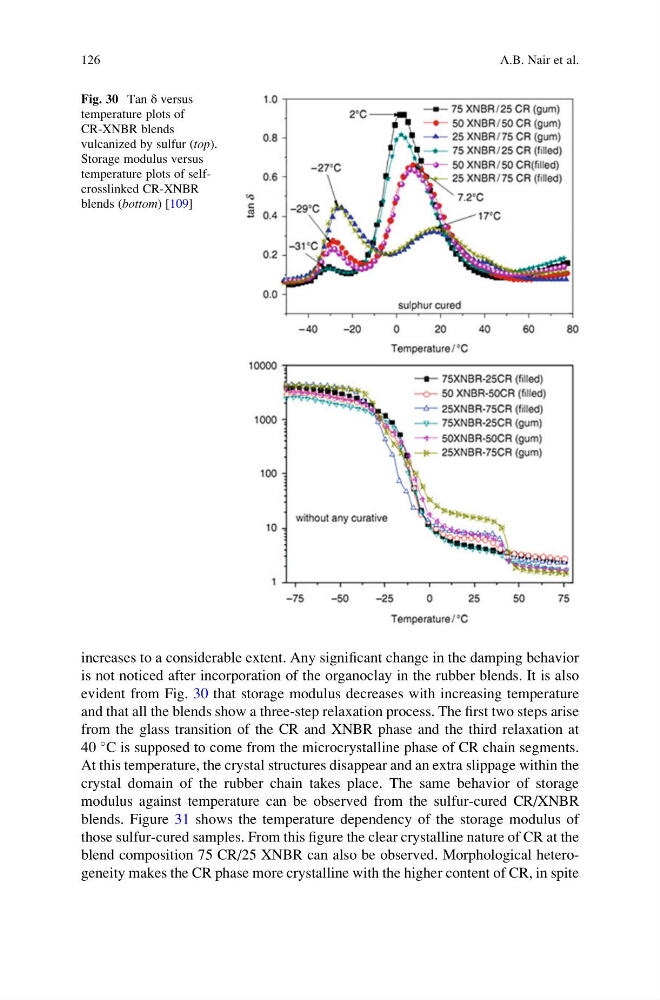
evident from Fig. 30 that storage modulus decreases with increasing temperature
and that all the blends show a three-step relaxation process. The first two steps arise
from the glass transition of the CR and XNBR phase and the third relaxation at
40
C is supposed to come from the microcrystalline phase of CR chain segments.
At this temperature, the crystal structures disappear and an extra slippage within the
crystal domain of the rubber chain takes place. The same behavior of storage
modulus against temperature can be observed from the sulfur-cured CR/XNBR
blends. Figure 31 shows the temperature dependency of the storage modulus of
those sulfur-cured samples. From this figure the clear crystalline nature of CR at the
blend composition 75 CR/25 XNBR can also be observed. Morphological heterogeneity makes the CR phase more crystalline with the higher content of CR, in spite
Fig. 30 Tan δ versus
temperature plots of
CR-XNBR blends
vulcanized by sulfur (top).
Storage modulus versus
temperature plots of selfcrosslinked CR-XNBR
blends (bottom) [109]
126
A.B. Nair et al.
is not noticed after incorporation of the organoclay in the rubber blends. It is also
evident from Fig. 30 that storage modulus decreases with increasing temperature
and that all the blends show a three-step relaxation process. The first two steps arise
from the glass transition of the CR and XNBR phase and the third relaxation at
40
C is supposed to come from the microcrystalline phase of CR chain segments.
At this temperature, the crystal structures disappear and an extra slippage within the
crystal domain of the rubber chain takes place. The same behavior of storage
modulus against temperature can be observed from the sulfur-cured CR/XNBR
blends. Figure 31 shows the temperature dependency of the storage modulus of
those sulfur-cured samples. From this figure the clear crystalline nature of CR at the
blend composition 75 CR/25 XNBR can also be observed. Morphological heterogeneity makes the CR phase more crystalline with the higher content of CR, in spite
Fig. 30 Tan δ versus
temperature plots of
CR-XNBR blends
vulcanized by sulfur (top).
Storage modulus versus
temperature plots of selfcrosslinked CR-XNBR
blends (bottom) [109]
126
A.B. Nair et al.