

Stephen et al., studied the viscoelastic properties of nano structured layered
silicates reinforced NR, XSBR and their blends [107]. The dynamic mechanical
properties of nanocomposites were analyzed as a function of the concentration of
filler. It was observed that upon the addition of nano filler the storage modulus
increased due to the enhanced contact surface area between polymer and filler.
However, at higher concentration the modulus was found to be decreased owing to
the agglomeration of filler. As the concentration of nano filler increased the loss
modulus also increased. This was explained in terms of the friction between the
filler particles and the matrix molecules when the filler particles are uniformly
dispersed in the rubber matrix. The damping values were decreased with the
amount of filler due to the restricted mobility of the polymer chain segments
owing to the intercalation of polymer chain into the layers of silicates. The
distribution of fillers in the two phases of 70/30 NR/XSBR blend system was
evaluated from the damping values and was observed that the filler migrated
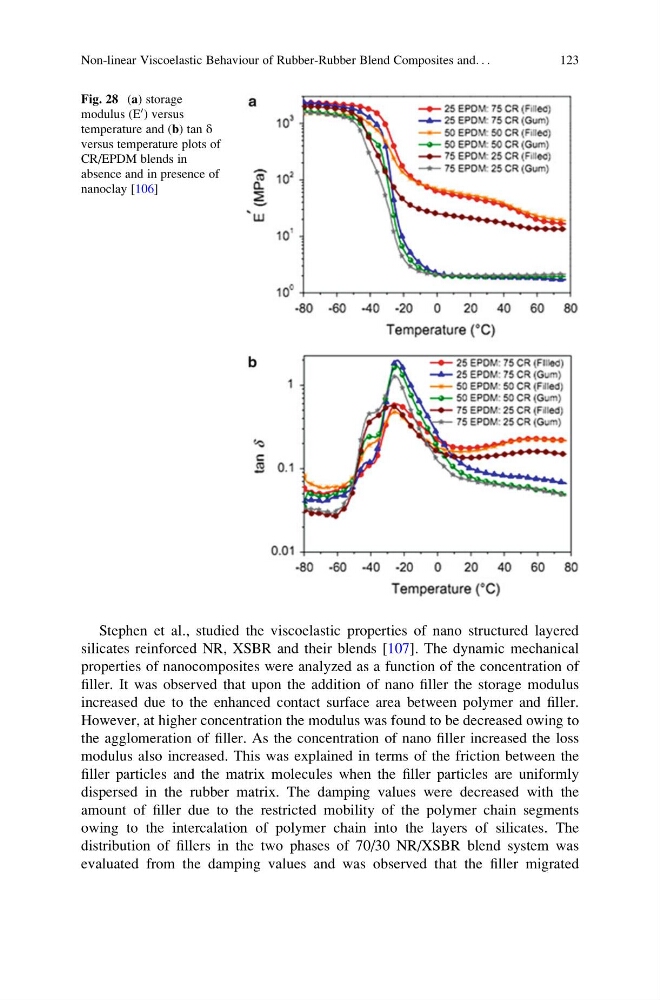
Fig. 28 (a) storage
modulus (E
0 ) versus
temperature and (b) tan δ
versus temperature plots of
CR/EPDM blends in
absence and in presence of
nanoclay [106]
Non-linear Viscoelastic Behaviour of Rubber-Rubber Blend Composites and. . .
123
silicates reinforced NR, XSBR and their blends [107]. The dynamic mechanical
properties of nanocomposites were analyzed as a function of the concentration of
filler. It was observed that upon the addition of nano filler the storage modulus
increased due to the enhanced contact surface area between polymer and filler.
However, at higher concentration the modulus was found to be decreased owing to
the agglomeration of filler. As the concentration of nano filler increased the loss
modulus also increased. This was explained in terms of the friction between the
filler particles and the matrix molecules when the filler particles are uniformly
dispersed in the rubber matrix. The damping values were decreased with the
amount of filler due to the restricted mobility of the polymer chain segments
owing to the intercalation of polymer chain into the layers of silicates. The
distribution of fillers in the two phases of 70/30 NR/XSBR blend system was
evaluated from the damping values and was observed that the filler migrated
Fig. 28 (a) storage
modulus (E
0 ) versus
temperature and (b) tan δ
versus temperature plots of
CR/EPDM blends in
absence and in presence of
nanoclay [106]
Non-linear Viscoelastic Behaviour of Rubber-Rubber Blend Composites and. . .
123