

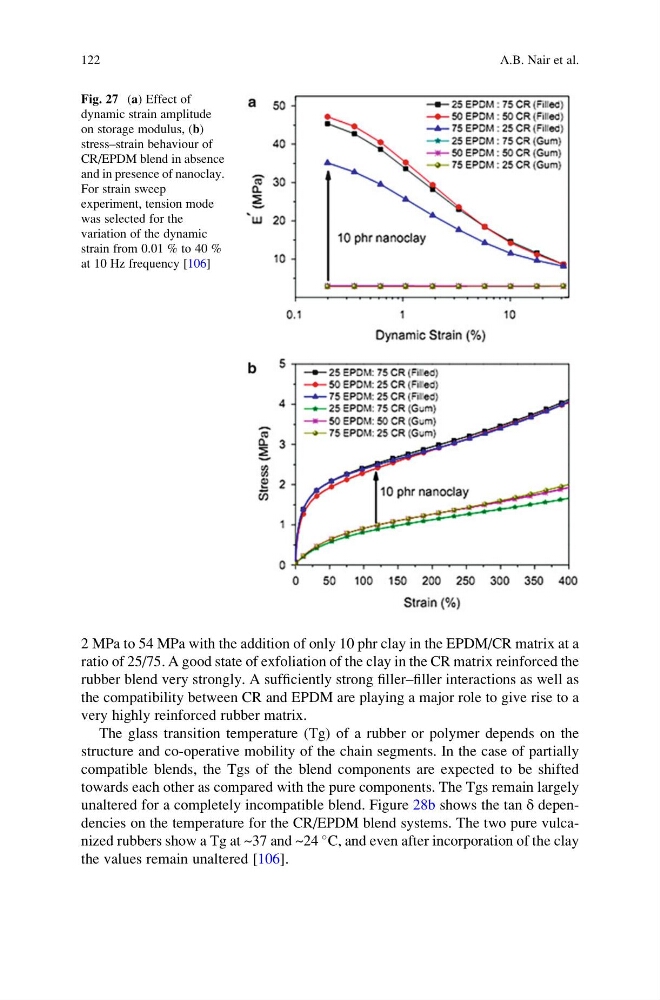
2 MPa to 54 MPa with the addition of only 10 phr clay in the EPDM/CR matrix at a
ratio of 25/75. A good state of exfoliation of the clay in the CR matrix reinforced the
rubber blend very strongly. A sufficiently strong filler–filler interactions as well as
the compatibility between CR and EPDM are playing a major role to give rise to a
very highly reinforced rubber matrix.
The glass transition temperature (Tg) of a rubber or polymer depends on the
structure and co-operative mobility of the chain segments. In the case of partially
compatible blends, the Tgs of the blend components are expected to be shifted
towards each other as compared with the pure components. The Tgs remain largely
unaltered for a completely incompatible blend. Figure 28b shows the tan δ dependencies on the temperature for the CR/EPDM blend systems. The two pure vulcanized rubbers show a Tg at ~37 and ~24
C, and even after incorporation of the clay
the values remain unaltered [106].
Fig. 27 (a) Effect of
dynamic strain amplitude
on storage modulus, (b)
stress–strain behaviour of
CR/EPDM blend in absence
and in presence of nanoclay.
For strain sweep
experiment, tension mode
was selected for the
variation of the dynamic
strain from 0.01 % to 40 %
at 10 Hz frequency [106]
122
A.B. Nair et al.
ratio of 25/75. A good state of exfoliation of the clay in the CR matrix reinforced the
rubber blend very strongly. A sufficiently strong filler–filler interactions as well as
the compatibility between CR and EPDM are playing a major role to give rise to a
very highly reinforced rubber matrix.
The glass transition temperature (Tg) of a rubber or polymer depends on the
structure and co-operative mobility of the chain segments. In the case of partially
compatible blends, the Tgs of the blend components are expected to be shifted
towards each other as compared with the pure components. The Tgs remain largely
unaltered for a completely incompatible blend. Figure 28b shows the tan δ dependencies on the temperature for the CR/EPDM blend systems. The two pure vulcanized rubbers show a Tg at ~37 and ~24
C, and even after incorporation of the clay
the values remain unaltered [106].
Fig. 27 (a) Effect of
dynamic strain amplitude
on storage modulus, (b)
stress–strain behaviour of
CR/EPDM blend in absence
and in presence of nanoclay.
For strain sweep
experiment, tension mode
was selected for the
variation of the dynamic
strain from 0.01 % to 40 %
at 10 Hz frequency [106]
122
A.B. Nair et al.