

Yan et al., studied Bis-(triethoxysilylpropyl)-tetrasulfane functionalised carbon
nanotubes (t-CNTs) were used as compatibiliser along with liquid isoprene rubber
(LIR) in the NR/BR blend. SEM and TEM images showed enhanced interfacial
adhesion between the binary rubber phases and improved dispersion of the minor
phase in the rubber blend respectively with the co-existence of LIR and carbon
nanotubes. The co-compatibilisation behaviour of t-CNTs and LIR suggests that
t-CNTs have a better effect than CB with the assistance of LIR, which is an
effective plasticiser in the NR/BR blend [103].
The tan δ curves for 80NR/20BR/22CB/3t-CNTs with different loadings of LIR
are shown in Fig. 25. The tan δ curve of the NR rich phase shows a peak at À46
C
due to the transition arising from the segmental motion, this corresponds to the glass
transition temperature Tg of NR in the blend. The Tg of BR rich phase is at À92
C,
as shown by a tan δ peak in the curve. There are two relaxation peaks corresponding
to two phases, which suggest the immiscibility of the binary components. However,
there is no relaxation peak corresponding to LIR, indicating good miscibility of LIR
with both NR and BR phases. It is noteworthy that the tan δ peak value for the NR
rich phase increases with increasing LIR content, whereas it decreases for the BR
rich phase. The area under the loss modulus curve was calculated by integrating the
loss modulus versus temperature curve in the temperature range of À110 to À70
C,
corresponding to the glass transition process of the BR rich phase. It shows that the
loss modulus peak area shifts to the lower value with an increase in the LIR content
in the 80NR/20BR/22CB/3tCNTs blends. The intensity of the tan δ peak and the
loss modulus peak area at the glass transition temperature are considered to reflect
the mobility of the molecular chain segments [104, 105]. The decrease in the
intensity of the tan δ peak and loss modulus peak area of the BR phase with
increasing LIR content indicates the decrease in mobility of the BR molecular
chain segments, which suggests the high interfacial interaction between matrix NR
and minor BR phase with the assistance of LIR and t-CNTs, which act as a bridge
40
Temperature, ºC
60
1
tan
δ
0.1
0.01
20
0
SBR/NBR/(CNT-NR)
SBR/(CNT-NBR)/NR
(CNT-SBR)/NBR/NR
CNT-SBR/NBR/NR
SBR
NBR
NR
–20
–40
–60
–80
Elastic modulus, MPa
1000
100
10
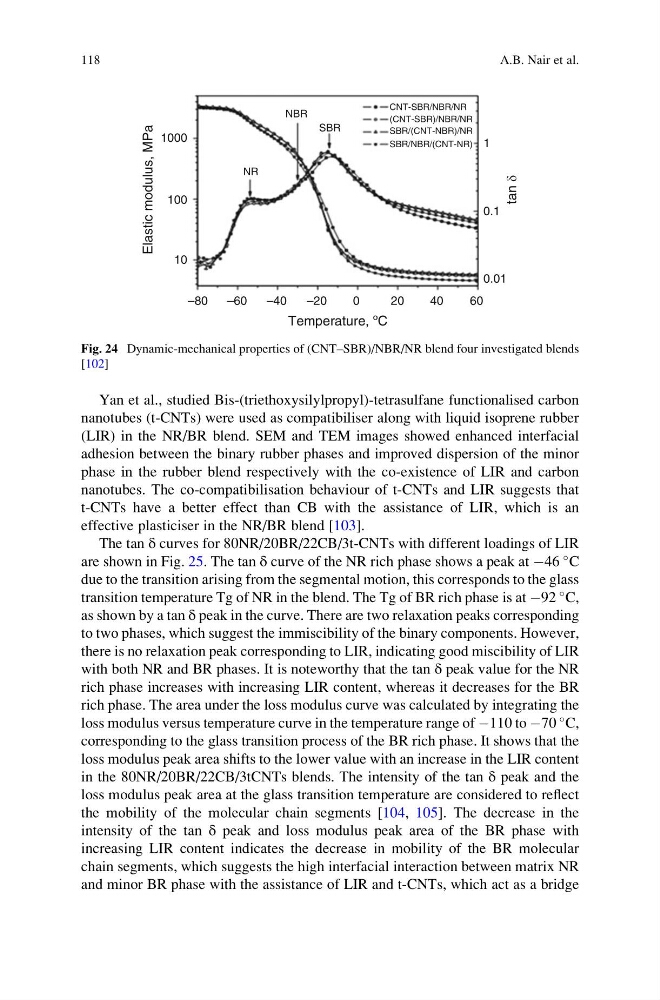
Fig. 24 Dynamic-mechanical properties of (CNT–SBR)/NBR/NR blend four investigated blends
[102]
118
A.B. Nair et al.
nanotubes (t-CNTs) were used as compatibiliser along with liquid isoprene rubber
(LIR) in the NR/BR blend. SEM and TEM images showed enhanced interfacial
adhesion between the binary rubber phases and improved dispersion of the minor
phase in the rubber blend respectively with the co-existence of LIR and carbon
nanotubes. The co-compatibilisation behaviour of t-CNTs and LIR suggests that
t-CNTs have a better effect than CB with the assistance of LIR, which is an
effective plasticiser in the NR/BR blend [103].
The tan δ curves for 80NR/20BR/22CB/3t-CNTs with different loadings of LIR
are shown in Fig. 25. The tan δ curve of the NR rich phase shows a peak at À46
C
due to the transition arising from the segmental motion, this corresponds to the glass
transition temperature Tg of NR in the blend. The Tg of BR rich phase is at À92
C,
as shown by a tan δ peak in the curve. There are two relaxation peaks corresponding
to two phases, which suggest the immiscibility of the binary components. However,
there is no relaxation peak corresponding to LIR, indicating good miscibility of LIR
with both NR and BR phases. It is noteworthy that the tan δ peak value for the NR
rich phase increases with increasing LIR content, whereas it decreases for the BR
rich phase. The area under the loss modulus curve was calculated by integrating the
loss modulus versus temperature curve in the temperature range of À110 to À70
C,
corresponding to the glass transition process of the BR rich phase. It shows that the
loss modulus peak area shifts to the lower value with an increase in the LIR content
in the 80NR/20BR/22CB/3tCNTs blends. The intensity of the tan δ peak and the
loss modulus peak area at the glass transition temperature are considered to reflect
the mobility of the molecular chain segments [104, 105]. The decrease in the
intensity of the tan δ peak and loss modulus peak area of the BR phase with
increasing LIR content indicates the decrease in mobility of the BR molecular
chain segments, which suggests the high interfacial interaction between matrix NR
and minor BR phase with the assistance of LIR and t-CNTs, which act as a bridge
40
Temperature, ºC
60
1
tan
δ
0.1
0.01
20
0
SBR/NBR/(CNT-NR)
SBR/(CNT-NBR)/NR
(CNT-SBR)/NBR/NR
CNT-SBR/NBR/NR
SBR
NBR
NR
–20
–40
–60
–80
Elastic modulus, MPa
1000
100
10
Fig. 24 Dynamic-mechanical properties of (CNT–SBR)/NBR/NR blend four investigated blends
[102]
118
A.B. Nair et al.