

phospholipids in NR. Phospholipid can act as coupling agent bonding the
α-terminal of NR with the CNT surface through cation-π interactions, which
make NR be competitive with NBR with respect to CNT hosting. Setting the
equilibrium CNT loadings experimentally determined by the wetting concept into
the Z-model recently developed in our previous work by keeping unchanged the
surface tension values of SBR and NBR a corrected value of surface tension of NR
was determined, which involves the effect of phospholipids [102].
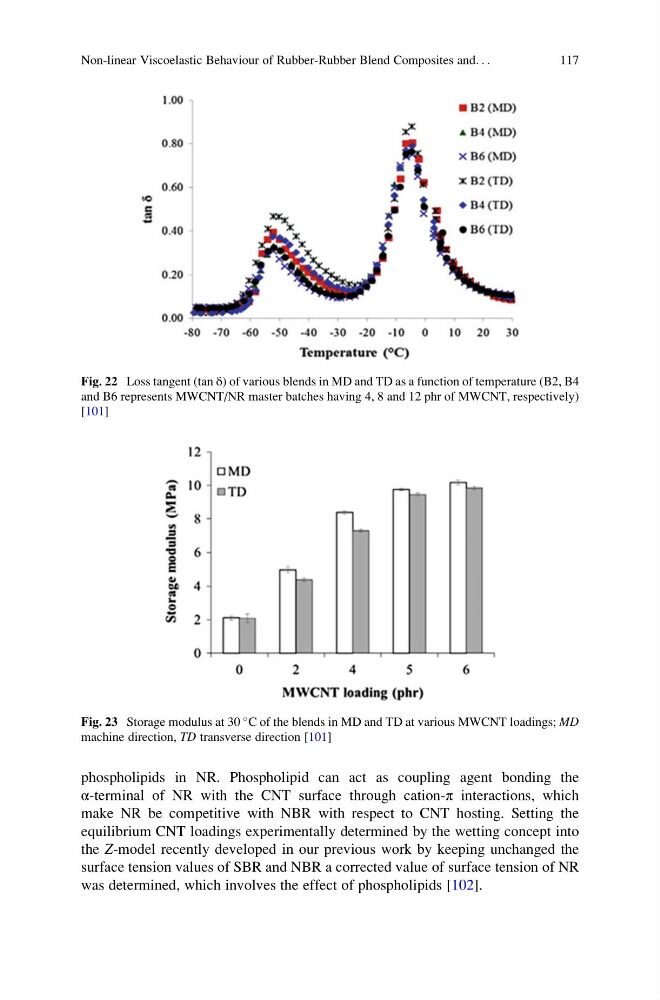
Fig. 23 Storage modulus at 30
C of the blends in MD and TD at various MWCNT loadings; MD
machine direction, TD transverse direction [101]
Fig. 22 Loss tangent (tan δ) of various blends in MD and TD as a function of temperature (B2, B4
and B6 represents MWCNT/NR master batches having 4, 8 and 12 phr of MWCNT, respectively)
[101]
Non-linear Viscoelastic Behaviour of Rubber-Rubber Blend Composites and. . .
117
α-terminal of NR with the CNT surface through cation-π interactions, which
make NR be competitive with NBR with respect to CNT hosting. Setting the
equilibrium CNT loadings experimentally determined by the wetting concept into
the Z-model recently developed in our previous work by keeping unchanged the
surface tension values of SBR and NBR a corrected value of surface tension of NR
was determined, which involves the effect of phospholipids [102].
Fig. 23 Storage modulus at 30
C of the blends in MD and TD at various MWCNT loadings; MD
machine direction, TD transverse direction [101]
Fig. 22 Loss tangent (tan δ) of various blends in MD and TD as a function of temperature (B2, B4
and B6 represents MWCNT/NR master batches having 4, 8 and 12 phr of MWCNT, respectively)
[101]
Non-linear Viscoelastic Behaviour of Rubber-Rubber Blend Composites and. . .
117