

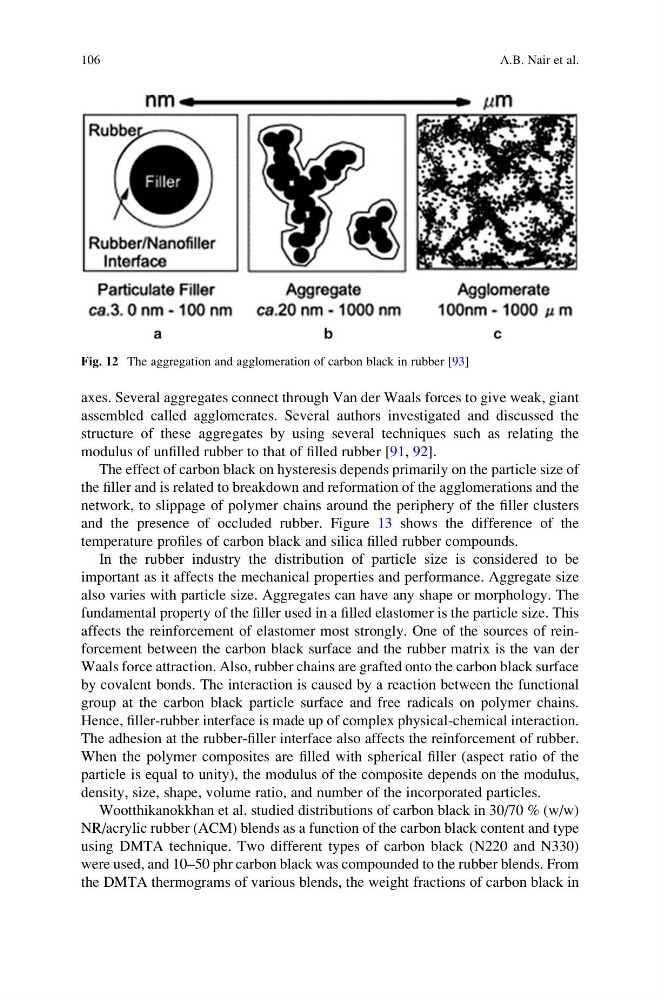
axes. Several aggregates connect through Van der Waals forces to give weak, giant
assembled called agglomerates. Several authors investigated and discussed the
structure of these aggregates by using several techniques such as relating the
modulus of unfilled rubber to that of filled rubber [91, 92].
The effect of carbon black on hysteresis depends primarily on the particle size of
the filler and is related to breakdown and reformation of the agglomerations and the
network, to slippage of polymer chains around the periphery of the filler clusters
and the presence of occluded rubber. Figure 13 shows the difference of the
temperature profiles of carbon black and silica filled rubber compounds.
In the rubber industry the distribution of particle size is considered to be
important as it affects the mechanical properties and performance. Aggregate size
also varies with particle size. Aggregates can have any shape or morphology. The
fundamental property of the filler used in a filled elastomer is the particle size. This
affects the reinforcement of elastomer most strongly. One of the sources of reinforcement between the carbon black surface and the rubber matrix is the van der
Waals force attraction. Also, rubber chains are grafted onto the carbon black surface
by covalent bonds. The interaction is caused by a reaction between the functional
group at the carbon black particle surface and free radicals on polymer chains.
Hence, filler-rubber interface is made up of complex physical-chemical interaction.
The adhesion at the rubber-filler interface also affects the reinforcement of rubber.
When the polymer composites are filled with spherical filler (aspect ratio of the
particle is equal to unity), the modulus of the composite depends on the modulus,
density, size, shape, volume ratio, and number of the incorporated particles.
Wootthikanokkhan et al. studied distributions of carbon black in 30/70 % (w/w)
NR/acrylic rubber (ACM) blends as a function of the carbon black content and type
using DMTA technique. Two different types of carbon black (N220 and N330)
were used, and 10–50 phr carbon black was compounded to the rubber blends. From
the DMTA thermograms of various blends, the weight fractions of carbon black in
Fig. 12 The aggregation and agglomeration of carbon black in rubber [93]
106
A.B. Nair et al.
assembled called agglomerates. Several authors investigated and discussed the
structure of these aggregates by using several techniques such as relating the
modulus of unfilled rubber to that of filled rubber [91, 92].
The effect of carbon black on hysteresis depends primarily on the particle size of
the filler and is related to breakdown and reformation of the agglomerations and the
network, to slippage of polymer chains around the periphery of the filler clusters
and the presence of occluded rubber. Figure 13 shows the difference of the
temperature profiles of carbon black and silica filled rubber compounds.
In the rubber industry the distribution of particle size is considered to be
important as it affects the mechanical properties and performance. Aggregate size
also varies with particle size. Aggregates can have any shape or morphology. The
fundamental property of the filler used in a filled elastomer is the particle size. This
affects the reinforcement of elastomer most strongly. One of the sources of reinforcement between the carbon black surface and the rubber matrix is the van der
Waals force attraction. Also, rubber chains are grafted onto the carbon black surface
by covalent bonds. The interaction is caused by a reaction between the functional
group at the carbon black particle surface and free radicals on polymer chains.
Hence, filler-rubber interface is made up of complex physical-chemical interaction.
The adhesion at the rubber-filler interface also affects the reinforcement of rubber.
When the polymer composites are filled with spherical filler (aspect ratio of the
particle is equal to unity), the modulus of the composite depends on the modulus,
density, size, shape, volume ratio, and number of the incorporated particles.
Wootthikanokkhan et al. studied distributions of carbon black in 30/70 % (w/w)
NR/acrylic rubber (ACM) blends as a function of the carbon black content and type
using DMTA technique. Two different types of carbon black (N220 and N330)
were used, and 10–50 phr carbon black was compounded to the rubber blends. From
the DMTA thermograms of various blends, the weight fractions of carbon black in
Fig. 12 The aggregation and agglomeration of carbon black in rubber [93]
106
A.B. Nair et al.