

phases and filler dispersion have no significant effect on the loss modulus in low
strains and effect of these parameters can be detected in medium and high strains.
Study of strain dependence of tanδ shows that, for all compounds tanδ increases
with increasing in strain. The trend of tanδ can be divided in two zones i.e. elastic
zone (tanδ < 1) and viscose zone (tanδ > 1). It is indicated that the elastic zone of
reclaimed is longer than NR, and in NR/reclaimed rubber blends with increasing
reclaimed rubber content elastic zone becomes longer. This is due to the fillers left
in reclaimed rubber. Non-homogeneity of phases and non-uniformed dispersion of
fillers in NR/reclaimed rubber 50/100 and 75/50 cause shorter elastic zones in these
blends than virgin natural rubber [90].
4.1 Effect of Spherical Fillers in Non-linear Viscoelasticity
of Blends
The average particle sizes of carbon blacks commonly available for industrial use;
range from 10 nm to 500 nm. Carbon black exists in three dimensional branched
structures called aggregates. High structure blacks exhibit a strong aggregation
whereas low structure blacks show only a weak aggregation. In the case of the
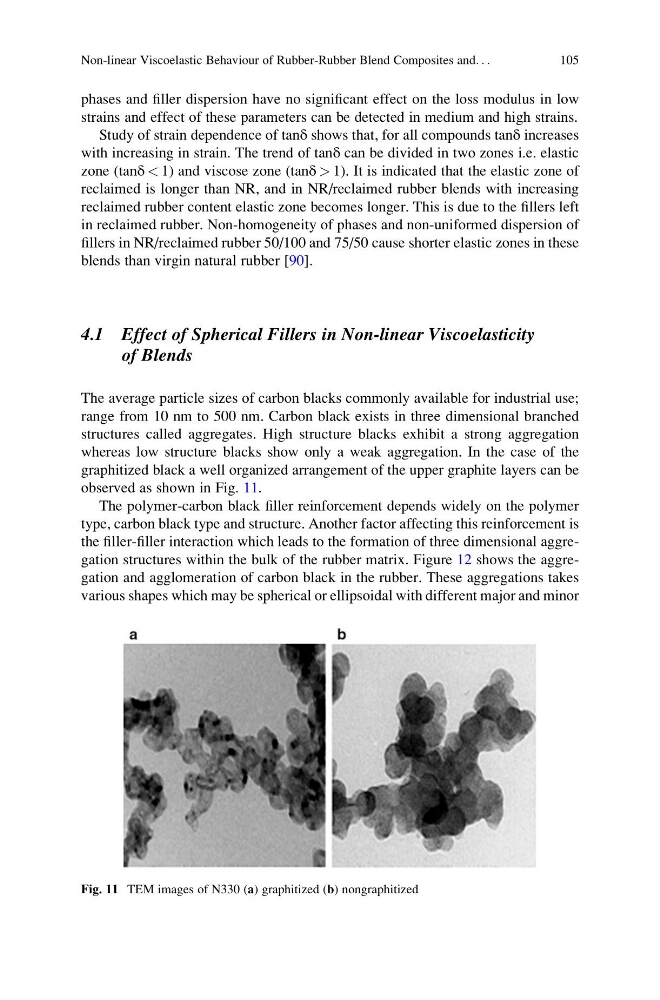
graphitized black a well organized arrangement of the upper graphite layers can be
observed as shown in Fig. 11.
The polymer-carbon black filler reinforcement depends widely on the polymer
type, carbon black type and structure. Another factor affecting this reinforcement is
the filler-filler interaction which leads to the formation of three dimensional aggregation structures within the bulk of the rubber matrix. Figure 12 shows the aggregation and agglomeration of carbon black in the rubber. These aggregations takes
various shapes which may be spherical or ellipsoidal with different major and minor
Fig. 11 TEM images of N330 (a) graphitized (b) nongraphitized
Non-linear Viscoelastic Behaviour of Rubber-Rubber Blend Composites and. . .
105
strains and effect of these parameters can be detected in medium and high strains.
Study of strain dependence of tanδ shows that, for all compounds tanδ increases
with increasing in strain. The trend of tanδ can be divided in two zones i.e. elastic
zone (tanδ < 1) and viscose zone (tanδ > 1). It is indicated that the elastic zone of
reclaimed is longer than NR, and in NR/reclaimed rubber blends with increasing
reclaimed rubber content elastic zone becomes longer. This is due to the fillers left
in reclaimed rubber. Non-homogeneity of phases and non-uniformed dispersion of
fillers in NR/reclaimed rubber 50/100 and 75/50 cause shorter elastic zones in these
blends than virgin natural rubber [90].
4.1 Effect of Spherical Fillers in Non-linear Viscoelasticity
of Blends
The average particle sizes of carbon blacks commonly available for industrial use;
range from 10 nm to 500 nm. Carbon black exists in three dimensional branched
structures called aggregates. High structure blacks exhibit a strong aggregation
whereas low structure blacks show only a weak aggregation. In the case of the
graphitized black a well organized arrangement of the upper graphite layers can be
observed as shown in Fig. 11.
The polymer-carbon black filler reinforcement depends widely on the polymer
type, carbon black type and structure. Another factor affecting this reinforcement is
the filler-filler interaction which leads to the formation of three dimensional aggregation structures within the bulk of the rubber matrix. Figure 12 shows the aggregation and agglomeration of carbon black in the rubber. These aggregations takes
various shapes which may be spherical or ellipsoidal with different major and minor
Fig. 11 TEM images of N330 (a) graphitized (b) nongraphitized
Non-linear Viscoelastic Behaviour of Rubber-Rubber Blend Composites and. . .
105