

the NR and ACM phases were calculated. Carbon black was unevenly distributed in
the rubber blend. It preferred to migrate into the NR phase, regardless of the amount
of carbon black that was used. By increasing the carbon black content, the weight
fraction of carbon black in the NR phase decreased whereas that in the ACM phase
increased. A change in the type of carbon black from N220 to N330 significantly
decreased the weight fraction of carbon black in the NR phase, but it was not
sufficiently strong to affect the tensile properties and hardness of the rubber
blend [94].
Sirisinha et al. studied the effects of filler and rubber polarity on the distribution
of filler in BR/NBR blends, using the DMTA technique. As 30-phr filler is added,
the reduction in heights of tan δ is attributed to the dilution effect. It has also been
also found that small and large particle sized carbon black prefer to reside in BR
phase compared NBR phase in the blends because of the lower viscosity and lower
polarity of the BR phase. The addition of silica instead of carbon black leads to an
increase in filler migration to the NBR in the 20/80 BR/NBR blend, which is
attributed to the strong silica–NBR interaction. In addition, an increase in NBR
polarity promotes carbon black migration to the BR phase.
The DMTA results also show that the morphology of BR/NBR blend is the
two-phase structure with two relaxation peaks at about À72 and 0
C,
corresponding to the BR and NBR phases, respectively. The addition of filler results
in a reduction in tan δ max , which is attributed to the dilution effect. The rigid filler
possesses no viscous response and therefore can dilute the viscous response of the
elastomeric phase. The use of damping peak tan δ, which decreases with filler
loading, will enable one to calculate the distribution of carbon black in each phase
of the blends. BR is more preferential than NBR for all three particle sizes of carbon
black to reside. As the BR/NBR ratio decreased, the BR phase became saturated
with carbon black, which then transferred to the NBR phase. Generally, the main
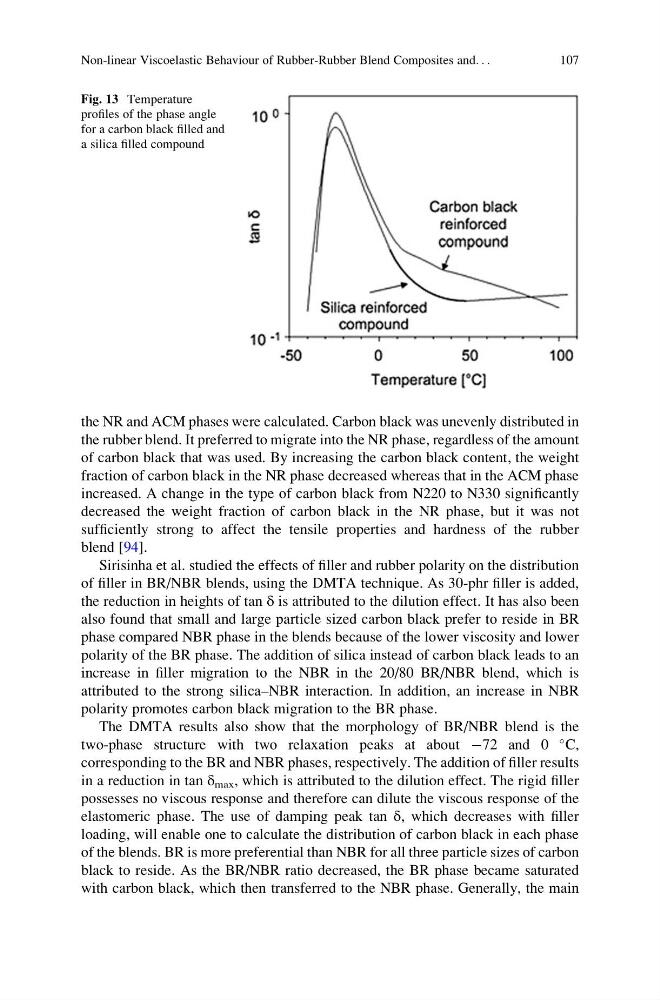
Fig. 13 Temperature
profiles of the phase angle
for a carbon black filled and
a silica filled compound
Non-linear Viscoelastic Behaviour of Rubber-Rubber Blend Composites and. . .
107
the rubber blend. It preferred to migrate into the NR phase, regardless of the amount
of carbon black that was used. By increasing the carbon black content, the weight
fraction of carbon black in the NR phase decreased whereas that in the ACM phase
increased. A change in the type of carbon black from N220 to N330 significantly
decreased the weight fraction of carbon black in the NR phase, but it was not
sufficiently strong to affect the tensile properties and hardness of the rubber
blend [94].
Sirisinha et al. studied the effects of filler and rubber polarity on the distribution
of filler in BR/NBR blends, using the DMTA technique. As 30-phr filler is added,
the reduction in heights of tan δ is attributed to the dilution effect. It has also been
also found that small and large particle sized carbon black prefer to reside in BR
phase compared NBR phase in the blends because of the lower viscosity and lower
polarity of the BR phase. The addition of silica instead of carbon black leads to an
increase in filler migration to the NBR in the 20/80 BR/NBR blend, which is
attributed to the strong silica–NBR interaction. In addition, an increase in NBR
polarity promotes carbon black migration to the BR phase.
The DMTA results also show that the morphology of BR/NBR blend is the
two-phase structure with two relaxation peaks at about À72 and 0
C,
corresponding to the BR and NBR phases, respectively. The addition of filler results
in a reduction in tan δ max , which is attributed to the dilution effect. The rigid filler
possesses no viscous response and therefore can dilute the viscous response of the
elastomeric phase. The use of damping peak tan δ, which decreases with filler
loading, will enable one to calculate the distribution of carbon black in each phase
of the blends. BR is more preferential than NBR for all three particle sizes of carbon
black to reside. As the BR/NBR ratio decreased, the BR phase became saturated
with carbon black, which then transferred to the NBR phase. Generally, the main
Fig. 13 Temperature
profiles of the phase angle
for a carbon black filled and
a silica filled compound
Non-linear Viscoelastic Behaviour of Rubber-Rubber Blend Composites and. . .
107