

compared with sludge conditioned using a single polymer. In addition, sludge
conditioned with dual polyelectrolytes (PEL) performed better in fine particle
capture and in the formation of larger aggregates, which resulted in a better
dewaterability and less chance of overdosing [34, 35].
The formation and breakage of flocs using dual systems was also investigated by
Yukselen and Gregory. In the case of cationic–anionic polymers, the re-growth of
flocs was fully reversible and the breakage factors were smallest, indicating highest
floc strength. In contrast, flocs formed using nonionic polymer together with
anionic or cationic polymer did not produce strong flocs [36].
Wang et al. [37] investigated the dual conditioning of activated sludge utilizing a
polyampholyte in combination with ferric chloride or cationic PEL. The investigations
indicated that dual conditioning of sludge exhibited better dewaterability at lower
doses compared with single conditioning. The advantages of PDADMAC over ferric
chloride as applied in dual systems were also discussed [38].
As shown for clay [39], the sediment height and therefore the density of the
sediment can be measured quantitatively using the separation analyzer LUMiFuge.
The results obtained agreed very well with other methods like the JAR-Test, which
is not so convenient.
One example of a very special dual-component polymeric flocculant is poly
(ethylene oxide) (PEO) and carboxylated phenolic resin (CPR), usually referred to
as a cofactor. It has been shown that this dual flocculant can induce a richness of
flocculation behavior depending on the concentration of the two components [40, 41].
Flocculation, deflocculation, and reflocculation of cellulose particles were studied for
various CPR:PEO ratios. It was found that reflocculation is a strong function of this
ratio. For low ratios, no reflocculation occurs after a few cycles, whereas for high
ratios very limited flocculation and reflocculation occurs.
PEI
A-PAM
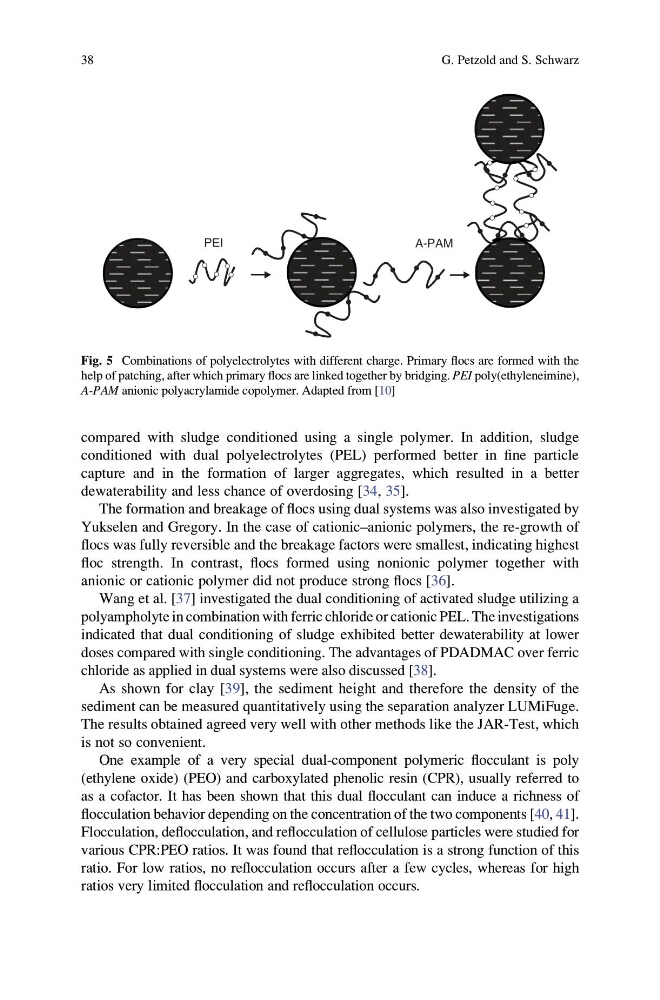
Fig. 5 Combinations of polyelectrolytes with different charge. Primary flocs are formed with the
help of patching, after which primary flocs are linked together by bridging. PEI poly(ethyleneimine),
A-PAM anionic polyacrylamide copolymer. Adapted from [10]
38
G. Petzold and S. Schwarz
conditioned with dual polyelectrolytes (PEL) performed better in fine particle
capture and in the formation of larger aggregates, which resulted in a better
dewaterability and less chance of overdosing [34, 35].
The formation and breakage of flocs using dual systems was also investigated by
Yukselen and Gregory. In the case of cationic–anionic polymers, the re-growth of
flocs was fully reversible and the breakage factors were smallest, indicating highest
floc strength. In contrast, flocs formed using nonionic polymer together with
anionic or cationic polymer did not produce strong flocs [36].
Wang et al. [37] investigated the dual conditioning of activated sludge utilizing a
polyampholyte in combination with ferric chloride or cationic PEL. The investigations
indicated that dual conditioning of sludge exhibited better dewaterability at lower
doses compared with single conditioning. The advantages of PDADMAC over ferric
chloride as applied in dual systems were also discussed [38].
As shown for clay [39], the sediment height and therefore the density of the
sediment can be measured quantitatively using the separation analyzer LUMiFuge.
The results obtained agreed very well with other methods like the JAR-Test, which
is not so convenient.
One example of a very special dual-component polymeric flocculant is poly
(ethylene oxide) (PEO) and carboxylated phenolic resin (CPR), usually referred to
as a cofactor. It has been shown that this dual flocculant can induce a richness of
flocculation behavior depending on the concentration of the two components [40, 41].
Flocculation, deflocculation, and reflocculation of cellulose particles were studied for
various CPR:PEO ratios. It was found that reflocculation is a strong function of this
ratio. For low ratios, no reflocculation occurs after a few cycles, whereas for high
ratios very limited flocculation and reflocculation occurs.
PEI
A-PAM
Fig. 5 Combinations of polyelectrolytes with different charge. Primary flocs are formed with the
help of patching, after which primary flocs are linked together by bridging. PEI poly(ethyleneimine),
A-PAM anionic polyacrylamide copolymer. Adapted from [10]
38
G. Petzold and S. Schwarz